

Which display specs ensure crisp text for close-range signage?
 2026-05-30
  18:01
18:01 

Designing for proximity requires high-resolution LCD screens with a pixel density that ensures text and graphics remain crisp and legible when viewed from just inches away. This is critical for close-range signage, point-of-sale systems, and interactive kiosks where clarity directly impacts user experience and information delivery.
What is the minimum PPI required for close-up readability?
For screens viewed from a distance of12 to24 inches, a minimum of150 PPI is essential for basic readability. However, for truly crisp text and sharp graphics that prevent eye strain, targeting200 PPI or higher is the industry standard for professional close-range applications.
Determining the right Pixels Per Inch is more than a simple calculation; it’s about matching human visual acuity to the digital canvas. At a typical reading distance of18 inches, the human eye can discern individual pixels if the density falls below approximately150 PPI, leading to visible jagged edges on text and curves. For this reason, high-resolution bar LCDs used in retail or hospitality often start at200 PPI to guarantee clarity. Think of it like printing a photograph: a low-resolution image looks fine from across the room, but up close, it becomes a blurry mosaic of colored dots. The same principle applies to digital signage. A screen with insufficient PPI will force customers to squint or step back, defeating the purpose of the interactive or informational display. What good is a detailed menu board if the ingredients list is pixelated? Consequently, investing in a higher PPI display from the outset is a proactive step toward superior user engagement. It ensures that every character is rendered with precision, which is particularly vital for branding and conveying detailed information. As a pro tip, always request a physical sample or a high-definition render of your content on the target display size to judge the visual outcome before committing to a large order. This hands-on evaluation can save significant time and cost, ensuring the final installation meets your exacting standards for close-up viewing.
How does screen size and resolution interact for close-up viewing?
Screen size and resolution are intrinsically linked for close-range applications. A larger screen at the same resolution will have a lower PPI, making individual pixels more noticeable. Therefore, increasing the physical size must be accompanied by a proportional increase in resolution to maintain the required pixel density for sharp imagery.
The relationship between screen size, resolution, and viewing distance is the cornerstone of effective display design. It’s a balancing act where changing one variable forces an adjustment in another. For instance, a10-inch display with a1920x1080 resolution boasts a high PPI of about220, making it excellent for a countertop point-of-sale terminal. If you simply scale that same1080p resolution up to a24-inch display for a larger kiosk, the PPI plummets to around92, resulting in a visibly grainy image that is unacceptable for close inspection. This is why specialized high-resolution bar LCDs exist; they offer elongated aspect ratios with resolutions like1920x720 on a21.5-inch screen, maintaining a high density across a unique form factor. Consider the analogy of a billboard versus a smartphone: the billboard has enormous pixels you can see from a hundred yards away, while the phone’s screen is packed with microscopic pixels for arm’s-length viewing. Applying a phone’s pixel density to a billboard would be technologically impossible and financially absurd. So, when planning a close-up display, you must first define the optimal viewing distance and then calculate the necessary PPI. From there, you can select a screen size and a corresponding native resolution that delivers that density. This approach guarantees that your content will appear as intended, without any unpleasant surprises during installation. How can you ensure your design translates perfectly from the computer screen to the final product? The answer lies in understanding these fundamental interactions and specifying the correct panel from a knowledgeable supplier like CDTech, who can guide you through these technical trade-offs.
What are the key technical specifications beyond PPI for a proximity display?
Beyond PPI, critical specs include high brightness to combat ambient light, wide viewing angles for off-axis clarity, robust color gamut for accurate visuals, and a durable construction with reliable touch integration. These factors collectively ensure the display remains functional, readable, and engaging in its intended close-range environment.
While PPI is paramount for sharpness, a high-resolution bar LCD destined for close-up interaction must excel in several other technical areas to perform reliably. Brightness, measured in nits, is crucial because proximity displays are often under harsh indoor lighting or even near windows. A panel with at least500 nits ensures the image doesn’t wash out, preserving contrast and color fidelity. Viewing angle technology, such as IPS (In-Plane Switching), is non-negotiable; it allows multiple people to view the screen from different standing positions without color inversion or contrast loss. Furthermore, a wide color gamut, like90% of NTSC or sRGB, ensures that branding colors and product images are represented accurately, which is vital for marketing and customer perception. The display’s physical durability is another key consideration. Will it be in a high-touch public kiosk? If so, it needs a hardened surface glass and a reliable projected capacitive touch solution that can withstand constant use. For example, a self-service ordering kiosk in a fast-food restaurant requires all these attributes: high brightness for a sunlit lobby, wide viewing angles for families huddled around it, accurate colors for food imagery, and a robust touchscreen for thousands of daily taps. Neglecting any one of these specifications can lead to a subpar user experience, no matter how high the pixel density. Therefore, a holistic specification review is essential. It’s not just about seeing the pixels; it’s about how the entire visual and interactive package performs under real-world conditions. Partnering with a specialist ensures you don’t overlook these critical, yet sometimes subtle, performance parameters that define a successful installation.
Which display technologies are best suited for high-PPI, close-range applications?
For high-PPI close-range applications, TFT LCD technology, particularly IPS (In-Plane Switching) variants, is the dominant choice due to its excellent color reproduction, wide viewing angles, and mature manufacturing for custom sizes. Advanced technologies like LTPS (Low-Temperature Polycrystalline Silicon) offer even higher pixel density and efficiency for premium applications.
| Display Technology | Key Advantages for Proximity Use | Typical PPI Range | Best Application Scenarios |
|---|---|---|---|
| IPS TFT LCD | Superior color accuracy and consistency, very wide viewing angles (178°/178°), stable image quality from all positions. | 150 -350 PPI | Retail POS systems, interactive museum exhibits, hospitality menu boards where color and off-axis viewing are critical. |
| LTPS TFT LCD | Extremely high pixel density, lower power consumption, faster electron mobility allowing for narrower bezels and brighter output. | 300 -600+ PPI | High-end medical imaging displays, ultra-sharp portable diagnostic devices, premium interactive kiosks where detail is paramount. |
| a-Si TFT LCD | Cost-effective solution for standard high-resolution needs, reliable performance, widely available in custom sizes and configurations. | 100 -250 PPI | Industrial HMIs, basic information displays, applications where very high PPI is not the primary driver and budget is a key factor. |
| OLED | Perfect black levels, infinite contrast ratio, ultra-fast response time, and potential for flexible form factors. | 250 -500+ PPI | Specialized high-contrast instrumentation, prototype or design-forward installations where emissive technology benefits outweigh typical cost and lifespan considerations. |
How do you integrate touch functionality without compromising display clarity?
Touch functionality is integrated using a separate capacitive touch panel laminated directly onto the LCD surface. To preserve clarity, optical bonding is the recommended process, which fills the air gap between the layers with a clear adhesive, reducing internal reflection, improving contrast, and ensuring the touch sensor does not create a visible haze or parallax error.
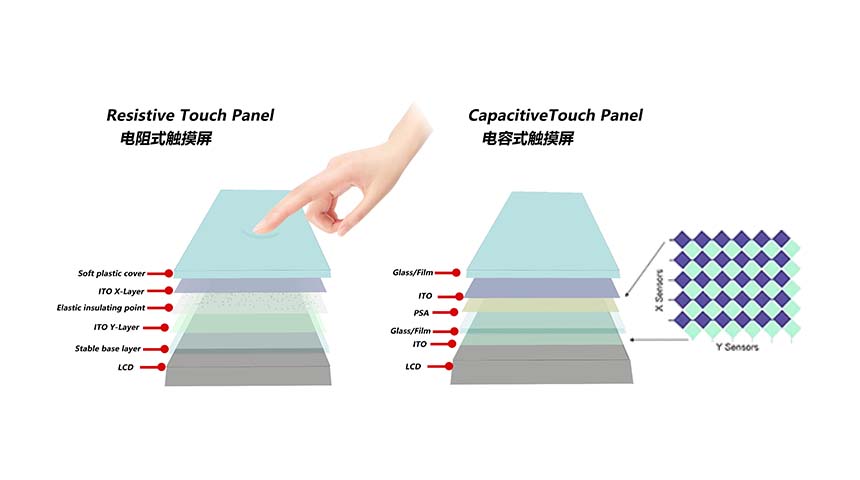
Adding touch to a high-resolution display introduces a potential point of visual degradation if not executed properly. The standard method involves a projected capacitive (PCAP) glass sensor placed over the LCD. Without optical bonding, a small air gap exists between the touch glass and the LCD surface. This gap causes internal reflections, which scatter light and can make the image appear washed out or create a slight double-image effect known as parallax, where the touch point doesn’t align perfectly with the underlying graphic. Optical bonding eliminates this air gap by using a clear, durable optical adhesive. The result is a dramatic improvement in optical performance: sunlight readability increases because reflections are minimized, contrast is enhanced as light transmission improves, and the touch experience becomes more direct and precise. For a customer standing inches from a kiosk, the difference is palpable; the graphics appear to be right on the surface of the glass, creating an immersive and intuitive interaction. Think of it as the difference between looking through a single pane of glass versus a double-paned window with a dusty gap in between. The bonded solution is clearer, stronger, and provides a better view. Is it worth the additional manufacturing step? For any professional close-range application where visual fidelity and user experience are priorities, the answer is a resounding yes. It protects the display from condensation and dust ingress while delivering the crisp, vibrant image your high-PPI screen was designed to produce. CDTech’s expertise in integrating and bonding touch panels ensures that the final product delivers both flawless touch response and uncompromised visual clarity.
What are the common pitfalls in designing close-up signage and how to avoid them?
Common pitfalls include underestimating required PPI, ignoring ambient light conditions, selecting poor viewing angle technology, using low-quality touch integration, and neglecting content design for the pixel grid. Avoid these by conducting on-site ambient light tests, specifying IPS or better panels, insisting on optical bonding, and creating content at the display’s native resolution.
| Common Pitfall | Consequence for Close-Up Viewing | Proactive Solution | Technical Consideration |
|---|---|---|---|
| Insufficient Pixel Density (PPI) | Text appears jagged and illegible, graphics look pixelated, causing user frustration and a perception of low quality. | Calculate required PPI based on closest viewing distance. Target a minimum of200 PPI for text-heavy applications. | Choose a native resolution that delivers the target PPI on your selected screen size. Do not rely on software scaling. |
| Glare and Reflection from Ambient Light | Screen content becomes washed out and unreadable, especially under bright store lighting or near windows. | Specify high-brightness panels (500+ nits) and combine with optical bonding and anti-glare surface treatments. | Measure ambient lux levels at the installation site during different times of day to inform brightness specifications. |
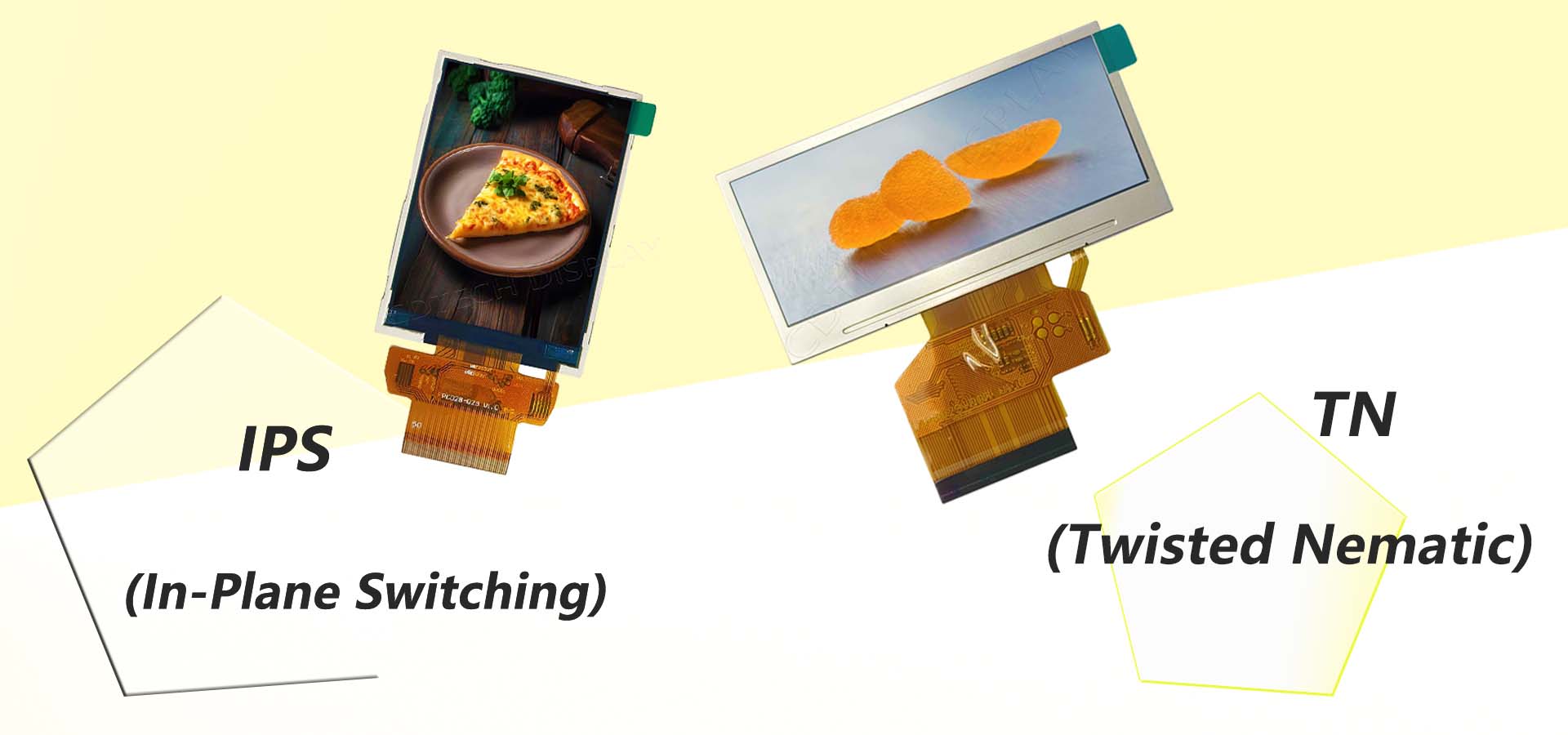
| Poor Off-Axis Viewing Quality | Colors shift and contrast fades when not viewed head-on, making the display ineffective for groups or angled installations. | Mandate IPS-type LCD technology to guarantee wide viewing angles (178°/178° is ideal). | Avoid TN (Twisted Nematic) panels, which are cost-effective but have very narrow viewing angles and color shift. |
| Touchscreen Parallax and Haze | A visible gap between touch point and on-screen element, or a milky haze over the image, degrading the high-resolution visual. | Insist on optically bonded touchscreen assemblies to eliminate the air gap between the sensor and the LCD. | Ensure the touch controller is properly calibrated post-bonding to achieve perfect alignment and linearity. |
| Content Designed at Wrong Resolution | Graphics and fonts are blurry because the system is stretching or compressing the image, wasting the display’s native sharpness. | Design all interface assets and layouts at the exact native pixel resolution of the chosen display panel. | Request the exact panel model and its native resolution from your display supplier early in the content creation phase. |
Expert Views
“The move towards intimate human-machine interfaces has fundamentally shifted display requirements. It’s no longer just about being seen from afar; it’s about holding up to intense scrutiny. A high PPI is the entry ticket, but the real challenge is system integration. The touch response must feel instantaneous, the colors must remain true from every angle, and the assembly must withstand a public environment. We often see projects falter by treating the display as a commodity component. Success lies in a holistic view: specifying the right optical stack, from the polarizer to the cover glass, and validating that stack under real-world lighting and usage conditions. This integrated approach is what separates a functional display from a truly engaging user experience.”
Why Choose CDTech
Selecting a display partner for critical proximity applications requires a blend of technical depth and practical experience. CDTech brings over a decade of specialization in custom TFT LCD and touch solutions, which is directly applicable to the unique demands of close-up signage. Their experience with2nd Cutting technology is a significant advantage, allowing for the creation of non-standard screen sizes and shapes that can fit innovative product designs without compromising on the essential high-resolution characteristics. This capability means you are not limited to off-the-shelf sizes that may force a compromise in your product’s form factor or user interface layout. Furthermore, their position as a solution provider, not just a component vendor, means they consider the entire system—LCD, touch integration, optical bonding, and durability—ensuring all elements work in harmony. This holistic engineering support helps avoid the common pitfalls that can degrade image quality or reliability. Their stable quality management system provides consistency from prototype to mass production, which is crucial for maintaining the visual standards required for crisp, close-up readability across all your deployed units. Ultimately, partnering with a specialist like CDTech provides access to the expertise needed to navigate the complex trade-offs between resolution, size, brightness, and cost, leading to a display solution that performs as intended in the field.
How to Start
Initiating a project for a high-resolution proximity display begins with a clear definition of the problem you are solving. First, meticulously document the user scenario: measure the exact expected viewing distance, assess the ambient lighting conditions throughout the day, and define the primary type of content (text, video, interactive graphics). Second, establish your non-negotiable technical parameters based on that scenario, such as minimum PPI, required brightness in nits, and essential durability features. Third, create mock-ups of your user interface at several potential screen sizes and resolutions to visualize the layout and text legibility. Fourth, engage with a technical display partner early in this process. Share your scenario, parameters, and mock-ups with their engineering team for review. They can provide feedback on feasibility, suggest optimal panel choices from their portfolio, and may offer samples for real-world testing. Fifth, based on this collaboration, narrow down to2-3 display options and procure evaluation samples. Test these samples in a simulated or actual environment with your content. Finally, use the findings from this hands-on testing to finalize your specifications before moving into the prototyping and integration phase. This methodical, problem-focused approach ensures the final display solution is tailored to your specific application needs from the outset.
FAQs
Can I use a standard smartphone display for a custom close-up kiosk?
While smartphone displays have very high PPI, they are not designed for continuous operation, lack the necessary brightness and durability for public use, and are difficult to source and integrate reliably. Custom industrial-grade LCDs from suppliers like CDTech are built for24/7 operation, offer longer lifespans, and support necessary features like wide-temperature ranges and robust touch interfaces.
Does a higher PPI display consume significantly more power?
Generally, yes, a higher pixel count requires more power to drive. However, advancements like LTPS (Low-Temperature Polycrystalline Silicon) backplanes improve electron mobility, allowing for higher efficiency at high resolutions. Power management also depends on backlight brightness; a well-designed system balances PPI with LED efficiency and intelligent dimming features to optimize overall power consumption for the application.
Is optical bonding necessary for all close-range touch displays?
While not absolutely necessary for every single application, optical bonding is highly recommended for any professional or public-facing close-range display. It drastically improves readability under bright light, enhances contrast, provides a better touch experience with no parallax, and increases durability by sealing the layers. For applications where image quality and user experience are priorities, it is a critical investment.
How do I future-proof my display choice for close-up applications?
Future-proofing involves specifying slightly higher performance than your current minimum needs. Choose a PPI at the higher end of your calculated range, opt for a wider color gamut, ensure the interface (e.g., LVDS, eDP) supports higher bandwidth for potential resolution upgrades, and select a supplier with a track record of supporting long product lifecycles and offering compatible future replacements.
Designing effective displays for close-up viewing is a meticulous process that blends human factors with precise engineering. The key takeaway is that pixel density, while foundational, is just one part of a larger equation. Success hinges on a holistic specification that includes high brightness, wide viewing angles, robust touch integration, and durable construction. Always begin by analyzing the real-world environment and user interaction model, then translate those needs into technical requirements. Avoid the common trap of prioritizing cost over performance metrics that directly impact readability and engagement. Partnering with an experienced provider like CDTech can streamline this complex process, offering access to custom solutions and integration expertise that ensure your high-resolution display delivers a crisp, reliable, and engaging experience for users standing just inches away. Start with a clear problem definition, validate your choices with physical samples, and never compromise on the optical clarity that defines a superior proximity interface.
Post Search
Related Articles
-
Capacitive vs Resistive Touch Screen Car Stereo: Which Is Right for You?
-
TN LCD vs IPS LCD: How to Choose the Right Display for You
-
Capacitive Touch Panel or Resistive: Which Suits Your Needs?
-
Why Choose an IPS LCD Panel for Your Next Screen Purchase?
-
CDTECH to Showcase Cutting-Edge Display Solutions at SID 2025
-
Comparing Different Types of Displays in Cars: A Detailed Overview
-
White Spots on LCD Screen: Causes, Fixes & Industrial Solutions (2026 Guide)