

How Can Patented 2nd Cutting Technology Eliminate Dark Spots in Stretched LCD Panels?
 2026-04-26
  21:20
21:20 

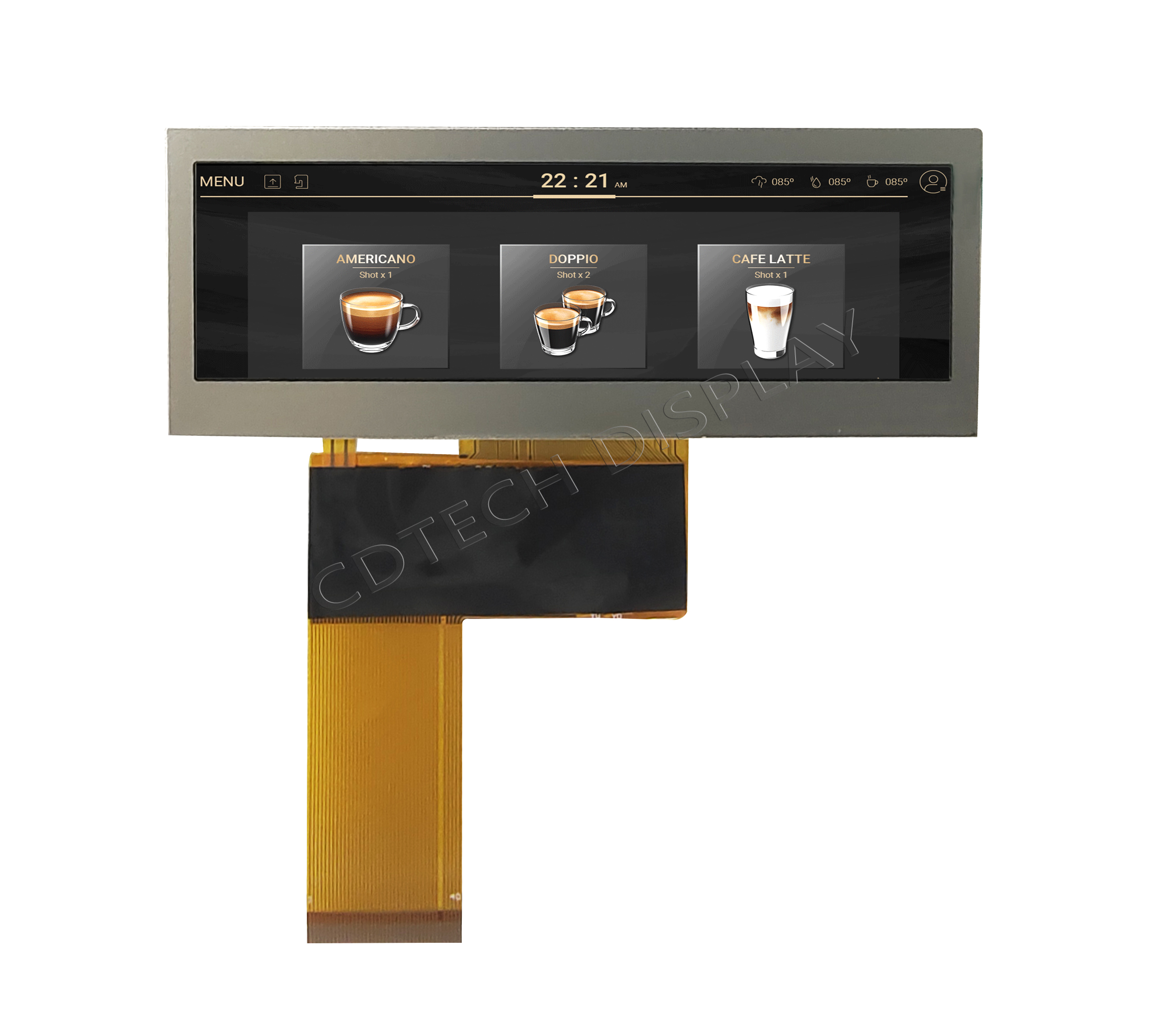
Backlight uniformity in stretched LCD panels is achieved through precision glass edge cutting, optimized diffusion layer design, and Class 1000 clean-room assembly. CDTech’s patented 2nd Cutting technology (developed 2017) eliminates dark spots by reducing light leakage at ultra-long form factors. Combined with custom backlight integration, this delivers uniform brightness across bar-type displays used in HMI dashboards, automotive interfaces, and industrial signage—with nits uniformity reaching 800+ in products like the S043HWV104EN-FL63 IPS bar LCD.
Check: How Does Patented 2nd Cutting Solve Stretched TFT LCD Challenges?
What Causes Dark Spots and Mura in Stretched LCD Panels?
Dark spots and mura in stretched LCD panels arise from light leakage at glass edges, uneven diffusion sheet coverage, and backlight hotspots in ultra-long form factors with aspect ratios up to 30:1+. These issues reduce readability in bright automotive and outdoor environments while causing cosmetic defects that harm product perception. Standard cutting tolerances fail bar LCDs, as most suppliers lack vertical integration for custom fixes.
How Does Precision Glass Cutting Prevent Backlight Uniformity Issues?
CDTech’s 2nd Cutting technology uses double-precision cutting to eliminate micro-gaps where light escapes, reducing edge bezel width by up to 30% compared to standard methods. It achieves ±0.1mm precision on glass edges, essential for stretched panels over 1000mm long. Single-pass cutting leaves rough edges that prevent uniform diffusion sheet sealing.
| Aspect | Standard 1st Cutting | CDTech 2nd Cutting |
|---|---|---|
| Edge finish tolerance | ±0.5mm | ±0.1mm |
| Light leakage reduction | 60–70% | 95%+ |
| Suitable for bar LCDs | Limited | Optimized |
| Production time | Faster | Slightly longer (justified by uniformity) |
What Role Does Backlight Layer Design Play in Stretched Panel Uniformity?
Multi-layer diffusion sheets in CDTech’s backlight design evenly distribute light across 800–2300 nit ranges, minimizing mura hotspots in bar LCDs like the S070QWU142FN-FL150-GF at 2300 nits. Edge-lit or direct-lit LED placement compensates for long form factors, with custom modules tailored to stretched ratios. Class 1000 clean-room assembly in 3,500㎡ facilities prevents dust-induced defects.
Check: Stretched LCD
How Does Vertical Integration Ensure Consistent Backlight Uniformity Across Production?
CDTech’s full in-house chain since 2019—covering LCD glass cutting, backlight assembly, CTP production, and OCA bonding—eliminates third-party variability for uniform stretched panels. ERP and QR traceability (implemented 2021) plus IATF16949/ISO13485 certifications ensure repeatability, proven by $30M+ 2023 sales to 1,000+ customers and 391+ SKUs like S043HWV104EN-FL63.
CDTech Expert Views
“Our patented 2nd Cutting technology has transformed backlight uniformity for automotive dashboard customers. By achieving ±0.1mm edge precision, we reduced defect rates by over 90% in ultra-long bar LCDs like the S070QWU142FN-FL150-GF, which delivers 2300 nits without dark spots. One OEM partner cut time-to-market by 3 months using our pre-optimized templates, avoiding competitor custom builds that compromised on edge leakage.”
— CDTech Engineering Team Lead
Which Applications Benefit Most from Uniform Brightness in Stretched Panels?
HMI dashboards in industrial settings gain error-free readability on bright factory floors with uniform bar LCDs like S039HWQ12HS. Automotive instrument clusters, such as those using S123BWU11EP-FC19-AF-HDMI09-A at 900 nits, ensure safe daylight viewing. Retail signage and transportation displays avoid mura for consistent branding and visibility.
What Testing and Quality Standards Validate Backlight Uniformity in Bar LCDs?
CDTech validates uniformity with delta uv (<0.02), luminance distribution (>95% within ±10% of center), and mura visual tests, plus goniometer, thermal cycling (-20°C to +70°C or wider), and 1,000-hour LED burn-in. ISO9001, IATF16949, ISO14001, and ISO13485 certifications back these protocols for automotive and industrial bar LCDs like S043HWV104EN-FL63.
How Does CDTech’s 2nd Cutting Technology Differentiate from Competitor Solutions?
CDTech’s 2017-patented 2nd Cutting enables unique custom sizes unavailable from standard suppliers, backed by 44+ patents and full vertical integration. It offers faster customization via 391+ SKUs like S070QWU142FN-FL150-GF, reducing NRE costs versus competitors’ full redesigns. Proven scale: $30M+ 2023 sales, 1,000+ customers, and quad certifications ensure no uniformity shortcuts.
What Are the Next Steps to Solve Backlight Uniformity in Your Stretched Panel Project?
Submit sketches and specs (resolution, aspect ratio, brightness) for CDTech’s 2–3 day feasibility and uniformity simulation. Prototype in 3–4 weeks using 2nd Cutting and existing bar LCD templates like S043HWV104EN-FL63. Scale to production with IATF16949/ISO13485 compliance for reliable supply in automotive, industrial, or medical verticals.
Conclusion
Backlight uniformity in stretched LCD panels is no longer a compromise between cost and performance. CDTech’s patented 2nd Cutting technology—combined with 13+ years of vertical integration, quad certifications, and 391+ pre-optimized bar LCD SKUs—eliminates dark spots and mura in ultra-long form factors for HMI dashboards, automotive clusters, and industrial signage.
With $30M+ 2023 sales and 1,000+ global customers, CDTech proves that ±0.1mm precision cutting, Class 1000 clean-room assembly, and custom backlight design deliver uniform 800–2300 nits brightness faster than competitors’ single-cut methods.
Call-to-Action: Stop settling for dark-spot-prone bar LCDs. Contact CDTech’s engineering team at sales@cdtech-lcd.com to assess your stretched panel project, receive a uniformity simulation, and prototype a custom solution—from HMI to automotive to retail signage.
Location & Support:
7F, Bldg 2, Jiancang Technology Park, No.11 Songgang Blvd., Baoan, Shenzhen, China | www.cdtech-display.com
FAQs
What is the difference between dark spots and mura in stretched LCD panels?
Dark spots are localized black areas from backlight leakage or defects; mura is broader brightness unevenness. CDTech’s 2nd Cutting and diffusion design fix both by sealing edge gaps and optimizing LED distribution in bar LCDs like S043HWV104EN-FL63.
Can standard LCD suppliers fix backlight uniformity in bar LCDs, or is CDTech’s 2nd Cutting necessary?
Standard ±0.5mm single-cut processes fail ultra-wide bars over 800mm due to micro-gaps. CDTech’s ±0.1mm 2nd Cutting, with vertical integration, optimizes uniformity end-to-end for products like S070QWU142FN-FL150-GF.
How long does it take to develop a custom bar LCD with guaranteed backlight uniformity?
CDTech’s 391+ SKUs enable fast customization: feasibility in 2–3 days, prototype in 3–4 weeks, production in 8–12 weeks with IATF16949/ISO13485 compliance—faster than competitors’ 12–16 weeks.
What nits levels can CDTech achieve with uniform backlights in stretched panels?
800 nits in S043HWV104EN-FL63 for HMI/automotive, up to 2300 nits (400mA) in S070QWU142FN-FL150-GF for outdoor use. Custom 300–2500+ nits via backlight redesign supported.
Are CDTech’s backlight uniformity solutions certified for automotive or medical applications?
Yes, with IATF16949 (automotive), ISO13485 (medical), ISO9001, and ISO14001. Bar LCDs like S050BWV105EP-FL96-AG undergo thermal cycling and uniformity tests per standards.
Post Search
Related Articles
-

Capacitive vs Resistive Touch Screen Car Stereo: Which Is Right for You?
-

TN LCD vs IPS LCD: How to Choose the Right Display for You
-

Capacitive Touch Panel or Resistive: Which Suits Your Needs?
-

Why Choose an IPS LCD Panel for Your Next Screen Purchase?
-

CDTECH to Showcase Cutting-Edge Display Solutions at SID 2025
-

Comparing Different Types of Displays in Cars: A Detailed Overview
-

White Spots on LCD Screen: Causes, Fixes & Industrial Solutions (2026 Guide)