

How Can Stretched Bar LCDs Replace Traditional Rear-View Mirrors with Camera Feeds?
 2026-04-21
  19:55
19:55 

Stretched bar LCDs integrate rear-view camera feeds to replace traditional mirrors, delivering superior visibility, wider viewing angles, and adaptive brightness control. Using patented 2nd Cutting technology, manufacturers like CDTech produce custom bar sizes (2.9″–7.0″) with OCA optical bonding and IATF16949 certification, enabling automotive OEMs to complete rear-view camera display integration in 6–8 weeks without full custom NRE costs.
Check: How Do Automotive Bar LCD Displays Modernize Digital Cockpits?
Why Are Automotive OEMs Replacing Mirrors with Rear-View Camera Displays?
Automotive OEMs replace mirrors with camera displays to meet safety regulations like EU 2009/661/EC and NHTSA mandates, improving rear visibility and sight lines beyond mechanical limits. These systems boost aerodynamics by reducing drag and weight, while offering adaptive brightness, HMI controls, and overlays for lane detection or parking aids, enhancing driver safety and experience.
What Makes Stretched Bar LCDs Ideal for Rear-View Camera Integration?
Stretched bar LCDs fit 2.9″–7.0″ mirror bezels with high brightness from 800–2300 nits for sunlight readability and -30°C to +85°C operation for global use. Low-latency MIPI or LVDS interfaces ensure real-time camera sync, while IPS technology provides wide angles critical for accurate rear views in vehicles.
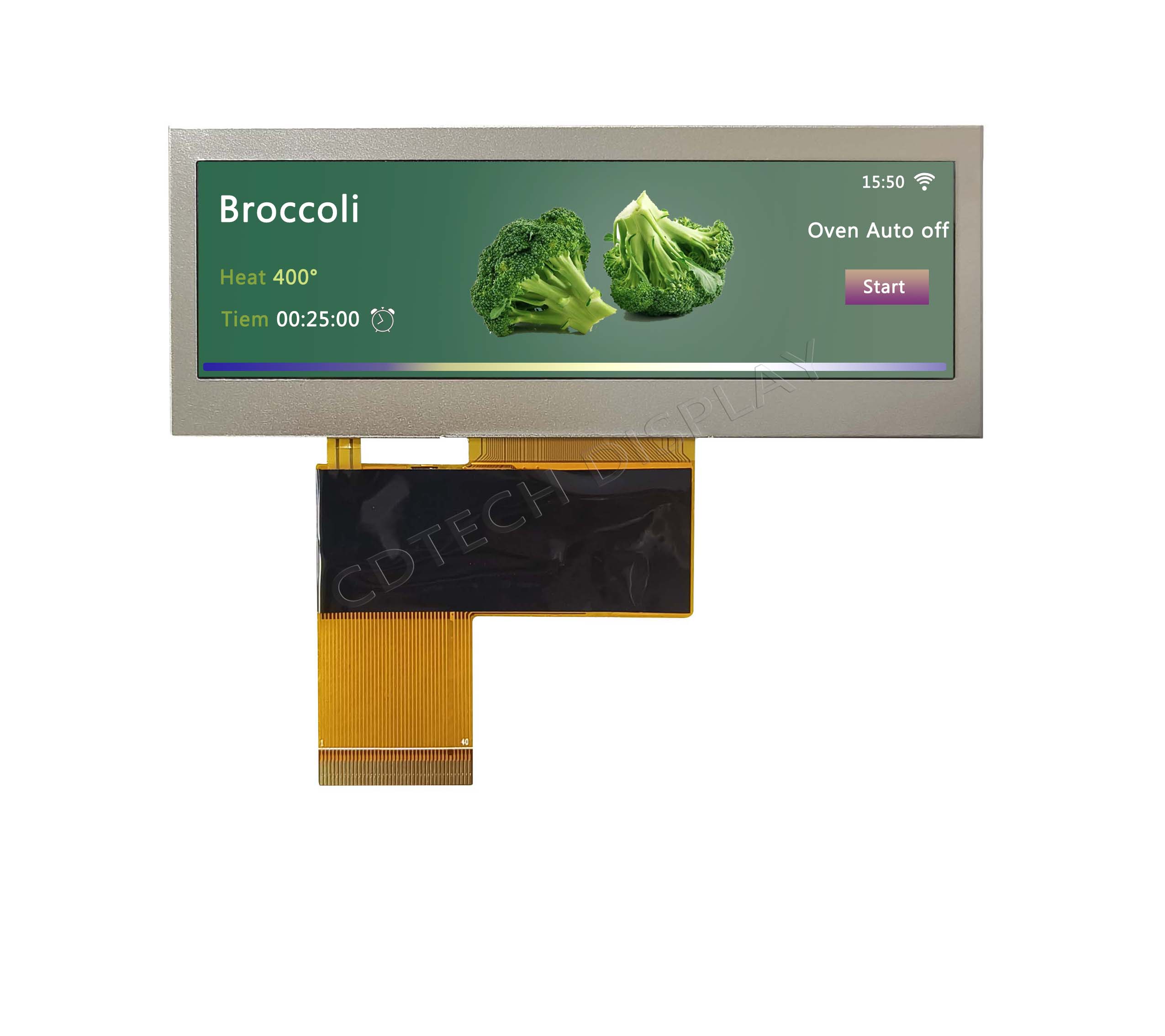
| Model | Size | Resolution | Brightness (nits) | Temp Range | Interface | OCA Bonding | Turnaround |
|---|---|---|---|---|---|---|---|
| S029HQ05NS | 2.9″ | 320×120 | 300 | -20°C~+70°C | SPI+RGB | No | 6-8 weeks |
| S039HWQ12HS | 3.9″ | 480×128 | 500 | -20°C~+70°C | RGB 24-bit | No | 6-8 weeks |
| S043HWV104EN-FL63 | 4.3″ | 800×130 | 800 | -20°C~+70°C | RGB | Yes | 6-8 weeks |
| S070QWU142FN-FL150-GF | 7.0″ | 1200×1920 | 1300/2300 | -20°C~+70°C | MIPI | Yes | 6-8 weeks |
How Does OCA Optical Bonding Enhance Camera Display Performance?
OCA optical bonding eliminates air gaps between LCD and cover glass, slashing glare and reflections for clearer high-res camera feeds. It boosts color vibrancy, durability against vibration, and thermal stability. CDTech’s in-house OCA in 3,500㎡ Class 1000 clean rooms speeds iteration for automotive rear-view applications.
What Is CDTech’s Patented 2nd Cutting Technology and Why Does It Accelerate Time-to-Market?
CDTech’s 2nd Cutting, patented in 2017, precisely cuts glass post-manufacturing for non-standard bar sizes like 2.9″ or 7.0″ without new tooling. This cuts lead times to 6–8 weeks versus 12–16, lowers NRE costs, and eases prototyping for rear-view displays, enabling OEMs to launch faster.
Check: Stretched LCD
Which Camera Input Interfaces and Latency Standards Must Rear-View Displays Meet?
Rear-view displays need MIPI CSI-2, LVDS, or RGB interfaces with <100ms latency for safety, 30–60fps rates, and tight sync from camera to pixels. CDTech’s vertical integration—from glass cutting to controller—optimizes firmware for 50–80ms latency, meeting OEM standards for reliable mirror replacement.
How Do Automotive Supply Chain Certifications Validate Rear-View Camera Display Reliability?
IATF16949 ensures automotive FMEA and traceability; ISO9001 guarantees quality; ISO14001 supports ESG; ISO13485 adds precision. CDTech’s four certifications de-risk qualification, proving reliability for rear-view displays through audits and process controls in their 10,000㎡ factory.
| Certification | Scope | Relevance to Rear-View Displays | Audit Frequency | Validator |
|---|---|---|---|---|
| IATF16949 | Automotive QMS | PPAP, FMEA for safety-critical displays | Annual | Third-party |
| ISO9001 | Quality Management | Consistent production, traceability | Annual | Third-party |
| ISO14001 | Environmental | ESG compliance for vehicle components | Annual | Third-party |
| ISO13485 | Medical Devices | Precision for high-rel HMI | Annual | Third-party |
What Are Real-World Case Studies of Rear-View Camera Display Deployment?
A Tier-1 supplier used CDTech’s 5.0″ bar LCD with OCA for EV mirror replacement, hitting 10,000 units/year after -30°C tests. A Chinese EV OEM deployed 2.9″ bars at 1300+ nits for sunny conditions. An AV integrator standardized CDTech’s 391+ SKUs across views, cutting complexity.
Why Should OEMs Consolidate Rear-View Display Sourcing with Vertically Integrated Manufacturers?
Vertical integration like CDTech’s—from cutting to OCA and QR traceability—avoids multi-vendor delays, finger-pointing, and costs. It offers transparent MOQ/NRE, 40% NRE savings, 50% faster production, and stability from $30M+ sales and 1,000+ customers for reliable rear-view camera scaling.
CDTech Expert Views
“Our patented 2nd Cutting technology revolutionizes rear-view camera integration by delivering custom stretched LCDs in weeks, not months. Combined with IATF16949 certification and full in-house OCA bonding in Class 1000 clean rooms, we enable OEMs to meet stringent latency and brightness specs while compressing timelines by 50%. This vertical control ensures every display—from prototype to 10,000-unit runs—performs reliably in -30°C to +85°C extremes.”
— CDTech Automotive Display Engineering Lead
Conclusion
Rear-view camera displays using stretched bar LCDs drive the shift from mirrors to digital systems for safety and efficiency. CDTech’s 2nd Cutting, quad certifications, vertical integration, and scale empower OEMs with 6–8 week timelines, reducing NRE and risks. Contact sales@cdtech-lcd.com for custom specs or visit automotive displays page.
FAQs
What is the minimum order quantity (MOQ) for a custom rear-view camera bar LCD from CDTech?
CDTech offers transparent MOQ: 100–500 units for prototypes (6–8 weeks via 2nd Cutting), scaling to 5,000–10,000 for production. This flexibility beats rigid tiers from panel makers, supporting fast iteration without hidden costs.
Can CDTech integrate capacitive touch functionality into rear-view camera displays?
Yes, CDTech’s in-house CTP adds touch for brightness, feed switching, or HMI. OCA bonding enhances sensitivity, reduces parallax in sunlight. With 391+ SKUs, customization fits automotive needs seamlessly.
What temperature and brightness specifications are required for automotive rear-view camera displays?
-30°C to +85°C operation and 1000+ nits brightness are standard; 1300–2300 nits for high-sun regions. CDTech’s clean rooms ensure consistency, with anti-glare options like in S070QWU142FN-FL150-GF.
How does latency affect rear-view camera display safety and user acceptance?
Latency over 150ms delays perception, risking accidents in reversing. CDTech achieves 50–80ms via integration, under 100ms best practice, building driver trust and meeting safety certifications.
What is the typical development timeline from concept to production volume for a rear-view camera display?
CDTech delivers in 6–8 weeks using 2nd Cutting and vertical flow, versus 16–24 weeks multi-vendor. Cases show 60% compression, with transparent NRE for rapid prototype-to-volume.
Post Search
Related Articles
-

Capacitive vs Resistive Touch Screen Car Stereo: Which Is Right for You?
-

TN LCD vs IPS LCD: How to Choose the Right Display for You
-

Capacitive Touch Panel or Resistive: Which Suits Your Needs?
-

Why Choose an IPS LCD Panel for Your Next Screen Purchase?
-

CDTECH to Showcase Cutting-Edge Display Solutions at SID 2025
-

Comparing Different Types of Displays in Cars: A Detailed Overview
-
White Spots on LCD Screen: Causes, Fixes & Industrial Solutions (2026 Guide)