

How Do Vibration-Proof Displays Meet EN50155 Standards for Railway Systems?
 2026-04-16
  17:52
17:52 

EN50155 LCD displays are railway-certified liquid-crystal panels engineered to withstand mechanical shock (up to 6G), vibration (4–500 Hz frequency range), and thermal extremes (–25° to +70°C). These displays meet European TSI standards for rail rolling stock, ensuring reliability in passenger information systems, driver HMIs, and wayside signage. CDTech’s patented 2nd Cutting technology and OCA optical bonding enable custom vibration-optimized sizes without yield loss, differentiating certified solutions for rail integrators.
Check: How Do Stretched LCDs Enhance Bus Route Maps in Narrow Overhead Spaces?
What is EN50155 and Why Does It Matter for Railway Displays?
EN50155 is the European technical specification for electronic equipment in railway rolling stock, mandating shock tolerance up to 6G with 11ms half-sine pulses, vibration from 4–500 Hz at ≤2G sustained, and temperatures from –25° to +70°C. It ensures compliance for passenger info systems, driver cab HMIs, and wayside signage across EU networks, preventing project delays, liability risks, and market barriers while enabling pan-European contracts.
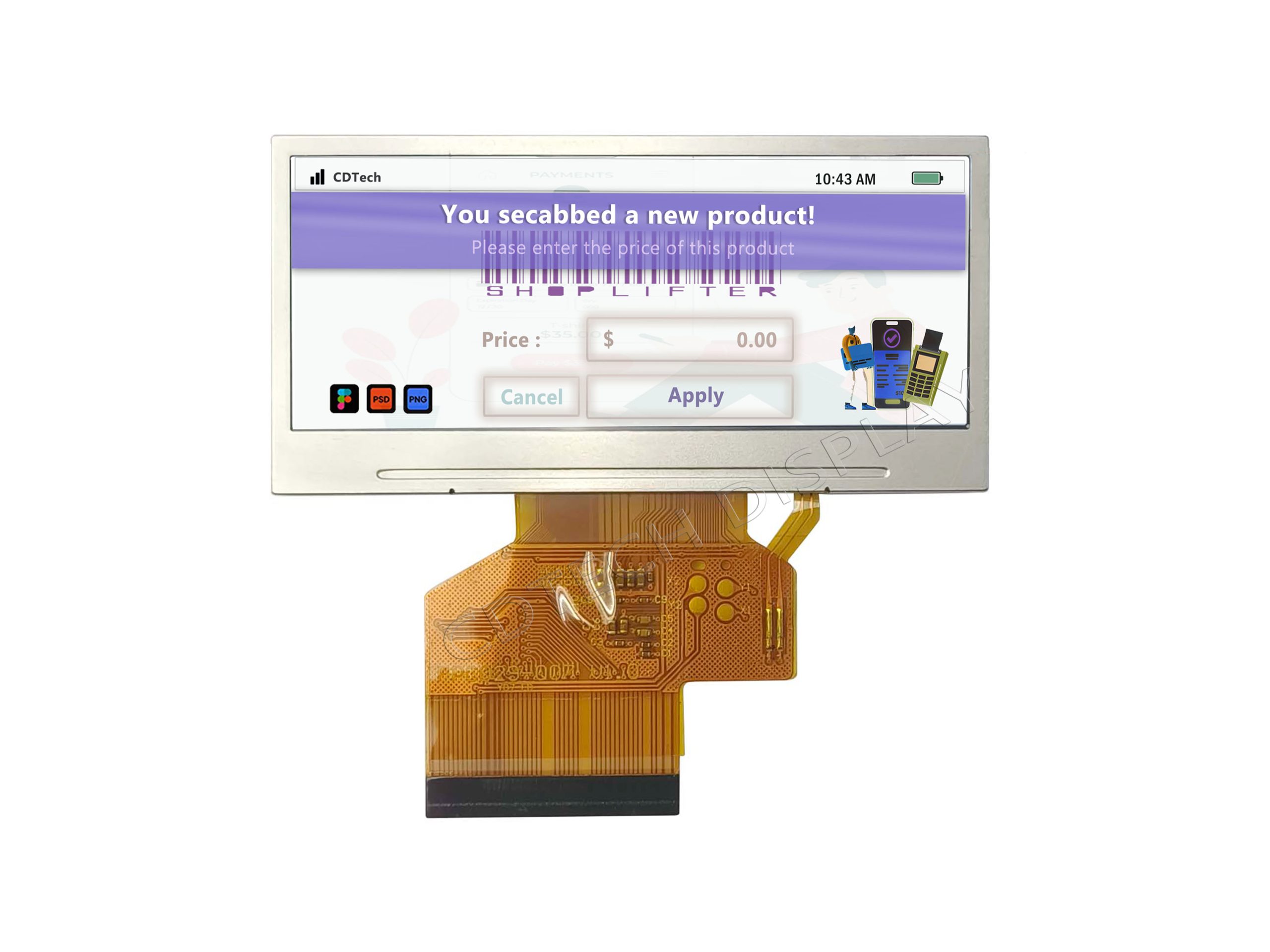
How Do Vibration-Proof Displays Differ from Standard LCD Panels?
Vibration-proof displays feature reinforced bezels, damping materials, stress-distribution housings, and enhanced edge protection, unlike standard LCDs limited to 1–2G shock and narrower temps. CDTech’s OCA optical bonding eliminates air gaps to reduce micro-fractures, while patented 2nd Cutting minimizes stress at custom edges in 4.3″–12.3″ bar formats. Chemically-strengthened glass further boosts durability.
| Specification | Standard LCD | EN50155 Vibration-Proof |
|---|---|---|
| Shock Tolerance | 1–2G typical | Up to 6G, 11ms pulse |
| Vibration Range | Limited (0–100 Hz) | 4–500 Hz, ≤2G sustained |
| Operating Temp | 0° to +50°C typical | –25° to +70°C |
| Edge Protection | Standard beveling | Stress-optimized geometry (2nd Cutting) |
| Glass Strength | Standard soda-lime | Gorilla or chemically-strengthened |
What Role Does OCA Optical Bonding Play in Shock Resistance?
OCA optically clear adhesive permanently bonds LCD panels to cover glass, eliminating air pockets that cause delamination under shock. It distributes impact loads, preventing cracking during vibrations. CDTech’s in-house OCA bonding in 3,500㎡ Class 1000 clean rooms ensures traceability for rail HMIs, validated via IEC 60068-2-6 shock and IEC 60068-2-64 vibration tests, optimized for thermal extremes at 15–25% added cost but lower TCO over 10 years.
Why Is Custom Sizing Critical for Railway HMI and Passenger Information Systems?
Standard 16:9 or 4:3 sizes misalign with rail ergonomics needing narrow 4.3″–7″ bars or 12.3″+ stretched formats. CDTech’s patented 2nd Cutting enables precise custom sizes without yield loss or stress points, ideal for driver cabs, overhead passenger info, and wayside signage. In-house vertical integration cuts lead times to 4–5 weeks from 8 weeks, supporting 391+ SKUs.
Check: Stretched LCD
Which Certifications and Standards Validate EN50155 Compliance?
EN50155 certifies rolling stock electronics, complemented by TSI for interoperability, IEC 61508 for safety, and IEC 60068 for stress testing. CDTech holds IATF16949 for quality, ISO9001, ISO14001, and ISO13485, with displays tested by labs like TÜV/DNV. Its 35 software and 44+ utility patents support proprietary rail solutions, with reports available on request.
CDTech Expert Views: Why Quad Certifications Matter for Rail Procurement Teams
“Rail projects demand unwavering reliability amid vibration, shock, and thermal stress. CDTech’s IATF16949, ISO9001, ISO14001, and ISO13485 certifications ensure end-to-end traceability from our 10,000㎡ factory’s Class 1000 clean rooms. Combined with patented 2nd Cutting and OCA bonding, we deliver EN50155-compliant displays that exceed specs, reducing qualification time and risks for integrators serving 1,000+ global customers.”
— CDTech Engineering Director
How Do Temperature Extremes and Vibration Interact in Rail Environments?
At –25°C, LCD viscosity rises, risking pixel sticking amplified by vibration; at +70°C, degradation accelerates with mechanical stress. CDTech uses wide-temp materials (-20°C~+70°C or -30°C~+85°C in automotive lines like S043HWQ50EG), thermal-relief elastomers, and OCA to prevent cracking. IEC 60068-2-14 cycling (100 cycles) validates reliability for Alpine winters and hot cabs.
What is the Procurement and Qualification Timeline for EN50155 Displays?
Rail phases span 18 months: 0–3 for specs/RFQ, 3–6 for validation, 6–9 for qualification, 9–18 for ramp-up. CDTech accelerates with 391+ SKUs, 4–5 week custom samples via 2nd Cutting/OCA, full documentation (EMC, RoHS), and support including spares and training, de-risking high-stakes programs.
Ready to accelerate your EN50155 qualification? Contact CDTech’s Rail Display Specialists: sales@cdtech-lcd.com
Can CDTech Customize Vibration-Proof Displays Beyond Standard Configurations?
Yes, CDTech customizes sizes (4.3″–12.3″+ via 2nd Cutting), brightness (up to 2300 nits like S070QWU142FN-FL150-GF), touch (CTP/RTP), interfaces (RGB/MIPI/LVDS/SPI/HDMI), and features (2.5D glass, anti-glare). Full in-house chain supports low-volume prototypes to high production with traceability, ideal for rail HMIs.
CDTech Expert Views: From Concept to Deployment: CDTech’s Rail Display Customization Workflow
“Our R&D team guides clients from prototype to mass production, leveraging ERP traceability and QR systems since 2021. For rail, we tune bezels to 50–200 Hz axle vibrations, integrate OCA for shock resistance, and deliver certified units in 4–5 weeks—proven with $30M+ 2023 sales across automotive/industrial apps adaptable to EN50155.”
— CDTech Customization Lead
Conclusion
EN50155 compliance opens European rail markets, but vibration-proof displays must tackle hidden supply risks. CDTech’s patented 2nd Cutting, in-house OCA bonding, quad certifications, and 13-year record (1,000+ customers, $30M+ sales) offer custom bar/stretched formats, 4–5 week leads, and <0.1% defect rates. This turns compliance into a fast, cost-effective advantage for HMIs and signage.
Download CDTech’s EN50155 Compliance Dossier & Custom Size Configurator—Request Free Now.
FAQs
Q1: What is the difference between EN50155 Level 1 and Level 2 vibration classifications?
Level 1 suits smoother mainline trains; Level 2 handles metro/suburban rough tracks with higher acceleration. CDTech’s OCA + 2nd Cutting meets Level 2, with testing data on request.
Q2: How long is the typical warranty for EN50155-certified displays in rail applications?
5–10 years operational life with spares. CDTech guarantees 7 years (no pixel failures/delamination) under duty cycles; extended options and diagnostics included.
Q3: Can CDTech displays handle the EMI/RFI environment of modern rail signaling systems?
Yes, designed for EN61000 immunity with shielded interconnects and grounded bezels, meeting CE/FCC limits. Custom Faraday options for noisy cabs.
Q4: What is the cost premium for vibration-proof EN50155 displays compared to standard industrial LCDs?
25–40% premium for reinforcements/OCA/testing, but eliminates €500–2,000/unit failures over 10 years. CDTech’s 2nd Cutting optimizes costs vs. framing standards.
Q5: How does CDTech ensure supply chain traceability for critical rail safety applications?
Batch-tracked components via serial numbers, test logs, and ISO/IATF audits in 10,000㎡ facility. Archival docs support 10+ year maintenance/investigations.
Post Search
Related Articles
-

Capacitive vs Resistive Touch Screen Car Stereo: Which Is Right for You?
-

TN LCD vs IPS LCD: How to Choose the Right Display for You
-

Capacitive Touch Panel or Resistive: Which Suits Your Needs?
-

Why Choose an IPS LCD Panel for Your Next Screen Purchase?
-

CDTECH to Showcase Cutting-Edge Display Solutions at SID 2025
-

Comparing Different Types of Displays in Cars: A Detailed Overview
-
White Spots on LCD Screen: Causes, Fixes & Industrial Solutions (2026 Guide)