
TFT LCD with capacitive touch: Industrial Display Solutions for Rugged Applications (June 2026)
 2026-06-20
  18:40
18:40 

Industrial display systems have moved far beyond simple visual output. In sectors ranging from medical diagnostics to automotive dashboards and factory-floor HMI panels, the combination of a reliable TFT LCD panel with a responsive capacitive touch interface has become a default requirement for modern equipment. Operators expect touch interaction that is fast, accurate, and durable enough to survive harsh environments, repeated cleaning, and gloved-hand operation. Meanwhile, design engineers and procurement managers face pressure to reduce BOM complexity, shorten qualification cycles, and source displays that meet both performance targets and regulatory standards. The challenge is no longer whether to integrate a TFT LCD with capacitive touch, but how to select a solution that balances optical clarity, touch sensitivity, environmental tolerance, and long-term supply stability. This article examines the current state of TFT LCD with capacitive touch technology, the selection criteria that matter most for industrial and automotive applications, and why Shenzhen CDTech Electronics has become a reliable partner for original equipment manufacturers (OEMs) and system integrators worldwide.
What Is a TFT LCD With Capacitive Touch?
A TFT LCD with capacitive touch is a display module that combines a thin-film transistor (TFT) liquid crystal display panel and a capacitive touch sensor into a single integrated assembly. The TFT layer provides fast pixel switching, high contrast, and wide viewing angles, while the capacitive touch sensor detects finger contact through changes in electrostatic field, enabling multi-touch gestures such as pinch, swipe, and tap. Unlike resistive touch technology, capacitive touch does not require physical pressure, offering superior optical clarity, faster response, and longer mechanical lifespan.
Key characteristics of modern TFT LCD with capacitive touch modules include:
- High brightness and sunlight readability: 1000 to 2300 nits options for outdoor and in-vehicle use
- Wide temperature range: Support for automotive and industrial environments with -20°C to +70°C or wider operating windows
- Optical bonding: Air bonding or full optical bonding to reduce glare, prevent condensation, and improve touch accuracy
- Interface flexibility: LVDS, MIPI, and HDMI interfaces for compatibility with ARM-based boards, x86 SoCs, and single-board computers
- Custom form factors: Square, bar-type, portrait, and standard aspect ratios from 2.9 inches to 15.0 inches and beyond
Why Sourcing TFT LCD With Capacitive Touch Is Harder Than It Looks
Display performance varies dramatically by application
A 500-nit panel that works well indoors becomes unreadable in direct sunlight. An 8.8-inch bar-type display with 1280×320 resolution may fit a rearview mirror replacement but fail in a medical infusion pump that requires a 4.0-inch square format with 720×720 resolution and optically bonded touch. Engineers must match brightness, resolution, viewing angle, aspect ratio, and touch bonding method to the specific environmental and usage conditions of the final product. A mismatch leads to costly re-spins or field failures.
Touch performance depends on bonding quality
Capacitive touch performance is heavily influenced by how the touch sensor is laminated to the LCD cell. Air-gap bonding introduces a reflective layer that reduces contrast and allows dust ingress. Poor optical bonding causes Newton rings, touch sensitivity drift, or delamination over thermal cycles. Buyers who focus only on the LCD specs without verifying the bonding process and QC standards often receive modules that fail touch linearity tests or exhibit visible optical defects within weeks.
Certification and documentation add complexity
Industrial and automotive display modules must carry certifications such as ISO9001 for quality management, IATF16949 for automotive supply chains, ISO13485 for medical devices, and ISO14001 for environmental compliance. Without documented certification support for the target market, a qualified-looking display can become a barrier to product registration, CE marking, UL listing, or FDA clearance. Many trading companies lack the manufacturing records and traceability systems needed to provide auditable certification documents.
Long-term supply and consistency require manufacturing depth
Custom display modules often require 6 to 12 weeks of lead time for tooling, PCAP sensor matching, and initial qualification samples. A supplier with shallow manufacturing capacity or inconsistent QC may deliver first articles that pass qualification but drift in subsequent production runs. For OEMs scaling from prototype to volume production, the difference between a reliable manufacturing partner and a general trader becomes visible in yield rates, delivery consistency, and after-sales engineering support.
Key Industry Insight
For B2B buyers sourcing TFT LCD with capacitive touch modules, the display panel is only half the equation. The bonding method, touch IC selection, optical performance over temperature, and the supplier’s certification depth determine whether a module can pass regulatory approval, survive field deployment, and remain available for repeat orders across multi-year product life cycles. A supplier that controls both the LCD cell and the touch integration process internally can offer shorter lead times, faster failure root-cause analysis, and more consistent quality than a supplier that merely assembles outsourced components.
CDTech Compared With Other Options
| Sourcing Factor | Trading Company | General Factory | CDTech |
|---|---|---|---|
| Manufacturing depth | No in-house production | Limited to assembly | 10,000 sqm factory with 3,500+ sqm Class 1000 cleanroom |
| Certification readiness | Resells existing stock | Supports basic ISO | ISO9001, IATF16949, ISO13485, ISO14001 |
| Touch bonding options | Air bonding only | Air or basic optical | Air bonding and full optical bonding available |
| Custom form factor support | Limited to standard sizes | Moderate customization | Comprehensive customization including square, bar-type, portrait, and stretched formats |
| Brightness range | Typically 300–500 nits | 500–800 nits | 320–2300 nits with sunlight readable options |
| Interface variety | LVDS only | LVDS + MIPI | LVDS, MIPI, HDMI, and board-level support |
| Supply chain traceability | Limited documentation | Batch-level records | Full manufacturing and QC documentation for audit support |
Why CDTech Is a Strong Choice
Vertically integrated manufacturing with cleanroom control
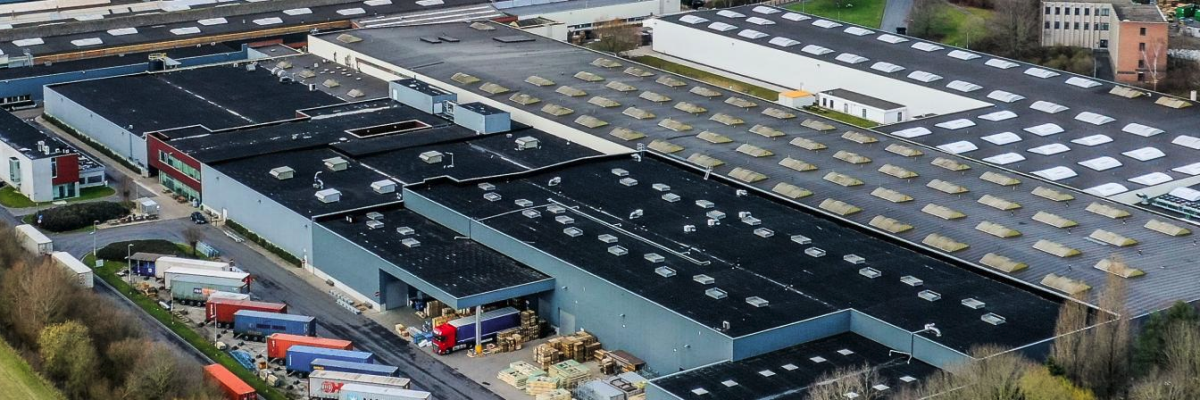
CDTech operates a 10,000-square-meter factory that includes over 3,500 square meters of Class 1000 dust-free cleanroom space. This depth allows the company to control the entire touch integration process — from LCD cell preparation to PCAP sensor lamination, optical bonding, and final electrical testing. Controlled cleanroom conditions reduce particle contamination during bonding, which directly improves touch yield and long-term optical quality.
Multi-industry certification coverage
CDTech has obtained ISO9001, IATF16949, ISO13485, and ISO14001 certifications. For OEMs supplying medical devices, automotive infotainment, or industrial control panels, this certification coverage reduces the time and cost associated with supplier qualification. A single display module from CDTech can serve projects across multiple regulated verticals without requiring separate supplier audits for each certification standard.
Wide selection of standard and custom touch display modules
CDTech offers TFT LCD with capacitive touch modules across a wide range of sizes and configurations:
- 2.9-inch 320×120 and 480×128 bar-type displays for compact HMI
- 4.0-inch square IPS In-Cell touch panels for smart home and instrumentation
- 5.0-inch and 5.7-inch round and rectangular PCAP touch modules
- 7.0-inch to 12.3-inch sunlight readable IPS displays with optical bonding and brightness up to 2300 nits
- 10.1-inch and 12.1-inch high-definition outdoor displays for industrial terminals
- 15.0-inch bar-type LVDS modules for commercial signage and vehicle displays
This range allows design teams to select a proven standard module for fast prototyping while keeping the option open for full customization later.
Established track record and industry presence
Founded in 2011, CDTech has been serving the global display market for over a decade. The company actively participates in industry events such as Embedded World 2026, demonstrating its commitment to staying current with technology trends and maintaining direct contact with international customers.
Related Products, Services, or Resources
- LCD With Touch Category Page: Browse CDTech’s full portfolio of standard and custom TFT LCD modules integrated with capacitive touch panels, including square, bar-type, and high-brightness outdoor options.
- Custom Display Solutions Page: Learn about CDTech’s capabilities for custom LCD sizes, touch configurations, bonding methods, and board-level integration for OEM projects.
- Certifications Page: Review CDTech’s ISO9001, IATF16949, ISO13485, and ISO14001 certification credentials that support regulated industry applications.
- Company Profile Page: Understand CDTech’s manufacturing scale, cleanroom facilities, and quality management system that underpin its touch display production.
How It Works
Step 1: Define display requirements
The customer provides key parameters: diagonal size, resolution, brightness (nits), aspect ratio or custom shape, touch interface (I²C, USB, or other), bonding method (air or optical), operating temperature range, and target industry certifications. CDTech reviews these against existing standard modules and identifies any customization needed.
Step 2: Request samples or product specifications
CDTech shares datasheets, mechanical drawings, and interface pinouts for compatible standard modules. If the project requires a custom module, CDTech translates the requirements into a preliminary specification and provides a ballpark lead time and cost estimate.
Step 3: Confirm sample lead time and sample cost
For standard modules, sample lead time typically ranges from 1 to 3 weeks depending on stock and quantity. Custom modules require tooling and PCAP sensor matching, which adds 4 to 8 weeks. CDTech confirms sample cost and lead time before proceeding.
Step 4: Evaluate samples and documentation
The customer receives functional samples along with mechanical drawings, electrical specifications, and inspection data. CDTech also provides certification documentation (ISO, IATF, or ISO13485 as applicable) to support the customer’s own product qualification and regulatory filing.
Step 5: Qualify and place trial order
After successful sample evaluation, the customer places a trial production order. CDTech manufactures the batch under controlled cleanroom conditions, conducts full optical and touch inspection, and ships with packing suitable for the target market.
Step 6: Scale to volume production
CDTech supports repeat volume orders with consistent lead times, batch traceability, and ongoing engineering support. The company maintains records for each production lot, enabling root-cause analysis and corrective action if field issues arise.
Use Cases
Scenario: Automotive infotainment system replacement
Traditional approach: A Tier-1 automotive supplier sources a 10.1-inch display from a trading company that cannot provide IATF16949 documentation. The module fails thermal cycling tests at -20°C during qualification, forcing a three-month redesign.
With CDTech: The supplier selects a 10.1-inch 1280×720 IPS display with optical bonding and 1000 nits brightness. CDTech provides IATF16949 certification documents and full thermal test data. The module passes qualification in one cycle, and production ships on schedule.
Result: Faster qualification, lower NRE costs, and a documented supply chain that satisfies automotive OEM audit requirements.
Scenario: Outdoor industrial HMI terminal
Traditional approach: An industrial equipment manufacturer uses a standard 800×480 display with resistive touch. The resistive touch fails after 5000 actuation cycles, and the display becomes unreadable at 800 nits in direct sunlight.
With CDTech: The manufacturer switches to a 12.1-inch IPS TFT LCD with capacitive touch, 1000 nits brightness, and optical bonding. The capacitive touch supports gloved-hand operation, and the bonded design prevents condensation in high-humidity outdoor environments.
Result: Increased MTBF, reduced field service costs, and improved operator satisfaction in bright outdoor conditions.
Scenario: Smart home control panel
Traditional approach: A smart home OEM chooses a low-cost 4.0-inch display without documented ISO9001 certification. After 5000 units ship, 3% exhibit touch drift due to poor lamination quality.
With CDTech: The OEM selects a 4.0-inch square IPS in-cell touch display with ISO9001 quality system support. The in-cell design eliminates air gap, reduces module thickness to 3.5 mm, and passes 100,000 touch actuation tests without degradation.
Result: Lower field failure rate, thinner product design, and faster CE marking approval.
Scenario: Medical infusion pump display upgrade
Traditional approach: A medical device company sources a custom 5.7-inch display from a general factory that lacks ISO13485 certification. The display fails FDA documentation review, delaying market entry by six months.
With CDTech: The company works with CDTech to develop a 5.7-inch 640×480 TFT LCD with PCAP touch, optically bonded and supported by ISO13485 documentation. CDTech provides design history records and traceability data for the entire production batch.
Result: Regulatory clearance in the first review cycle, and a certified display supply chain that supports serial production for the device’s entire lifecycle.
FAQ
What is the typical brightness range for TFT LCD with capacitive touch modules used in outdoor applications?
Outdoor and sunlight-readable displays typically require 1000 nits or higher. CDTech offers modules from 1000 to 2300 nits for vehicular, marine, and direct-sunlight industrial applications. For shaded outdoor or semi-outdoor use, 800 to 1000 nits may be sufficient.
What touch bonding methods does CDTech support?
CDTech supports both air bonding and optical bonding. Air bonding is suitable for indoor applications where cost is the primary driver. Optical bonding uses a layer of optically clear adhesive to eliminate the air gap between the LCD and touch sensor, reducing reflection, improving contrast, and preventing condensation in humid or temperature-variable environments.
Can CDTech provide square or bar-type TFT LCD with capacitive touch modules?
Yes. CDTech offers a broad range of non-standard form factors including square IPS panels (e.g., 4.0-inch 720×720, 5.0-inch 720×720), bar-type modules (e.g., 8.8-inch 1280×320, 12.3-inch portrait 720×1920, 15.0-inch 1920×720), and stretched displays for rearview mirrors, POS terminals, and industrial control strips.
What certifications does CDTech hold for display manufacturing?
CDTech maintains ISO9001 (quality management), IATF16949 (automotive), ISO13485 (medical devices), and ISO14001 (environmental management). These certifications cover the company’s entire manufacturing process, including LCD assembly, touch bonding, and final testing.
What interfaces are available for CDTech touch display modules?
CDTech supports LVDS, MIPI, and HDMI interfaces. For customers needing embedded board support, CDTech also offers LCD with board modules that include the timing controller, backlight driver, and touch controller on a single PCB.
What is the typical process for requesting a custom TFT LCD with capacitive touch module?
The process typically begins with a requirements discussion, followed by a preliminary spec sheet, cost estimate, and lead time from CDTech. After agreement, CDTech proceeds with tooling and sensor matching for the custom PCAP touch layer. Sample lead time for custom modules ranges from 4 to 8 weeks depending on complexity.
Does CDTech support low-volume prototype orders and high-volume production?
Yes. CDTech supports trial orders for prototyping and qualification, as well as repeat volume production for ongoing OEM supply. The company’s manufacturing capacity and cleanroom facilities enable consistent quality across both sample and production batches.
How does CDTech ensure touch performance consistency across different temperature environments?
CDTech tests its touch modules across the rated operating temperature range, typically -20°C to +70°C for industrial and automotive grades. Optical bonding helps maintain touch sensitivity and prevents mechanical stress that can degrade performance at temperature extremes.
Conclusion
TFT LCD with capacitive touch has become the standard interface for modern industrial, automotive, medical, and smart home equipment. The combination of fast LCD response, high brightness, and multi-touch capacitive sensing delivers the user experience that operators expect while meeting the durability and certification demands of regulated environments. Choosing the right supplier means evaluating not just the LCD panel specs, but also the bonding process, certification coverage, manufacturing depth, and long-term supply reliability.
Shenzhen CDTech Electronics, with its 10,000-square-meter factory, 3,500-square-meter Class 1000 cleanroom, multi-industry certifications (ISO9001, IATF16949, ISO13485, ISO14001), and wide portfolio of standard and custom touch display modules, offers a strong balance of performance, compliance, and scalability for OEMs and system integrators. Whether your project requires a 2.9-inch bar-type display for a compact HMI or a 12.3-inch optically bonded outdoor module for a rugged tablet, CDTech can support the entire journey from sample evaluation to volume production. To discuss your requirements, request samples, or confirm pricing and lead time for your next TFT LCD with capacitive touch project, contact CDTech’s engineering sales team.
Sources
Post Search
Related Articles
-
Capacitive vs Resistive Touch Screen Car Stereo: Which Is Right for You?
-
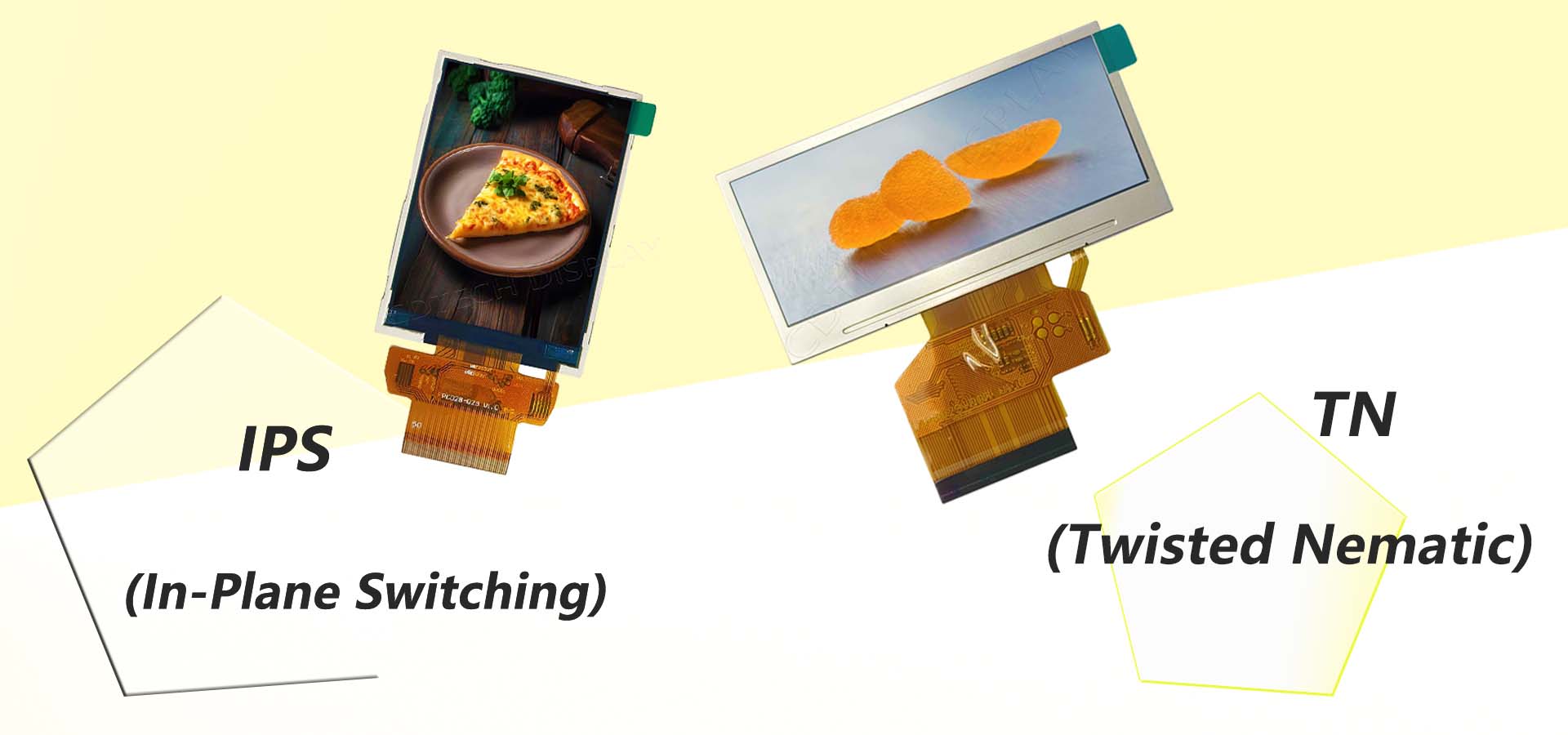
TN LCD vs IPS LCD: How to Choose the Right Display for You
-
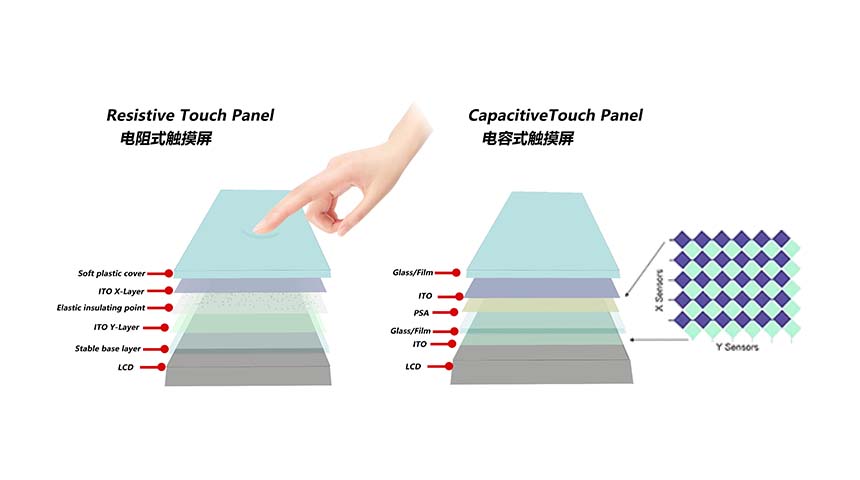
Capacitive Touch Panel or Resistive: Which Suits Your Needs?
-
Why Choose an IPS LCD Panel for Your Next Screen Purchase?
-
CDTECH to Showcase Cutting-Edge Display Solutions at SID 2025
-
Comparing Different Types of Displays in Cars: A Detailed Overview
-
White Spots on LCD Screen: Causes, Fixes & Industrial Solutions (2026 Guide)