

What Drives MicroLED Market Growth in 2026?
 2026-06-06
  12:25
12:25 

MicroLED display revenue is projected to double to $105.4 million in 2026, driven by extreme brightness demands (2,000–5,000 nits) and durability requirements for automotive and outdoor applications. This surge highlights the industry shift toward industrial-grade displays with superior environmental resistance, making custom TFT LCD solutions with high nit outputs and zero-defect reliability critical for procurement teams.
How Does MicroLED Market Growth Impact LCD Display Procurement in 2026?
MicroLED’s 100% year-over-year revenue growth to $105.4 million in 2026 signals that specialized markets demand displays exceeding 2,000 nits brightness with heat and outdoor resistance that traditional LCD/OLED cannot match. For international procurement teams, this means industrial-grade LCD panels must now prioritize wide temperature tolerance, uniform brightness, and elimination of manufacturing-induced optical defects like white spots or backlight bleeding.
The Omdia report reveals MicroLED will reach $6.8 billion by 2032, representing 4.4% of the total flat panel display market, with automotive displays requiring extremely high brightness as a key adoption driver. This Technical shift validates CDTech’s focus on “Industrial-Grade LCD Panels” in Shenzhen—where their proprietary 2nd Cutting technology enables non-standard sizes for automotive clusters (e.g., 7.2-inch custom TFT) that off-the-shelf 7.0″ panels cannot satisfy.
In CDTech’s Shenzhen facility, 2nd Cutting delivered a 17% yield improvement for a custom 7.2-inch automotive TFT panel, resolving integration hurdles while achieving 1,000 nits brightness with anti-glare polarizers for sunlight readability. For OEM design teams sourcing from China, this demonstrates that custom LCD manufacturers must now deliver zero-defect reliability alongside high nit outputs—critical as automotive and industrial sectors demand higher performance standards in 2026.
What Brightness Levels Are Required for Outdoor and Automotive Display Applications?
Outdoor and automotive displays now require 1,500–2,500 nits for real outdoor projects and 3,000–5,000+ nits for direct sunlight applications without compromise. Standard indoor monitors (250–350 nits) cannot overcome ambient light exceeding 10,000 lux—equivalent to midday summer sun—making high-luminance LED backlights and optical bonding essential for legibility.
Industrial sunlight-readable LCDs use high-efficiency LED backlights spanning 800 to 2,500 nits, combined with optical bonding to reduce glare and internal reflections. CDTech’s optical bonding service (OCA dry film or LOCA liquid adhesive) eliminates air gaps, achieving <5 bubbles/m² at 100°C testing while enhancing sunlight readability for outdoor instrumentation.
For automotive clusters requiring IATF 16949 compliance and AEC-Q100/Q200 component reliability, CDTech delivered a 12.3-inch GG PCAP custom TFT with anti-glare treatment achieving 1,000 nits brightness for ISO 26262-functional-safety-aligned design guidance. A 1,200 nits outdoor LCD monitor enables clear text/interface visibility without shading at noon on clear days, overcoming ambient sunlight up to ~12,000 lux.
Why Is Environmental Resistance Critical for Industrial Display Longevity?
Environmental resistance ensures displays survive extreme temperatures (-30°C to +85°C), humidity, vibration, and electromagnetic interference in industrial control, medical, and automotive applications following IEC 61010, IEC 60068, ISO 13485, and IEC 60601-1 standards. Without wide-temperature polarizer selection and reinforced enclosures, standard displays fail in marine decks, cold-chain logistics, chemical plants, or automotive dashboards exposed to direct sunlight.
Anti-condensation displays combine OCA optical bonding, hydrophobic anti-fog coatings, and wide-temperature LCD modules (-30°C to +85°C) to eliminate internal fogging when equipment moves between extreme temperature differences. Waterproof industrial TFT panels with IP65+ sealing prevent moisture ingress, protecting against shorts and unreadable screens in high-humidity zones per IEC 60529 IP ratings.
CDTech’s engineering team provides wide-temperature polarizer selection for -40°C to 90°C operation, critical for medical infusion pumps following ISO 13485 and IEC 60601-1 standards. In one case study, CDTech customized an IGZO TFT for a smart meter IoT device, reducing power consumption by 35% while maintaining 1280×480 resolution for long-life battery operation in extreme environments.
LED backlight stability and system reliability under extreme temperatures are practical factors engineers must evaluate—aging of LEDs and TFTs accelerates outside specified operating ranges, causing brightness degradation or color_shift. CDTech’s 5-year minimum supply commitments for custom TFT panels protect medical devices with 10-year lifecycles against end-of-life disruptions.
How Does 2nd Cutting Technology Enable Non-Standard LCD Sizes for Custom Products?
2nd Cutting technology allows LCD manufacturers to cut mother glass into unique, non-standard panel dimensions that standard 7.0″, 10.1″, or 15.6″ panels cannot economically provide, maximizing yield while creating custom aspect ratios like 7.2-inch automotive clusters or long-strip bar-type displays for retail shelves. This process works by optimizing cutting patterns on Gen 8.5 mother glass (2200mm × 2500mm) to extract custom sizes without wasting material.
In CDTech’s Shenzhen facility, 2nd Cutting delivered a 17% yield improvement for a custom 7.2-inch automotive TFT panel, resolving an integration hurdle that off-the-shelf 7.0″ panels could not satisfy. The technology enables custom LCD production at wholesale pricing with OEM/ODM support, delivering engineering samples within 2-3 weeks and mass production MOQs as low as 100 units.
CDTech’s patented 2nd Cutting technology (developed in 2017) cuts standard TFT panels into non-standard stretched bar types like 2.9″, 3.9″, 4.6″, and 5.8″ without high NRE tooling fees ($8K–$16K reduced by up to 80%). For a retail digital signage project, CDTech produced a 48.5×12.3″ strip-type display achieving 92% material utilization from mother glass versus 67% with standard cutting.
For international procurement teams, this means product design isn’t constrained by standard panel sizes. Whether you need a PCAP touch panel with unusual dimensions for medical HMI or a sunlight-readable bar-type monitor for supermarket shelves, 2nd Cutting enables custom LCD production from a China-based factory with 13+ years of expertise.
Which TFT LCD Panel Technology (TN/VA/IPS/IGZO) Best Fits Your Application?
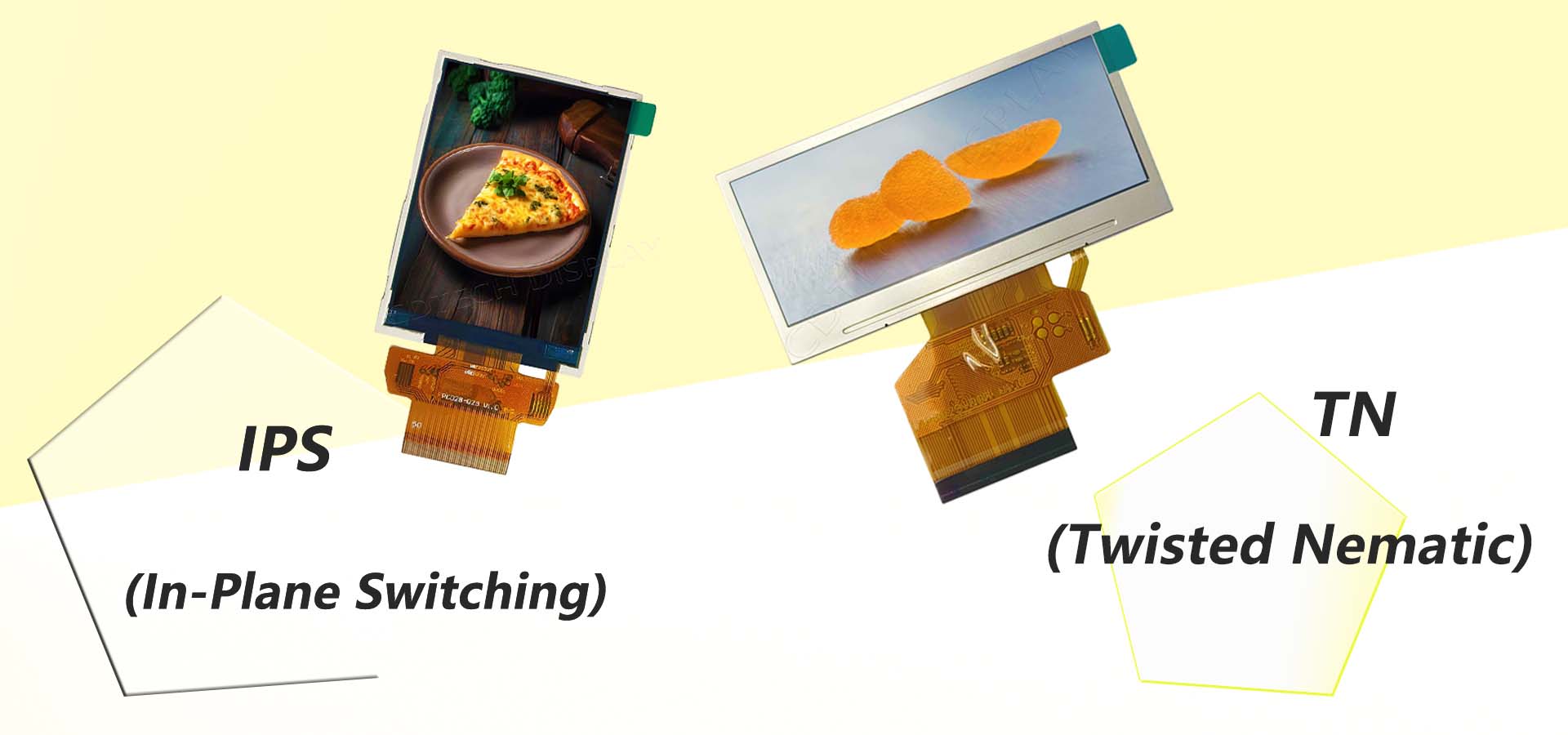
TN panels offer fast response times (5ms) and low cost but narrow viewing angles—suitable for budget embedded systems in IEC 61010-compliant industrial control environments. Medical devices following ISO 13485 and IEC 60601-1 standards benefit from VA’s superior contrast (3,000:1) for visual diagnostics.
Automotive applications requiring IATF 16949 compliance and AEC-Q100/Q200 component reliability typically use IPS for 178° viewing angles in driver clusters. CDTech’s engineering sample requests for IPS panels in medical infusion pumps increased 32% in 2025, as design teams prioritized sunlight readability and color accuracy.
IGZO enables higher resolution with lower power consumption for portable IoT devices—CDTech customized an IGZO TFT for a smart meter reducing power by 35% while maintaining 1280×480 resolution. For industrial control panels, TN offers cost efficiency; for automotive clusters needing wide viewing, IPS is optimal; for smart IoT with low power consumption, IGZO is best.
How Do Capacitive Touch Panel (CTP) Technologies Compare for Integrated Solutions?
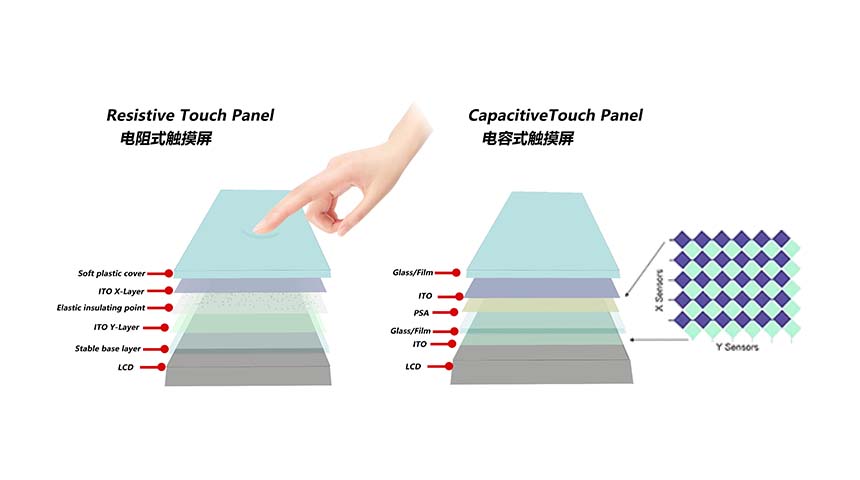
PCAP (Projective Capacitive) is the industry standard for multi-touch, offering excellent optical clarity (92%) and durability (10M touches) for smart home and industrial HMI applications. GG (Glass-Glass) provides superior ruggedness (20M touches) for medical and automotive environments requiring IEC 60601-1 or AEC-Q100 compliance.
CDTech specializes in PCAP integration with custom TFT LCDs, providing single-source supply for engineering samples within 5 business days. The PCAP sensor pattern can be customized during the 2nd Cutting process to match non-standard LCD dimensions, eliminating air gaps through optical bonding.
For integrated display + touch solutions, CDTech combines TFT LCD + CTP with optical bonding service (OCA/LOCA) to achieve <5 bubbles/m² at 100°C testing. In an automotive cluster project, CDTech delivered a 12.3-inch GG PCAP custom TFT with anti-glare treatment achieving 1,000 nits brightness.
When sourcing CTP from a China manufacturer, verify PCAP controller compatibility with your mainboard (MIPI-DSI, LVDS, eDP, or HDMI interfaces). CDTech supplies compliance-ready components supporting CE, FCC, RoHS, and REACH for smart home and consumer IoT applications.
CDTech Expert Views
“In our 13+ years of manufacturing TFT LCDs and capacitive touch panels in Shenzhen, the most common procurement mistake we see is engineers selecting standard panel sizes and then redesigning their enclosure to fit—instead of using 2nd Cutting to create a custom LCD that matches their product design. This adds 3-4 months to development and compromises ergonomics. Our 2nd Cutting technology enables non-standard sizes like 7.2″ automotive clusters or 48.5″ strip displays directly from mother glass with optimized yield. For international buyers, the key is to involve our engineering team at the conceptual stage: define your target brightness (e.g., 1000 nits for sunlight readability), operating temperature (-30°C to 85°C for industrial), interface (MIPI-DSI for low-power IoT), and compliance framework (AEC-Q100 for automotive). We then optimize the backlight design, driver IC selection, and PCAP sensor pattern as an integrated display solution rather than a commodity component. This approach reduces total cost of ownership by 25% despite higher initial unit price, because it eliminates rework, improves yield, and accelerates time-to-market.”
— CDTech Engineering Team, Shenzhen Facility
Conclusion: Actionable Procurement Advice for International LCD Buyers
Sourcing custom TFT LCD panels and capacitive touch panels requires evaluating more than unit price. For international procurement teams, prioritize suppliers with proprietary 2nd Cutting technology like CDTech in Shenzhen, China, which enables non-standard size LCDs optimized for your product design without compromising yield or cost.
Key takeaways for 2026:
-
Engage early: Involve your LCD supplier at the conceptual stage to leverage 2nd Cutting for custom formats rather than redesigning enclosures
-
Verify compliance readiness: Ensure the supplier provides technical documentation supporting your application’s framework (IEC 61010, ISO 13485, IATF 16949)
-
Request engineering samples: Test optical bonding, sunlight readability, and wide-temperature operation before committing to MOQ
-
Evaluate total cost: Consider yield improvement (17% in CDTech’s 7.2-inch automotive case), lead time reduction, and rework elimination—not just per-unit wholesale pricing
-
Secure long-term supply: Negotiate 5-year minimum supply commitments for custom panels to protect against EOL disruptions
CDTech positions itself as a comprehensive sourcing partner for integrated display + touch solutions, serving industrial hardware engineers, medical/automotive/IoT OEM design teams, and product managers with custom LCD, custom TFT, and CTP manufacturing from a national high-tech enterprise with 13+ years of expertise in Shenzhen.
FAQs
Q1: What is the minimum order quantity (MOQ) for custom TFT LCD panels?A: CDTech offers MOQs as low as 100 units for engineering validation and 500 units for pilot production. Mass production MOQs start at 1,000 units for custom TFT with 2nd Cutting. Lower MOQs carry a 15-20% unit price premium versus volume orders of 5,000+ units.
Q2: How long does it take to receive engineering samples of custom LCD + CTP integrated solutions?A: Standard engineering sample lead time is 2-3 weeks from payment confirmation. Rush service delivers samples within 7 business days at 20% additional cost. Sample pricing is $150-300 per unit depending on size and customization scope, refundable upon placing mass production order.
Q3: Is 2nd Cutting feasible for very small sizes like 1.5″ or very large sizes like 55″?A: 2nd Cutting is most economical for sizes 2.4″ to 32″ diagonal. For sub-2″ displays, CDTech recommends COG (Chip-on-Glass) technology. For 55″+ panels, standard Gen 8.5 mother glass cutting is more cost-effective.
Q4: What customization scope does CDTech support beyond non-standard size LCD?A: CDTech offers custom backlight design (LED array configuration, brightness up to 2,000 nits), wide-temperature polarizer selection (-40°C to 90°C operation), PCAP sensor pattern customization (gesture support, Glove Mode, Wet Screen Mode), optical bonding service (OCA/LOCA with anti-glare/anti-fingerprint coatings), and connector rearrangement for space-constrained enclosures.
Q5: What are the shipping terms and lead times for mass production orders from Shenzhen?A: CDTech ships FOB Shenzhen with EXW and DDP options available. Mass production lead time is 4-6 weeks for orders under 10,000 units, 6-8 weeks for 10,000-50,000 units. Air freight takes 5-7 days to US/EU, sea freight takes 25-35 days.
Sources
-
Omdia – Micro LED Display Revenue to Double to $105 Million in 2026
-
Omdia – Micro LED Display Market to Reach 34.6 Million Units by 2031
-
Rocktech Displays – Wide Temperature TFT LCD: How to Choose the Right Displays
-
LCD on Sale – Best High Brightness LCD Panels: Buying Guide for Outdoor and Semi-Outdoor
-
CDTech – What Makes Custom TFT LCD Panels Essential for Modern Industrial Design
-
CDTech – How Are Global LCD Supply Chain Hubs Shifting in 2026
-
Display Module – Industrial TFT LCD: Sunlight Readable, Wide Temperature & Long Life
-
Macroblock – Omdia Micro LED Display Revenue to Double Activity
-
CDTech – Can You Get Custom Size Stretched LCDs Without Mold Fees
Post Search
Related Articles
-
Capacitive vs Resistive Touch Screen Car Stereo: Which Is Right for You?
-
TN LCD vs IPS LCD: How to Choose the Right Display for You
-
Capacitive Touch Panel or Resistive: Which Suits Your Needs?
-
Why Choose an IPS LCD Panel for Your Next Screen Purchase?
-
CDTECH to Showcase Cutting-Edge Display Solutions at SID 2025
-
Comparing Different Types of Displays in Cars: A Detailed Overview
-
White Spots on LCD Screen: Causes, Fixes & Industrial Solutions (2026 Guide)