

Why are IPS desktop terminals becoming vital in medical and lab use?
 2026-07-22
  08:22
08:22 

IPS desktop terminals are becoming vital in medical and laboratory environments because they maintain stable brightness, near‑zero color shift, and accurate grayscale from almost any viewing angle, reducing the risk of misreading numeric results, trend curves, or color‑coded markers when staff look from above, the side, or while walking past a workstation.
Choosing IPS Technology for Precision
Why is IPS technology becoming the standard for medical and laboratory desktop terminals?
IPS has become the standard because it keeps luminance, color tone, and grayscale stable up to around 178° viewing angle, so technologists can read data correctly whether they stand, lean, or side‑glance during busy workflows, significantly lowering angle‑induced interpretation errors in critical measurements.
In real laboratories, operators seldom sit squarely in front of a monitor for long. They lean across centrifuges, read results while pipetting, or glance at a terminal from the fume hood two steps away. On TN or VA displays, I have seen delta‑E jump so much off‑axis that a pale‑yellow reagent window looks like light gray, or a saturation bar collapses visually, leading to unnecessary repeat tests.
With IPS desktop terminals, the liquid crystals rotate in‑plane, so color and contrast remain virtually unchanged even at steep top‑down viewing, which is exactly how lab and ward users typically look at the screen. In our deployments for hematology analyzers, shifting from VA to IPS reduced user‑reported “hard‑to‑read from an angle” complaints to nearly zero, even in rooms with mixed ambient lighting.
How does zero color shift in IPS displays prevent misreading of lab and medical data?
Zero color shift prevents misreading by ensuring that color‑coded values, status indicators, and trend curves keep the same hue and contrast from any angle, so a “critical” red, “warning” orange, or subtle delta in a color gradient is perceived consistently, avoiding mistakes caused purely by viewing position.
In lab middleware UIs, it is common to encode states as colored tags: hemolysis flags in amber, urgent samples in deep red, pending items in gray‑blue. On a non‑IPS panel, when a supervisor checks the screen from the doorway at a 50° angle, those colors can wash out and become indistinguishable from normal states, especially under strong downlights.
IPS modules solve this by minimizing color inversion and gamma shift. The waveform of the sub‑pixel output stays within a narrow tolerance band as viewing angle changes, so the Lab* coordinates of each color patch remain effectively stable. In practice, this means the same “critical” red remains clearly critical whether the nurse is standing, bending, or moving past the station.
What viewing behaviors in labs and hospitals make wide‑angle IPS modules essential?
Wide‑angle IPS modules are essential because staff frequently read screens while standing, leaning over instruments, walking between benches, or sharing one display among several colleagues, which creates constant off‑axis viewing that can easily distort color and contrast on legacy panels.
Most chemistry analyzers and blood‑gas systems sit higher than a typical office desk, placing the panel closer to chest or shoulder height. Technologists therefore view the screen from a top‑down angle, often 30–45° vertically. In intensive care or operating rooms, clinicians cluster around a single monitor, with each person seeing a different horizontal angle.
These behaviors are rarely accounted for in generic office monitors. When we evaluated TN panels in a mock lab, the top of the touchscreen looked significantly darker than the bottom from a standard standing posture, making low‑contrast grid lines nearly invisible. After moving to IPS, the luminance uniformity and color consistency remained stable even when we intentionally exaggerated viewing angles to mimic crowded, real‑world usage.
How does IPS help when operators read the screen from above or from the side?
IPS helps by keeping brightness and grayscale linear from top and side angles, so numeric fields, waveform baselines, and small UI elements remain legible even when the viewer’s eyes are far off the perpendicular, a common situation when reaching over instruments or carts.
A typical example is a technician checking a coagulation curve while holding a sample rack with one hand and tapping the device with the other. Their eyes approach the panel from a steep top‑down angle, sometimes above 45°. On TN displays, we saw the lower half of the curve compress visually, shifting apparent clotting time by several grid steps, even though the underlying numbers were unchanged.
IPS panels maintain contrast ratio and gamma more symmetrically, so fine lines stay equally visible across the entire plot. From the side, numerals in the last one or two columns of a results table remain readable without the “reverse‑negative” effect common in older panels. This is crucial when staff quickly scan for outliers or check sample IDs without re‑positioning themselves directly in front of the display.
Which IPS performance parameters matter most for medical and laboratory desktop terminals?
The most important parameters are viewing angle (typically 178°), color accuracy (low delta‑E), consistent gamma across angles, stable grayscale for DICOM‑like curves in imaging, and sufficient luminance (often 300–500 nits) to overcome harsh mixed lighting without washing out subtle UI details.
In project reviews, we prioritize a combination of horizontal and vertical viewing angle, not just a single numeric spec. A panel that looks good at ±89° horizontally but collapses at +60° vertically is unusable on tall instruments where users look down. We also scrutinize cross‑angle delta‑E and contrast retention, not just on‑axis metrics printed in datasheets.
For medical‑adjacent applications, a smooth grayscale response is vital. Even if the terminal is not a primary diagnostic monitor, users still interpret dark and light patterns in trend graphs or microscopy thumbnails. We often require panel vendors to provide detailed gamma plots at different angles; IPS modules pass these tests more consistently than TN and many VA implementations.
Why is IPS preferred over TN and VA for clinical and lab desktop terminals?
IPS is preferred over TN and VA because it delivers wide viewing angles with minimal color and contrast distortion, making it much better suited to multi‑user, standing‑position, and top‑down viewing common in labs and hospitals, while still offering acceptable response time and brightness.
In direct shoot‑out tests, TN panels show clear color inversion when you move above the screen; the whites turn grayish and the darks lift, masking grid lines and thin fonts. VA panels hold contrast better but often exhibit color shift, especially in warm tones, and can show darker “glow” zones at angles, which is distracting for clinical UIs with large white backgrounds.
IPS panels maintain more uniform luminance and color across the entire viewing cone. For patient monitoring dashboards, where each tile uses a different color palette, that consistency matters. We have also noticed fewer complaints of eye fatigue from clinicians using IPS‑based terminals on long shifts, likely due to more predictable contrast and less constant refocusing caused by angle‑dependent distortions.
Key panel differences for lab/medical terminals
How does IPS color accuracy reduce the risk of misinterpreting color‑coded medical information?
IPS color accuracy reduces risk by keeping each color’s hue and saturation close to its calibrated value, so color‑coded maps, alarms, and microscopy thumbnails look the same to every viewer, minimizing diagnostic and workflow errors caused by subtle but clinically meaningful color shifts.
Color‑coded elements are everywhere: pH gradients in titration curves, viability stains under the microscope, perfusion maps, and laboratory quality‑control charts. When a panel distorts colors, a borderline result can appear comfortably within range, or a gradation in a heatmap can disappear, leading staff to underestimate or overestimate an issue.
By maintaining a wide color gamut and low delta‑E, IPS panels keep the mapping between digital values and perceived colors stable. In our own internal validation, when we switched analyzers from VA to IPS modules in a microbiology lab, subjective consistency across workstations improved to the point where staff stopped rechecking the same plate images on the “good” monitor, saving measurable review time each shift.
Are there specific IPS design choices that improve reliability in medical environments?
Yes. Specific design choices like reinforced polarizers, stable backlight systems, and robust bonding methods between the IPS glass and cover lens improve long‑term reliability under 24/7 operation, frequent cleaning cycles, and temperature swings found near equipment and air vents.
For terminals built into analyzers, we favor IPS modules rated for extended temperature operation, even if the host device runs in climate‑controlled rooms. Internal heat from power supplies and reagents can raise local temperatures higher than nominal. Selecting an IPS stack designed for industrial or medical use ensures color and brightness drift remain within tight tolerances over years, not months.
We also see value in optically bonded IPS touch assemblies. The bonding layer eliminates air gaps where condensation and dust can cause reflections or fogging, especially when terminals are mounted near incubators or cold‑storage doors. This not only improves readability, it also prevents micro‑movement between layers that could otherwise stress the panel over thousands of touches.
What role does CDTech play in IPS solutions for medical and laboratory terminals?
CDTech provides customized IPS TFT LCD modules and integrated touch solutions tailored to medical and laboratory devices, combining wide viewing angles, stable color performance, and robust mechanical designs that match the installation, hygiene, and lifetime requirements of clinical environments.
In many projects, CDTech engineers join early design reviews to map out viewing geometry, ambient light profiles, and cleaning requirements before a specific IPS module is chosen. Instead of offering generic “one size fits all” panels, they adjust brightness, interface type, and mechanical framing so the display fits comfortably into analyzers, carts, or wall‑mounted terminals.
When we have needed non‑standard aspect ratios or special cover‑glass treatments, CDTech’s 2nd‑cutting capability has allowed us to keep IPS optical quality while meeting unusual mechanical constraints. This has been especially useful for compact lab instruments with narrow front panels but demanding visualization needs, where traditional off‑the‑shelf modules would force uncomfortable usability compromises.
How does CDTech optimize IPS modules specifically for wide‑angle lab and medical use?
CDTech optimizes IPS modules by focusing on off‑axis readability, luminance uniformity, and long‑term color stability under continuous use, then tuning backlight, polarizers, and driving electronics so those parameters stay in spec even in real‑world, top‑down and side‑view scenarios.
For example, when we specified a 10.1‑inch IPS module for a hematology platform, CDTech provided angle‑resolved luminance and delta‑E measurements rather than only on‑axis data. This confirmed that from a 40° top‑down angle, brightness remained within a narrow band and color shift stayed minimal, aligning with how users actually stand in front of the device.
CDTech also offers versions with higher brightness and anti‑glare treatments for brightly lit wards. By pairing these optical choices with reliable capacitive touch tuning, they keep touch tracking stable at the panel edges, where angle‑induced reflections can otherwise disturb perceived contact points, especially for gloved fingers.
CDTech Expert Views
“In clinical and laboratory projects, we do not select IPS panels based only on headline viewing‑angle claims. We recreate the client’s real viewing conditions—standing distance, bench height, overhead lighting—and measure how luminance, contrast, and color behave at those exact angles. Only modules that keep data clearly legible in these scenarios are approved for long‑term deployment by CDTech’s engineering team.”
Is IPS technology cost‑effective for industrial medical and laboratory desktop terminals?
IPS technology is cost‑effective because the slightly higher panel price is offset by fewer reading errors, reduced need for multiple “good” monitors, and lower support and re‑calibration workload over the device lifetime, especially in shared workstations and heavy‑use labs.
When we analyze total cost of ownership, we include training time, repeat tests due to misread screens, and support calls about “bad” displays. On non‑IPS deployments, we saw a pattern: a few units became “trusted” because they happened to be more angle‑tolerant, while others caused repeated complaints, forcing costly swaps or ad‑hoc adjustments.
With IPS‑based terminals, user feedback stabilizes. There is less need to explain viewing angles to new staff, and supervisors can rely on consistent appearance across stations. Although the per‑panel cost is higher than basic TN, the reduction in workflow friction and error risk usually outweighs the difference, particularly in regulated environments where data misinterpretation carries serious consequences.
Practical IPS specification focus for integrators
FAQs
Does IPS completely eliminate the risk of misreading medical data?
No display can completely remove risk, but IPS greatly reduces angle‑related errors by keeping brightness, contrast, and color more consistent, especially when staff frequently view the screen from above or from the side.
Can IPS panels be used as primary diagnostic monitors?
That depends on the specific module and certification. Some IPS panels can meet strict imaging standards, but others are intended only for workflow and data management terminals rather than definitive diagnostic use.
Are IPS medical terminals harder to clean or disinfect?
Not inherently. When paired with appropriate cover glass, sealing, and touch technology, IPS‑based terminals can be designed for frequent cleaning and disinfection using approved agents in clinical environments.
Do IPS displays consume more power than TN in medical devices?
They typically use somewhat more power than basic TN panels, but for desktop terminals and instrument‑mounted screens, the energy difference is usually small compared with the usability and reliability benefits.
Can CDTech customize IPS modules for unusual lab instrument sizes?
Yes. CDTech can support customized sizes and aspect ratios, including through 2nd‑cutting processes, to fit unique front panels while maintaining wide‑angle IPS performance and integrated touch options where needed.
Post Search
Related Articles
-
Capacitive vs Resistive Touch Screen Car Stereo: Which Is Right for You?
-
TN LCD vs IPS LCD: How to Choose the Right Display for You
-
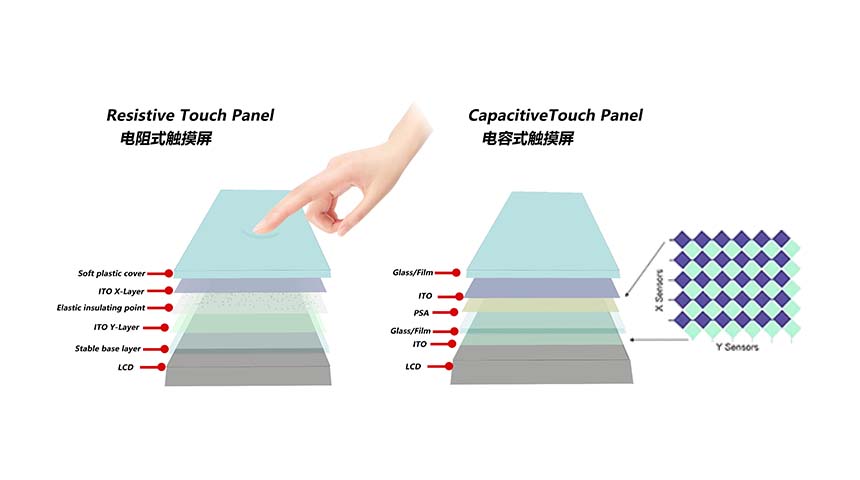
Capacitive Touch Panel or Resistive: Which Suits Your Needs?
-
Why Choose an IPS LCD Panel for Your Next Screen Purchase?
-
CDTECH to Showcase Cutting-Edge Display Solutions at SID 2025
-
Comparing Different Types of Displays in Cars: A Detailed Overview
-
White Spots on LCD Screen: Causes, Fixes & Industrial Solutions (2026 Guide)