

How China Capacitive Touch Panel Innovations Drive Technology Forward
 2026-10-08
  11:00
11:00 

Assessing China capacitive touch panel innovation in engineered modules for real products rather than newness alone reveals progress in cover-glass design, stability of sensing, optical bonding, environmental sensitivity, interfaces, and traceability in manufacturing. Of most interest to OEMs, however, is how an innovation can better complete specific user tasks and whether the supplier can scale up to deliver consistent quality.
What Counts as China Capacitive Touch Panel Innovation?
The innovation in capacitive touch panels in China can be seen in the sensor, controller, cover layer, bonding, firmware and the manufacturing process itself. Reducing the thickness of the cover layer, better performance with gloves or a more suitable FPC connection can be as relevant as a new gesture. Please specify a use case, test conditions and the relevant acceptance criteria for such an innovation, so that we can tell you whether there is any real engineering value behind the respective slogan or not.
What Does a Capacitive Touch Screen Include Beyond the Sensor?
A capacitive touch screen consists of a touch sensor, a controller, a cover glass, bonding materials and a firmware as well as a host interface. The touch sensor recognizes changes of capacitance which are caused by a human finger or by other devices. The controller calculates the signals which are measured by the sensor and calculates the position of the touch event as well as the type of touch event. The meaning of the term capacitive touch screen usually also comprises the complete interaction system. Therefore a projected capacitive (PCAP) touch module has to be checked for its sensing, optical, mechanical and signal processing performance.
How Can OEMs Measure Improvements in Capacitive Touch Performance?
Useful signals include stable operation with gloves or water, lower false touches, clearer optical performance, faster recovery after interference and a better fit to the enclosure. Buyers should request before-and-after test conditions, not only a claim that a layer is “new.” Innovation is meaningful when it improves a defined workflow without creating a new integration risk.
Which China Capacitive Touch Panel Innovations Improve Professional Interaction?
When selecting a China capacitive touch panel for a project, it is important to ensure that the touch surface is connected to the task at hand. For automotive controls, examples may include sunlight readable displays with robust gesture recognition. For smart appliances, very narrow control bars that are still useable after cleaning would be required. For medical and industrial interfaces, support of gloves, waterproofing, thick cover glass, or active pen would be required. Each application has its own validation route.
How Are Automotive Capacitive Touch Screens Evolving?
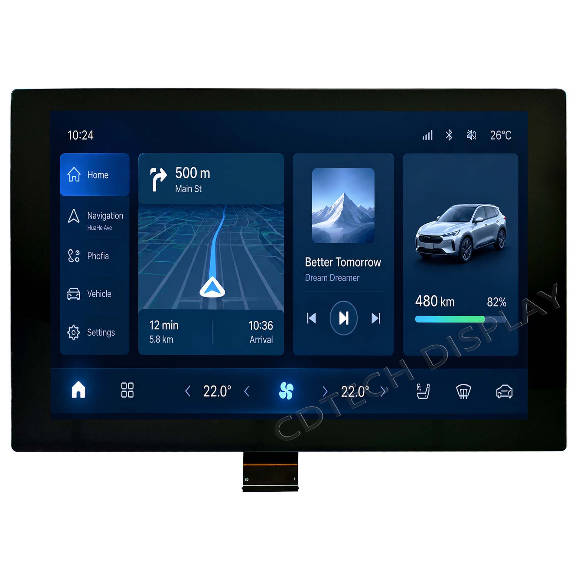
An automotive capacitive touch screen must address several conflicting requirements. It must function well in the presence of strong sunlight, varying temperatures, vibrations, electromagnetic interference, as well as from long reach by the driver. Possible innovations could be adapted coverings, adjusted sensors, EMI protection, larger touch areas or even an entirely different interface. A capacitive touch screen car stereo has to be tested in the vehicle with the intended host, not on a desktop.
How Does a Capacitive Touch Bar Enhance Temperature Control Interfaces?
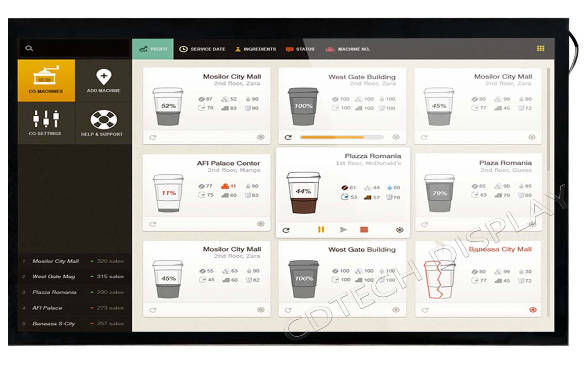
A capacitive touch bar can offer a flexible combination of status information and controls on a very narrow appliance surface. For fully automatic temperature control with capacitive touch for example the status information for the set point, the timer and the operating status can be displayed on the bar while the user is tapping or swiping. All aspects which could jeopardize this improvement have to be checked, such as moisture, cleaning agents, gloves, false touches and the readability at the typical installation angle.
How Do Custom Capacitive Touch Panels Support OEM Innovation?
Innovative OEM solutions are often created using panels that match the shape of the product rather than forcing the product’s enclosure to fit a standard rectangular shaped panel. Custom capacitive touch solutions can modify the cover, active area, printed border, bonding, FPC, controller, surface finishing and connection interfaces. When creating a custom touch screen request, link each modification to a drawing and test case. The best customization is the smallest modification required to solve a mechanical or user problem that can still be tested in production.
Which Touch Panel Features Can Be Customized for OEM Applications?
A custom capacitive touch screen manufacturer can support thick cover glass, gloving, water-resistant touch and active or passive stylus. Customization options for touch surfaces are anti-glare (AG), anti-fingerprint (AF), anti-reflective (AR) coatings as well as a combination of 3A surface coatings and surface processing for UV protection. The mechanical drawings, bonding materials, touch controller settings and flexible printed circuit (FPC) revisions need to be managed by the factory. Each feature that has been customized should be represented by samples, be tested with defined test procedures and be managed with controlled revision records.
How Do PLS LCD, OLED and Touch Technologies Affect Display Design?
A PLS LCD capacitive touchscreen is a backlit LCD display that can be touched using capacitive touch sensing. An OLED capacitive touchscreen uses a self-emissive display. The choice of display has significant implications for luminance, thermal design, power, black level, image retention, wall thickness and supply voltage. Neither of these display types is necessarily better than the other.
The choice between resistive touchscreens and capacitive touchscreens is a separate engineering decision. The input on a resistive touchscreen can be based on pressure and thus can be conducted with fingers, gloves or passive styluses. Projected capacitive (PCAP) touchscreens are better suited for multi-touch gestures, a smooth cover-glass surface and today’s graphical user interfaces. The performance of PCAP touchscreens with thick gloves, moisture or water droplets depends on the sensor and the controller settings.
When selecting a project, OEM teams should compare input methods, glove thickness, wet-operation requirements, touch points, optical performance, cover-glass thickness, mechanical integration and total system cost. Validation of the selected solution against the intended enclosure, environment and host controller is also required.
Which Manufacturing Signals Show That Innovation Can Scale?
Lab breakthroughs need stable material control, reproducible assembly and a quality file. The innovation team must explain how glass, sensors, controllers, bonding, FPC and final inspection are controlled in production. The buyer must link each claimed improvement to the corresponding production control and sample measurement results.
What Should Buyers Verify in a Capacitive Touch Panel Manufacturer?
Such a review would cover process ownership, the scope of equipment used, incoming inspection, change control, traceability of components, the firmware revision level and the ability to deliver a complete module. In a custom capacitive touch display proposal LCD, PCAP, cover glass, controller, bonding and interfaces should all be described in some detail rather than the term “touch” being described as some sort of after market accessory. This is how a buyer views a capacitive touch panel manufacturer and should not be confused with a market label.
How Should Innovation Teams Test Touch Durability and Interfaces?
Tests should match the use case: repeated contact, gloves, moisture, cleaning, temperature, electromagnetic noise, sunlight and host timing. Record touch accuracy, false activation, recovery behavior, optical change and interface stability. A supplier should explain the fixture and acceptance criteria so the result can be repeated at pilot and production stages.
.jpg)
How Does CDTech Turn Touch Innovation Into Deployable Modules?
At CDTech, we can review China capacitive touch panel requirements as an integrated LCD, PCAP, cover, bonding and interface program. Our verified capabilities include custom cover glass, thick-cover, waterproof and glove touch, active or passive pens, AG/AF/AR/3A/UV treatments, custom CTP FPC and USB or IIC touch interfaces. We connect an innovation idea to drawings, samples and model-specific validation rather than presenting an unverified universal promise.
Which Custom Capacitive Touch Display Capabilities Can CDTech Review?
Our custom capacitive touch display route can combine a TFT-LCD module with PCAP, optical or air bonding, a selected controller and an FPC suited to the host. Our product records include industrial, automotive, smart-home and medical touch-display applications, including bar formats. Exact brightness, temperature, interface and EMI values remain tied to the selected model.
What Should an OEM Include in a China Capacitive Touch Panel Brief?
Please provide the use case, the mechanical drawing, the active area, cover thickness, touch tool, glove or water conditions, target luminance, all interfaces, operating range, EMC limits, test sequence and amount of tests. At CDTech we then can determine which innovation is relevant for you, which fields of application need a customization and which claims you can support with samples before we go to production.
FAQ
Q: What Is the Most Useful Definition of China Capacitive Touch Panel Innovation?
Q: What is a feature change for your product? A: A feature change is a measurable change in the area of sensing, optics, mechanics, software or manufacturing that fixes a problem for your product and is repeatable in the host product you are testing.
Q: How Should Buyers Compare Capacitive Touch Panel Manufacturers?
B: Compare process ownership, drawings, sample evidence, environmental testing, interface control, revision management and production traceability. A strong innovation claim must have a test method.
Q: How Should OEMs Choose Between Resistive and Capacitive Touchscreens?
A: This decision is dependent upon several factors, including the environment that the application will be used in, the type of input that the application requires, and the type of interaction that the user will have with the screen. The resistive touchscreen is best suited for a number of applications that utilize a pressure-based input, such as signature capture, and can support the use of many different types of gloves and passive styluses. The capacitive touchscreen, on the other hand, is typically preferred for multi-touch gestures and provides a smooth touch surface that looks and functions great with graphical user interfaces. Other factors that should be evaluated are wet-touch, glove thickness, optical requirements, mechanical requirements, controller requirements, and total system cost.
Post Search
Related Articles
-

Capacitive vs Resistive Touch Screen Car Stereo: Which Is Right for You?
-

TN LCD vs IPS LCD: How to Choose the Right Display for You
-

Capacitive Touch Panel or Resistive: Which Suits Your Needs?
-

Why Choose an IPS LCD Panel for Your Next Screen Purchase?
-

CDTECH to Showcase Cutting-Edge Display Solutions at SID 2025
-

Comparing Different Types of Displays in Cars: A Detailed Overview
-
White Spots on LCD Screen: Causes, Fixes & Industrial Solutions (2026 Guide)