
How Can You Achieve 1000+ Nits in Ultra-Thin Bar LCD Formats?
 2026-04-26
  21:21
21:21 

Achieving 1000+ nits in ultra-thin bar LCD formats requires optimized LED array design for high-density light output, OCA optical bonding to eliminate air gaps and boost transmission, and advanced thermal management to sustain brightness in thin vertical spaces. CDTech integrates these in-house with patented 2nd Cutting technology for custom bar sizes.
Check: How Does Patented 2nd Cutting Solve Stretched TFT LCD Challenges?
What Makes Custom Backlight Design Critical for High-Nit Bar LCDs?
Custom backlight design is essential because standard bar LCDs max at 500-800 nits due to thermal limits in thin profiles, while automotive dashboards and industrial HMIs demand 1000+ nits for sunlight readability. CDTech’s full in-house chain enables precise LED optimization, OCA bonding, and heat control without compromising <5mm stacks.
Off-the-shelf panels face vertical space constraints that limit LED density and heat dissipation, causing hotspots and brightness decay. Market needs in automotive and industrial sectors push for wide-angle IPS panels like CDTech’s S070QWU142FN-FL150-GF at 1300-2300 nits. Engineering balances power, optics, and cooling for reliable high-nit performance across -30°C to +85°C.
How Does LED Strip Engineering Maximize Brightness in Thin Profiles?
LED strip engineering maximizes brightness by using high-efficiency LEDs in dense arrays with optimized PCB layouts for even light distribution, paired with PWM dimming for scalable output up to 2300 nits while managing heat in <5mm profiles. CDTech models these for uniformity in bar formats.
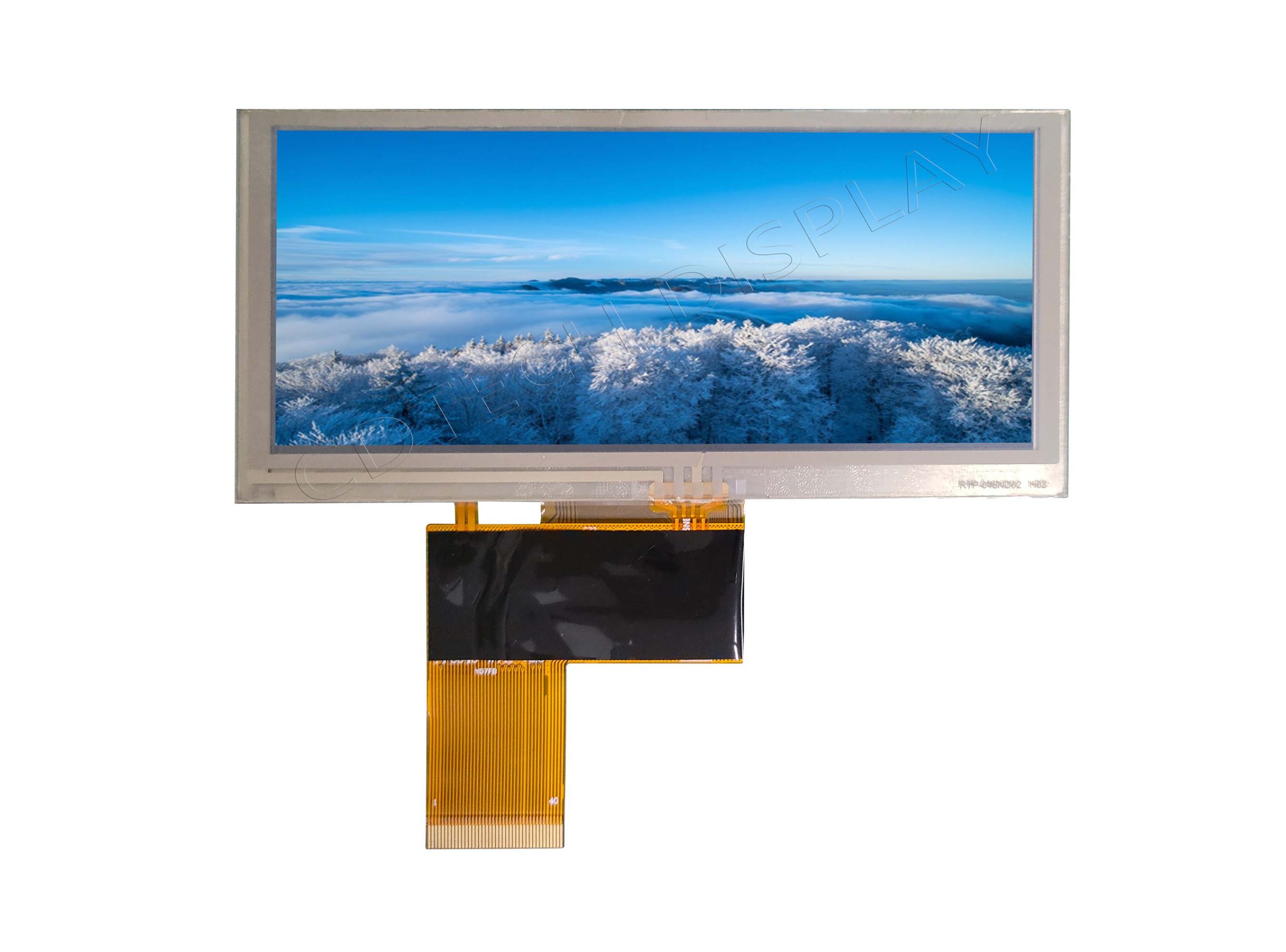
High-density white LED strips ensure uniform illumination across stretched apertures, as in CDTech’s 7.0″ S070QWU142FN-FL150-GF (1200×1920, 1300 nits at 240mA or 2300 nits at 400mA, MIPI interface). Custom spacing prevents hotspots, and FEA simulations predict thermal behavior. PWM control allows 5-100% dimming, maintaining color stability in industrial temps (-20°C~+70°C).
| Specification | Standard LED Strip | CDTech Custom LED Strip (1000+ Nit) |
|---|---|---|
| Brightness Output | 500–800 nits | 1000–2300 nits |
| Vertical Profile | 3–4mm | <5mm (with OCA) |
| Operating Temp Range | 0°C~+60°C | -30°C~+85°C |
| Dimming Range | 10–100% | 5–100% (PWM) |
What Role Does Optical Bonding Play in Achieving Peak Light Output?
OCA optical bonding eliminates air gaps between LCD and backlight, reducing reflection losses by 8-10% and increasing effective brightness by 10-15% without extra power. CDTech’s in-house lamination integrates this with touch for thin, high-nit bar LCDs.
Check: Stretched LCD
Air bonding loses light to Fresnel reflections; OCA’s refractive index matching (n≈1.48-1.50) maximizes transmission, enhancing contrast in sunlight. Examples include CDTech’s S043HWV104EN-FL63 (4.3″ bar, 800 nits, optical bonded CTP) and S101ZWX89FP-FC86 (10.1″, 1500 nits, optical bonded). This supports -20°C~+70°C operation in industrial applications.
How Do You Manage Thermal Dissipation in Ultra-Thin Vertical Stacks?
Manage thermal dissipation with custom aluminum heat-sinks, high-conductivity TIMs like graphite pads, and lateral heat spreaders to direct heat from LEDs to edges, ensuring <10°C rise at 1000+ nits in thin bars. CDTech’s automotive-grade designs handle -30°C~+85°C passively.
For bars like S070QWU142FN-FL150-GF (2300 nits max), heat-sinks (10-15mm deep) couple via TIMs (>3 W/mK) to the frame. ERP traceability and testing validate performance. Passive cooling suffices for most; active options for extremes ensure reliability in HMI and automotive uses.
What Is CDTech’s Patented 2nd Cutting Technology and Why Does It Matter?
CDTech’s patented 2nd Cutting technology (2017) enables custom LCD sizes by post-processing standard panels, delivering unique bar dimensions like 7.0″×0.7″ without retooling, cutting lead-times to 6-8 weeks and low MOQs for high-nit projects.
Standard makers demand high MOQs for customs; 2nd Cutting supports vertical integration from cutting to OCA bonding. This powers products like S039HWQ12HS (3.9″ bar, 480×128, 500 nits) and stretched automotive panels, reducing NRE costs. Combined with 10,000㎡ factory and Class 1000 clean rooms, it accelerates prototyping for 1,000+ global customers.
CDTech Expert Views
Our 2nd Cutting technology revolutionizes high-nit bar LCD development. Competitors lock customers into standard sizes with 16-week delays and high NRE, but we prototype custom 1000+ nit bars—like our 2300-nit 7″ model—in 6-8 weeks at low MOQ. This speed is vital for automotive dashboards and industrial HMIs, backed by IATF16949 reliability.” — CDTech Engineering Lead
What Certifications and Standards Ensure Reliability in High-Brightness Bar LCDs?
CDTech’s IATF16949, ISO9001, ISO14001, and ISO13485 certifications ensure reliability, with AEC-Q200 testing for thermal cycling (-40°C~+85°C) and vibration. ERP+QR traceability supports audits in automotive and medical apps.
These standards validate wide-temp operation (-30°C~+85°C) in products like S050BWV105EP-FL96-AG (5.0″ automotive, 1000 nits, anti-glare CTP). Full in-house production since 2019 guarantees consistency, serving 1,000+ customers with $30M+ 2023 sales.
How Can You Integrate Custom Backlights with Touch Panels and Connectivity?
Integrate via OCA bonding for CTP touch overlays (<0.5mm added), custom FPCs for traces, and HDMI/MIPI interfaces. CDTech’s designs maintain brightness in bars like S123BWU11EP-FC19-AF-HDMI09-A (12.3″, 900 nits, HDMI+Type-C).
Capacitive I2C touch works seamlessly, as in S043HWV104EN-FL63. EMI shielding protects automotive RF environments. Options include LVDS/RGB for HMIs, enabling plug-and-play with Raspberry Pi or embedded systems.
Which Design Parameters Should You Specify When Requesting a Custom 1000+ Nit Bar LCD Quote?
Specify size (e.g., 7″×0.7″), nits/uniformity, interface (MIPI/HDMI), temp range (-30°C~+85°C), touch type, OCA thickness, MOQ, and certifications. CDTech’s free 2-3 week review includes simulations.
- Display dimensions and resolution
- Brightness target and dimming
- Interfaces: RGB/LVDS/MIPI/HDMI
- Touch: PCAP I2C, anti-glare
- Temp: -30°C~+85°C
- Quantity and timeline
Conclusion
Custom backlight design delivers 1000+ nits in ultra-thin bar LCDs through LED optimization, OCA bonding, and thermal engineering—essential for sunlight-readable automotive and industrial apps. CDTech’s 2nd Cutting patent, quad certifications, and vertical integration enable fast, reliable customs for 1,000+ customers. Contact sales@cdtech-lcd.com for a 2-3 week quote.
FAQs
Can you achieve 1000+ nits in a <5mm bar LCD without active cooling?
Yes, CDTech’s passive designs with optimized LEDs and heat-sinks hit 1000-1500 nits in 5mm stacks, as in S101ZWX89FP-FC86 (1500 nits). Active cooling aids extremes like 2300 nits in S070QWU142FN-FL150-GF at high temps.
How does OCA bonding improve brightness compared to air-gap assemblies?
OCA eliminates 8-10% reflection losses, boosting output 10-15% and contrast. Seen in CDTech’s S050HWV18ES-DC95 (1000 nits, air bonded) vs. optical bonded bars for superior sunlight readability.
What is the typical lead-time for a custom 1000+ nit bar LCD project?
6-8 weeks via 2nd Cutting for 100-500 units, including review and prototypes. Larger runs or standards like S043HWQ50EG ship faster at 2-3 weeks.
Are custom 1000+ nit bar backlights compatible with capacitive touch integration?
Yes, OCA integrates CTP without thickness or brightness loss, as in S043HWV104EN-FL63 (800 nits bar with touch) and automotive models.
What certifications does CDTech hold for automotive and medical bar LCD applications?
IATF16949 (automotive), ISO13485 (medical), ISO9001, ISO14001. Supports wide-temp bars like S050BWV125ES (-30°C~+85°C, 1000 nits).
Post Search
Related Articles
-
Capacitive vs Resistive Touch Screen Car Stereo: Which Is Right for You?
-
TN LCD vs IPS LCD: How to Choose the Right Display for You
-
Capacitive Touch Panel or Resistive: Which Suits Your Needs?
-
Why Choose an IPS LCD Panel for Your Next Screen Purchase?
-
CDTECH to Showcase Cutting-Edge Display Solutions at SID 2025
-
Comparing Different Types of Displays in Cars: A Detailed Overview
-
White Spots on LCD Screen: Causes, Fixes & Industrial Solutions (2026 Guide)