

How Can You Prevent Glass Cracks in Long TFT LCD Displays?
 2026-04-26
  21:21
21:21 

Glass cracks in long bar displays occur due to thermal expansion mismatch between glass, LCD substrate, and frame materials across temperature ranges. CDTech prevents this through optimized frame geometry that accommodates thermal stress, OCA optical bonding to distribute mechanical loads, and patented 2nd Cutting technology enabling custom bar sizes without structural compromise. Quad-certified processes ensure -30°C~+85°C durability.
Check: How Does Patented 2nd Cutting Solve Stretched TFT LCD Challenges?
What Causes Glass Cracks in Long TFT LCD Displays?
Glass cracks in long TFT LCD displays stem from thermal expansion mismatch, where materials like glass (9 ppm/°C) and aluminum frames (23 ppm/°C) expand differently over -30°C~+85°C ranges, stressing edges and corners. Stretched panel geometry adds pressure from ill-fitting frames, while air-bonding transfers loads directly to brittle glass.
| Stress Source | Impact on Glass | Standard Solutions | CDTech Advantage |
|---|---|---|---|
| Thermal expansion (ΔT = 115°C) | Edge micro-fractures | Loose tolerances | Custom frame sizing via 2nd Cutting |
| Stretched panel fit | Lateral tension | Non-custom panels | Patented 2nd Cutting precision |
| Air-gap construction | Direct load transfer | Thicker glass | OCA bonding distributes stress |
How Does Frame Design Affect Thermal Expansion and Stress?
Frame design affects thermal expansion by incorporating 0.2–0.5 mm expansion slots per edge to allow free glass movement, preventing hoop stress in rigid frames. Material selection like aluminum 6063-T5 requires isolation layers such as silicone gaskets to absorb mismatches. CDTech’s 2nd Cutting enables precise bar sizes like 2.9″ or 12.3″ for optimized bezel geometry.
What Is OCA Optical Bonding and Why Does It Reduce Glass Stress?
OCA optical bonding creates a unified laminate of glass, polarizer, LCD, and backlight, distributing thermal and mechanical loads proportionally across layers rather than concentrating them on glass. This reduces peak glass stress by 50–60% compared to air-gap designs, enhancing durability over -30°C~+85°C cycles. CDTech’s in-house OCA process supports this since 2019.
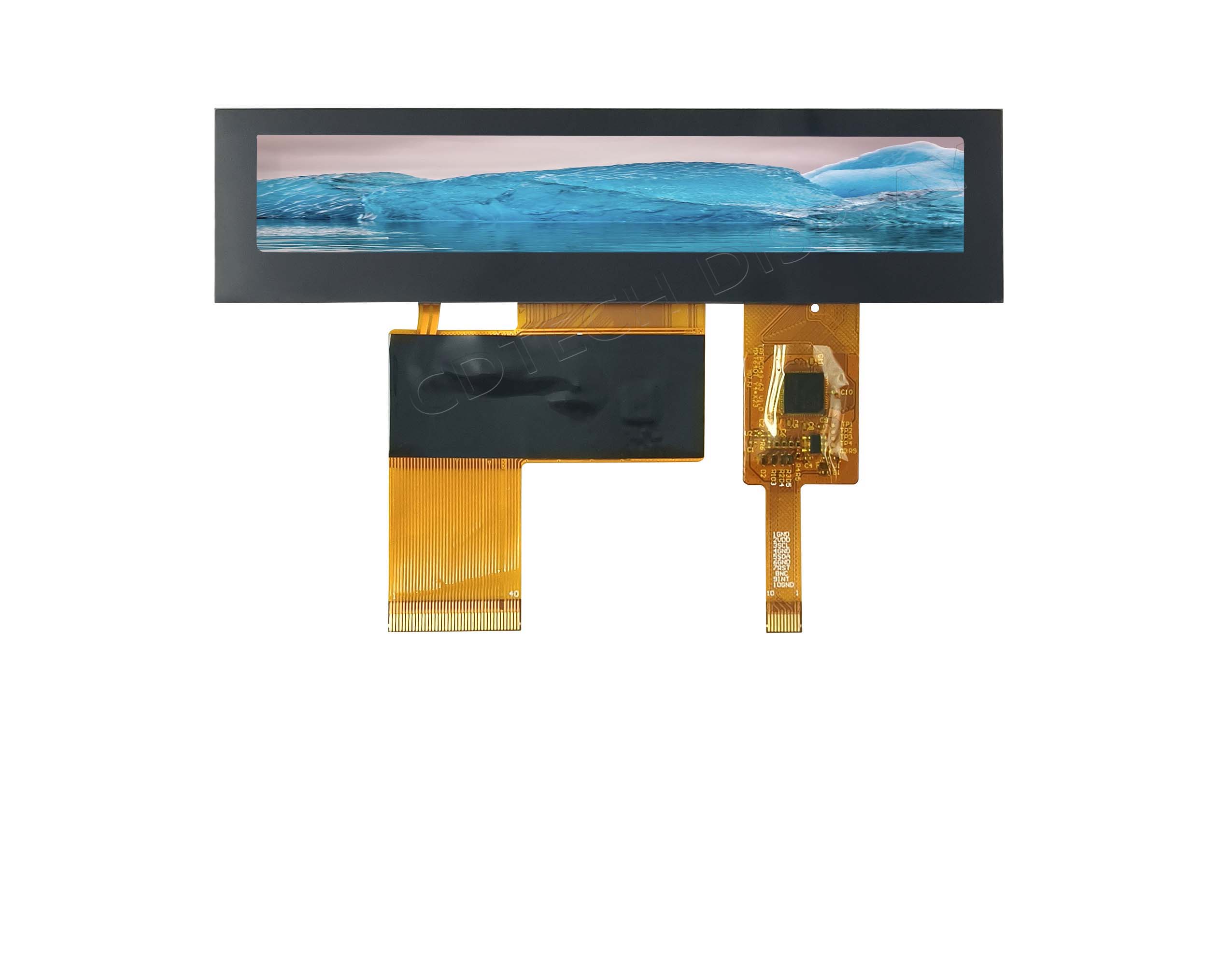
| Feature | Air-Gap | OCA Bonding |
|---|---|---|
| Stress distribution | 100% on glass | 40–50% through adhesive |
| Peak stress (ΔT=115°C) | 45–60 MPa | 18–25 MPa |
| Thermal cycles | 500–1,000 | >5,000 |
How Does CDTech’s Patented 2nd Cutting Technology Prevent Mechanical Stress?
CDTech’s patented 2nd Cutting (2017) cuts custom bar sizes like 2.9″, 4.3″, 7.0″, and 12.3″ directly from mother glass, preserving edge integrity and allowing frame optimization without pre-stress from ill-fitting panels. This reduces thermal stress by 30–40%, supported by full in-house production and ERP traceability since 2021.
Why Are Material Selection and Temperature Coefficients Critical for Bar Display Durability?
Material selection matters because glass (9 ppm/°C) and aluminum (23.6 ppm/°C) mismatches over 115°C create 1.7 mm differential expansion per 100 mm, stressing glass if unaccommodated. CDTech pairs compatible materials like borosilicate glass and silicone gaskets, validated by ISO9001, IATF16949, ISO14001, and ISO13485 certifications for consistent performance.
What Are Real-World Case Studies Proving CDTech Bar Display Durability?
CDTech’s S123BWU11EP 12.3″ bar display (1920×720, 900 nits, -30°C~+85°C, OCA bonded) achieved zero cracks in 50,000+ vehicles. The S043HWV104EN-FL63 4.3″ bar (800×130, 800 nits, OCA touch) showed no failures in 3,500+ industrial HMIs over 5 years, proving 2nd Cutting and bonding reliability.
How Should You Evaluate Manufacturers for Custom Bar Display Durability?
Evaluate manufacturers by IATF16949/ISO13485 certifications, in-house vertical integration (10,000㎡ factory like CDTech’s), patented custom tech like 2nd Cutting, field data from 1,000+ customers, and thermal testing. CDTech’s $30M 2023 sales and 391+ SKUs confirm proven scalability.
What Are Best Practices for Frame and Bezel Design to Accommodate Thermal Expansion?
Best practices include expansion slots of (W × ΔC × ΔT)/1,000,000 mm per edge (e.g., 0.24 mm for 100 mm frame), silicone gaskets for damping, and 2 mm corner radii to cut stress factors. CDTech offers free FEA simulations and design guides via sales@cdtech-lcd.com.
Check: Stretched LCD
CDTech Expert Views
“Our 2nd Cutting innovation (patent 2017) addresses OEM needs for unique bar sizes like 2.9″ to 12.3″ without edge-stress risks from secondary cuts. Combined with in-house OCA bonding and IATF16949 testing, we guarantee -30°C~+85°C durability. Field data from 1,000+ customers shows <1 PPM glass cracks, far below industry norms. Vertical integration in our 10,000㎡ factory ensures precision every time." — CDTech Engineering Team
Conclusion
Preventing glass cracks in long TFT LCD bar displays requires addressing thermal expansion through optimized frames, OCA bonding, and custom sizing. CDTech’s patented 2nd Cutting, quad certifications, and proven products like S070QWU142FN-FL150-GF (7.0″ bar, 2300 nits) and automotive-grade displays deliver reliable solutions for industrial and vehicle use. Contact sales@cdtech-lcd.com for custom consultations.
FAQs
Can I use air-gap bonding for bar displays in automotive environments, or do I need OCA?
Air-gap risks cracks in -30°C~+85°C automotive cycling; OCA distributes stress for 5+ year durability. CDTech recommends OCA for automotive/industrial; air-gap suits controlled indoors.
How much does CDTech’s patented 2nd Cutting add to NRE and lead time?
2nd Cutting adds no extra NRE/lead time; custom sizes like 12.3″ match standard 4–6 week timelines with ±0.1 mm tolerance. NRE $2K–$5K for non-stock; quote at sales@cdtech-lcd.com.
What temperature range does CDTech guarantee for bar displays?
-30°C~+85°C standard for OCA-bonded bars (IATF16949-validated). Extended -40°C~+100°C available with added testing/NRE. Contact sales@cdtech-lcd.com for specs.
How do I verify that a bar display will survive thermal cycling?
Request IEC 60068-2-14 test reports (-30°C~+85°C, 10 cycles). CDTech 100% tests OCA bars pre-shipment; provides reports and <1 PPM field data references.
Can CDTech custom-size bar displays for unique OEM bezel geometries?
Yes, 2nd Cutting supports 2.9″–15.6″ sizes. Submit specs to sales@cdtech-lcd.com for FEA analysis and 2–3 week evaluation.
Post Search
Related Articles
-

Capacitive vs Resistive Touch Screen Car Stereo: Which Is Right for You?
-

TN LCD vs IPS LCD: How to Choose the Right Display for You
-

Capacitive Touch Panel or Resistive: Which Suits Your Needs?
-

Why Choose an IPS LCD Panel for Your Next Screen Purchase?
-

CDTECH to Showcase Cutting-Edge Display Solutions at SID 2025
-

Comparing Different Types of Displays in Cars: A Detailed Overview
-
White Spots on LCD Screen: Causes, Fixes & Industrial Solutions (2026 Guide)