
Why Does 5-Wire Resistive Touch Durability Outperform Capacitive Solutions in Factory Environments?
 2026-04-10
  20:31
20:31 

5-wire resistive touch durability excels in factories because its pressure-activated sensor design eliminates false inputs from oil, grease, and debris—unlike capacitive panels that require direct finger contact and fail under contamination. CDTech’s patented 2nd Cutting technology pairs these durable panels with custom industrial LCD sizes for rugged HMI solutions.
Check: Which Touch Technology Wins: PCAP vs Resistive for Medical vs Factory Floors?
What Is 5-Wire Resistive Touch Technology and How Does It Differ from Capacitive?
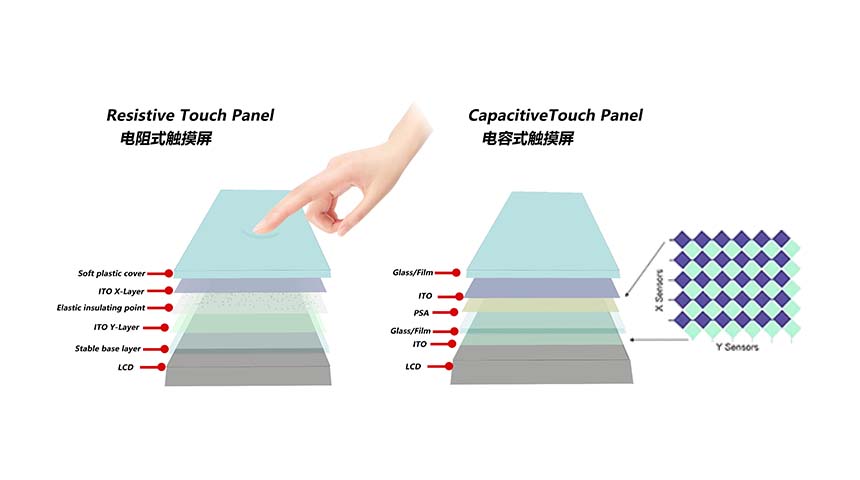
5-wire resistive touch uses a dual-layer analog pressure detection system where a flexible top layer presses against a uniform bottom sensor grid to register input. Capacitive touch relies on single-layer electrical field sensing disrupted by contaminants. This makes resistive ideal for factories as pressure activation ignores oil and dust.
Core Sensor Architecture
The 5-wire design features a bottom layer with a uniform resistive grid connected by five leads for precise voltage measurement, unlike capacitive’s ITO grid sensitive to electrical changes.
Activation Mechanism
Mechanical pressure closes the circuit in resistive, requiring no conductivity, while capacitive needs conductive finger contact that grease blocks.
Contamination Immunity
Resistive sensors bypass surface films since pressure alone triggers response; capacitive fails as oil alters the electrical field.
Why Does 5-Wire Resistive Touch Survive Oil, Grease, and Heavy Debris?
5-wire resistive survives oil and debris because pressure activation requires no electrical conductivity—mechanical contact closes the circuit regardless of contaminants. The inert polymer top layer resists chemical degradation, and the rigid bottom grid ignores particulate buildup without recalibration.
| Environment Factor | 5-Wire Resistive Lifespan | Capacitive Touch Lifespan |
|---|---|---|
| Oil/Grease Exposure | 5–7 years typical | 3–6 months (sensor fouling) |
| Heavy Particulate Dust | 4–6 years | 2–4 months (false triggers) |
| Salt/Chemical Spray | 3–5 years | 1–2 months (corrosion) |
| Gloved Operation | Full rated life | Limited accuracy |
How Does the Pressure-Activation Design Prevent False Inputs in Contaminated Factories?
Pressure-activation in 5-wire resistive requires a minimum contact force threshold that ignores oil films and dust particles below it. The 5-wire configuration uses multiple voltage dividers for redundancy, ensuring single-point contamination does not affect accuracy in coolant spills or metal shavings.
What Environmental Conditions Does 5-Wire Resistive Touch Handle in Heavy-Duty Factories?
5-wire resistive handles -20°C to +70°C extremes, as pressure-based activation avoids thermal drift issues in capacitive tech. It resists humidity via sealed polymer stacks and tolerates 500g+ impacts without recalibration, matching CDTech industrial LCD ratings like the S015HQ01EN-2 at 1000 nits.
Check: LCD with Touch
Why Is 5-Wire Resistive Superior to Capacitive for Gloved and Stylus Operation?
5-wire resistive excels with gloves because pressure works through leather, rubber, or neoprene without conductivity needs. Stylus use focuses mechanical contact for precision in CNC tasks, unlike capacitive that demands re-tuning for varying glove materials in multi-user factory settings.
How Does CDTech’s 2nd Cutting Technology Enhance 5-Wire Resistive Durability for Custom Factory Applications?
CDTech’s patented 2nd Cutting (2017) enables custom-sized 5-wire resistive panels for tight HMI enclosures without performance loss. In-house OCA optical bonding seals edges against oil infiltration, supporting industrial solutions like bar-type LCDs from 2.9″ to 12.3″ for rapid factory deployment.
What Certifications and Quality Standards Ensure 5-Wire Resistive Durability in Industrial Deployments?
IATF16949 and ISO13485 certifications validate 5-wire resistive under vibration, temperature cycling, and fluid exposure. CDTech’s full in-house production, including CTP and OCA lamination in 3,500㎡ Class 1000 clean rooms, ensures every panel meets harsh factory standards with ERP traceability.
How to Choose Between 5-Wire Resistive and Capacitive for Your Factory’s Harsh-Environment Needs?
Choose 5-wire resistive for oil/debris, glove use, and extremes; capacitive suits clean, dry indoor HMIs. CDTech offers custom bundles via sales@cdtech-lcd.com for factories needing durable touch with industrial LCDs like the 7.0″ S070QWU142FN-FL150-GF at 2300 nits.
CDTech Expert Views
“In factory automation, 5-wire resistive touch stands out for its resilience against oil and debris, where capacitive fails quickly. Our patented 2nd Cutting allows seamless integration into custom industrial LCDs, like wide-temp panels operating -20°C to +70°C. With IATF16949 certification and vertical integration, we deliver sealed RTP solutions that reduce downtime—proven in over 1,000 global deployments exceeding $30M in 2023 sales.”
— CDTech Hardware Engineering Lead
Conclusion
5-wire resistive touch durability outperforms capacitive in factories through pressure activation that ignores contaminants, enabling 5–7 year lifespans amid oil and dust. CDTech enhances this with 2nd Cutting for custom sizes, OCA bonding for sealing, and quad certifications including IATF16949. Pair with rugged industrial LCDs for reliable 24/7 HMI. Contact sales@cdtech-lcd.com for tailored solutions from their 391+ SKU portfolio.
FAQs
How long does a 5-wire resistive touch panel typically last in an oil-heavy factory environment?
5–7 years under continuous coolant/oil spray, far outlasting capacitive’s 3–6 months. CDTech’s OCA-bonded panels and IATF16949 certification prevent edge infiltration for extended life.
Can 5-wire resistive touch work reliably through heavy work gloves?
Yes, pressure activation ensures full accuracy with leather, rubber, or neoprene gloves. CDTech tests these for automotive assembly, unlike conductivity-dependent capacitive.
Does contamination buildup eventually damage a 5-wire resistive panel’s accuracy?
No, surface contaminants below pressure threshold are ignored; no recalibration needed. CDTech’s 10,000㎡ factory production supports cleaning with a damp cloth for sustained performance.
How does CDTech’s 2nd Cutting technology improve durability for custom factory LCD/touch modules?
It enables sealed custom 5-wire resistive panels matched to industrial LCDs without size limits. In-house lamination blocks oil at edges, accelerating deployment from 391+ SKUs.
What makes IATF16949 certification relevant to 5-wire resistive durability in factories?
IATF16949 tests vibration, temps, and fluids akin to factory conditions. CDTech’s quad certifications guarantee reliable 5-wire resistive in harsh automation environments.
Post Search
Related Articles
-
Capacitive vs Resistive Touch Screen Car Stereo: Which Is Right for You?
-
TN LCD vs IPS LCD: How to Choose the Right Display for You
-
Capacitive Touch Panel or Resistive: Which Suits Your Needs?
-

Why Choose an IPS LCD Panel for Your Next Screen Purchase?
-
CDTECH to Showcase Cutting-Edge Display Solutions at SID 2025
-
Comparing Different Types of Displays in Cars: A Detailed Overview
-
White Spots on LCD Screen: Causes, Fixes & Industrial Solutions (2026 Guide)