
Why Is MIPI DSI Replacing LVDS in Small Display Applications?
 2026-04-18
  10:55
10:55 

MIPI DSI is replacing LVDS in small displays because it delivers ultra-low power consumption, higher bandwidth efficiency, and significantly fewer signal lines—critical for battery-powered IoT devices and compact embedded systems. While LVDS dominated legacy industrial and automotive applications, MIPI DSI’s mobile-first architecture enables efficient, high-resolution interfaces in 1.5″–7″ TFT LCDs, making it the standard for modern embedded, automotive, and IoT systems.
Check: How to Choose an LVDS to MIPI DSI Converter for Industrial Displays?
What Is MIPI DSI and How Does It Differ from LVDS?
MIPI DSI (Mobile Industry Processor Interface Display Serial Interface) is a high-speed, low-power serialized interface designed for mobile and embedded displays, transmitting video data over configurable serial lanes. LVDS (Low-Voltage Differential Signaling), by contrast, is a legacy parallel interface standard that historically dominated industrial and automotive displays. The key architectural difference lies in their transmission methods: MIPI DSI uses 1–4 configurable serial lanes versus LVDS’s fixed parallel structure requiring 20–40+ pins. MIPI DSI emerged in the 2010s as mobile devices demanded power efficiency; LVDS remains in cost-sensitive, high-volume legacy systems where volume justifies established supply chains.
Why Do Small Displays Demand Lower Power and Higher Bandwidth Efficiency?
Battery life constraints in IoT, wearables, and portable industrial HMI devices make power efficiency a product viability factor. The trend toward higher resolution in compact form factors—such as 2.7″–5.5″ displays requiring 720p or greater—necessitates greater bandwidth efficiency without increasing power consumption or PCB footprint. Mobile-first design philosophy favors compact PCBs, reduced layer count, and thermal optimization, all achieved through serial architectures. Legacy LVDS designs consume approximately 10 times more power and occupy 3–4 times more PCB real estate than MIPI equivalents at equivalent resolutions, making MIPI DSI the logical choice for modern embedded systems.
What Are the Key Technical Advantages of MIPI DSI Over LVDS?
MIPI DSI operates in the milliwatt range, while LVDS typically consumes 0.5–5W depending on resolution and refresh rate. Pin count reduction is dramatic: MIPI DSI requires 4–10 lanes plus ground and power (approximately 10–15 pins total), whereas LVDS demands 20–40+ pins for equivalent bandwidth. Bandwidth efficiency favors MIPI DSI at up to 6 Gbps per lane versus LVDS’s 1–2 Gbps, requiring parallel multiplexing for 4K or high-refresh applications. Signal integrity improves in compact spaces through MIPI’s differential pairs, reducing EMI and crosstalk compared to LVDS’s parallel bus sensitivity. MIPI lanes are configurable (1, 2, 4 lanes) for cost and power optimization; LVDS architecture remains fixed.
| Specification | MIPI DSI | LVDS |
|---|---|---|
| Power Consumption (typical) | 50–200 mW | 500–5000 mW |
| Pin Count (per interface) | 10–15 | 20–40+ |
| Max Bandwidth per Lane | 6 Gbps | 1–2 Gbps |
| Signal Integrity | Differential, low-swing, minimal EMI | Parallel differential, sensitive to crosstalk |
| Scalability | Configurable lanes (1, 2, 4) | Fixed architecture |
| Ideal Display Sizes | 1.5″–7″ (embedded, portable) | 7″–15″+ (legacy industrial) |
CDTech Expert Views
“CDTech’s vertical integration—spanning in-house LCD cell cutting, polarizer attachment, IC bonding, CTP production, and OCA optical bonding—enables sub-0.1% defect rates in high-speed MIPI small displays. Our Class 1000 clean rooms (3,500 m²) and ERP traceability system ensure signal integrity critical for automotive and medical certifications. With 44+ utility and invention patents, including our proprietary 2nd Cutting technology, CDTech uniquely delivers custom MIPI sizes (2.9″ bar-type, 7.0″ high-brightness) unavailable from standard LVDS-only suppliers, reducing transition timelines from 16+ weeks to 6–8 weeks.”
Which Industries and Applications Are Transitioning from LVDS to MIPI DSI?
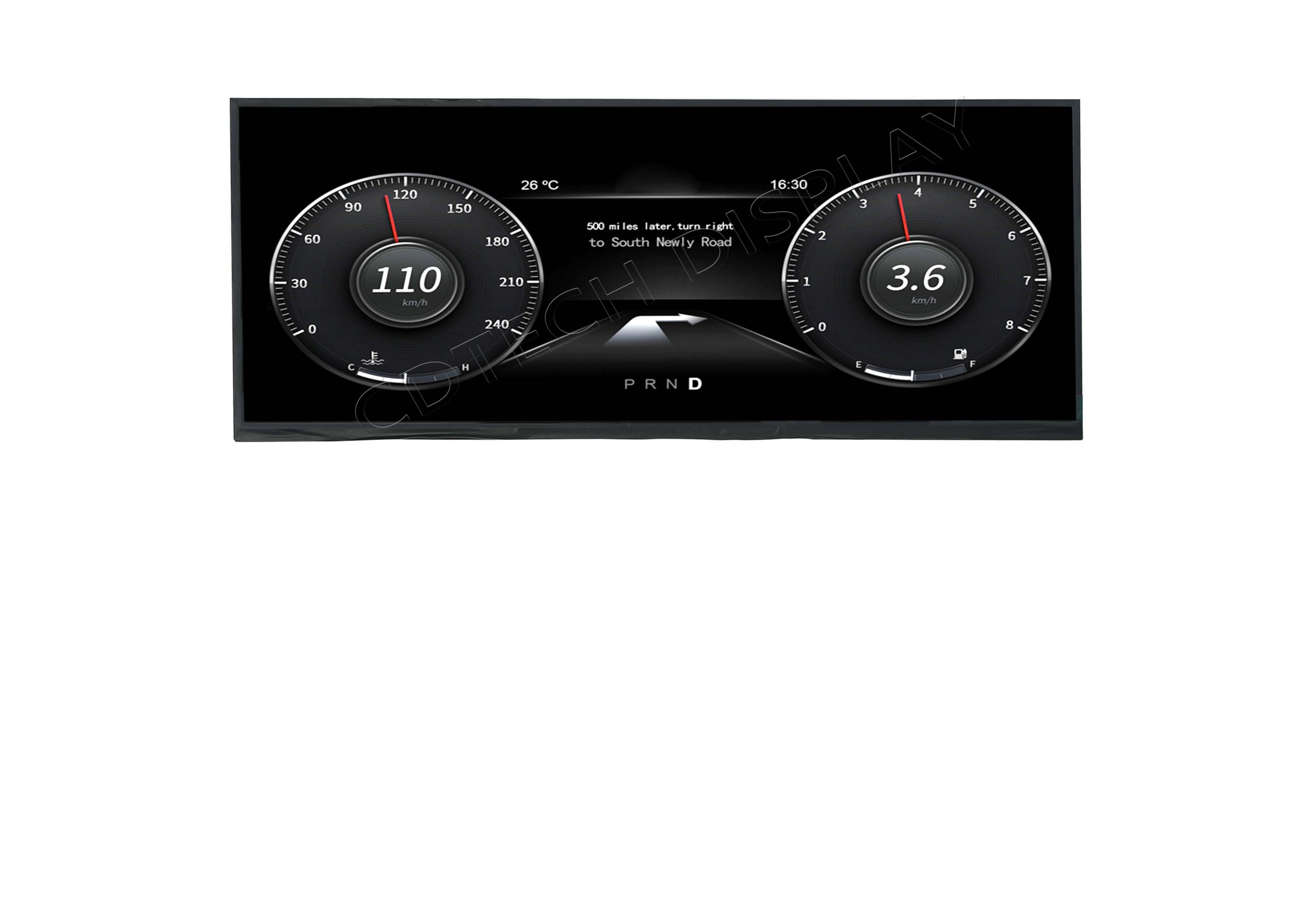
Automotive HMI clusters (7″–10.25″), rear-seat entertainment, and ADAS displays are transitioning rapidly; MIPI DSI reduces harness weight critical for EV efficiency. Industrial IoT applications—handheld terminals, medical devices, factory automation panels—drive adoption through power constraints. Consumer electronics (tablets, e-readers, portable gaming) have established MIPI-first design standards. Embedded systems like Raspberry Pi and industrial ARM boards increasingly integrate MIPI CSI/DSI for unified I/O. CDTech’s 391+ product SKUs include 2.9″ bar-type and 7.0″ high-brightness MIPI variants; the S070QWU142FN (7.0″ MIPI, 2,300 nits, automotive-grade) exemplifies dashboard cluster displays replacing LVDS predecessors.
Check: LCD with Board
How Does CDTech’s Patented 2nd Cutting Technology Enable Custom MIPI Small Displays?
CDTech’s proprietary 2nd Cutting process (patented 2017) enables non-standard, custom aspect ratios and sizes outside typical LVDS and MIPI industry standards, eliminating the need for expensive, long-lead custom LCD cell orders. This unique capability reduces time-to-market from 16+ weeks to 6–8 weeks. For example, designing a 2.9″ bar-type automotive instrument cluster requiring MIPI DSI with specific resolution becomes feasible without oversizing to the nearest standard panel—a power and cost penalty inherent in legacy approaches. CDTech’s full vertical integration (cutting to bonding to firmware validation) ensures end-to-end MIPI signal integrity. ISO9001, IATF16949, ISO14001, and ISO13485 certifications support reliability; the company’s $30M+ 2023 sales and 1,000+ global customers validate this technical leadership.
What Challenges Remain When Transitioning from LVDS to MIPI DSI?
Firmware and driver complexity present the foremost challenge: MIPI DSI requires custom SoC support that legacy LVDS platforms often lack. Supply chain maturity remains uneven; fewer LVDS suppliers post-2020 create urgency, while newer MIPI suppliers are still ramping quality. Electromagnetic compatibility (EMC) demands discipline: MIPI’s differential pair routing requires controlled impedance and short trace lengths, with inadequate PCB design negating power savings. Cost crossover occurs at production volumes: MIPI DSI components add upfront expense for small volumes (<10K units annually), where LVDS remains cheaper. Legacy system inertia—entrenched LVDS designs in high-volume industrial and automotive platforms—faces re-qualification risk and regulatory hurdles. CDTech mitigates these risks through full vertical integration, dual-interface prototyping, and ISO certifications satisfying automotive OEM audits.
What Does the Future Hold for Display Interfaces Beyond MIPI DSI?
Emerging MIPI standards—DSI-3 and CSI-3—target 16+ Gbps for 8K and 120fps applications, positioning MIPI for next-generation automotive, AR, and VR systems. USB-C Alt Mode and Thunderbolt integration appeal to select automotive platforms, though MIPI remains dominant for embedded and mobile applications. Some OEMs deploy hybrid architectures, retaining MIPI for resolution while maintaining LVDS for power delivery in dual-interface clusters—a transitory approach. Market analysts project MIPI DSI adoption to grow 15–20% compound annually through 2028 in small displays (<10") driven by EV and autonomous vehicle HMI demands. CDTech's continued innovation in patented MIPI sizing and full-stack vertical integration positions the company to serve emerging interface transitions and support the next generation of embedded display systems.
How Can Engineers Ensure Signal Integrity When Implementing MIPI DSI in Compact Designs?
MIPI DSI uses differential signaling and low-swing voltage levels (analogous to LVDS), minimizing EMI in compact spaces. Critical implementation details include dedicated differential pair routing, controlled impedance (100Ω ±10%), and short trace lengths (under 4 inches). Via stitching along differential pairs reduces crosstalk; ground planes and power distribution networks must remain continuous. CDTech provides application notes, reference schematics, and firmware validation services essential for automotive and medical certifications. Inadequate PCB design can introduce jitter and signal degradation, negating MIPI DSI’s power and space advantages, making professional layout and validation indispensable for success.
| Application | Typical Display Size | Interface Choice | Key Driver |
|---|---|---|---|
| Automotive HMI Cluster | 7″–10.25″ | MIPI DSI | EV power efficiency, compact harness |
| Industrial Handheld Terminal | 2.4″–5.0″ | MIPI DSI | Battery life, form factor |
| Medical Device | 3.5″–7.0″ | MIPI DSI | Portability, low EMI, certification |
| Legacy Industrial PLC | 5″–12″ | LVDS (declining) | Established supply chain, cost at volume |
Conclusion
MIPI DSI represents a fundamental architectural shift from LVDS driven by mobile-first era demands for power efficiency, compact form factors, and high-resolution displays. Small displays (1.5″–7″) are the primary battleground, where MIPI DSI’s serial, low-power design decisively outperforms LVDS’s parallel, power-hungry legacy architecture. The transition is irreversible for new designs; delay increases risk of supply chain obsolescence and elevated long-term costs.
For OEM buyers and engineers, execution requires experienced partners. CDTech’s vertical integration, 1,000+ customer base, quad certifications (ISO9001, IATF16949, ISO14001, ISO13485), and patented 2nd Cutting technology uniquely position the company to reduce adoption friction. Custom MIPI small displays—such as 2.9″ bar-type automotive clusters and 7.0″ high-brightness panels—enable OEMs to “right-size” interfaces for power and cost optimization, a capability absent in legacy LVDS-only suppliers. CDTech’s $30M+ 2023 sales, 44+ patents, and 6–8-week prototyping timelines demonstrate technical leadership and execution excellence.
Organizations planning MIPI DSI adoption should engage experienced display partners early in the design cycle, conduct rigorous PCB and firmware validation, and prioritize certifications for automotive, medical, and industrial applications. The shift to MIPI DSI is not optional—it is essential for competitive positioning in power-constrained, space-limited embedded systems.
FAQs
Can I retrofit an existing LVDS display with MIPI DSI without complete PCB redesign?
Direct retrofitting is not possible; LVDS and MIPI DSI require different signal architectures and SoC controllers. However, CDTech’s 2nd Cutting technology enables custom MIPI small display designs tailored to your existing form factor (exact width, height, and resolution), allowing drop-in replacement at the display level. Firmware updates to the SoC are required. Typical retrofit timeline with CDTech engineering support: 6–8 weeks.
Is MIPI DSI always lower power than LVDS?
Yes, for small displays under 10 inches. MIPI DSI operates with configurable lane counts (1–4 lanes typical), consuming 50–90% less power than fixed LVDS architectures. At displays larger than 15 inches, the power advantage narrows because MIPI lanes scale linearly; legacy LVDS systems designed for larger panels may compete on efficiency. For small, battery-powered devices, MIPI DSI is the standard choice.
What certifications should I verify when sourcing a MIPI DSI small display?
For automotive and industrial applications, verify ISO9001 (quality management), IATF16949 (automotive supply chain), ISO14001 (environmental), and ISO13485 (medical, if applicable). Reliability is critical for high-speed MIPI interfaces. CDTech holds all four certifications and maintains sub-0.1% defect rates through vertical integration and Class 1000 clean-room manufacturing, ensuring certified reliability for mission-critical applications.
Are MIPI DSI displays available in non-standard sizes like 2.9″ bar-type formats?
Yes—CDTech’s patented 2nd Cutting technology delivers custom MIPI sizes outside industry standards. Examples include 2.9″ bar-type automotive clusters and 7.0″ high-brightness panels, reducing time-to-market and enabling unique product differentiation. Lead times: 6–8 weeks versus 16+ weeks for traditional custom LCD cells.
How does MIPI DSI handle signal integrity in compact embedded designs?
MIPI DSI uses differential signaling and low-swing voltage levels, minimizing EMI in compact spaces. Critical implementation includes dedicated differential pair routing, controlled impedance (100Ω), and short trace lengths. CDTech provides application notes, reference schematics, and firmware validation services ensuring signal integrity for automotive and medical certifications.