
IPS Panel vs VA Panel: Industrial TFT Display Technology Comparison
 2026-10-26
 10:58


Introduction
When selecting an industrial TFT LCD display, engineers need to balance viewing-angle performance, native contrast, operating conditions, and system integration requirements. IPS and VA panels offer different optical characteristics, so the right choice depends on how the display will be installed and used.
IPS panels are often preferred when consistent image appearance across wide viewing angles is important. VA panels typically offer higher native contrast and deeper black levels, which can benefit applications with defined viewing positions and strong contrast requirements.
CDTech provides customized IPS TFT LCD modules for industrial, medical, smart home, and embedded applications. Although CDTech does not currently offer VA TFT panels, this guide compares both technologies to help engineers and procurement teams evaluate display requirements and determine whether an IPS module is a suitable alternative.
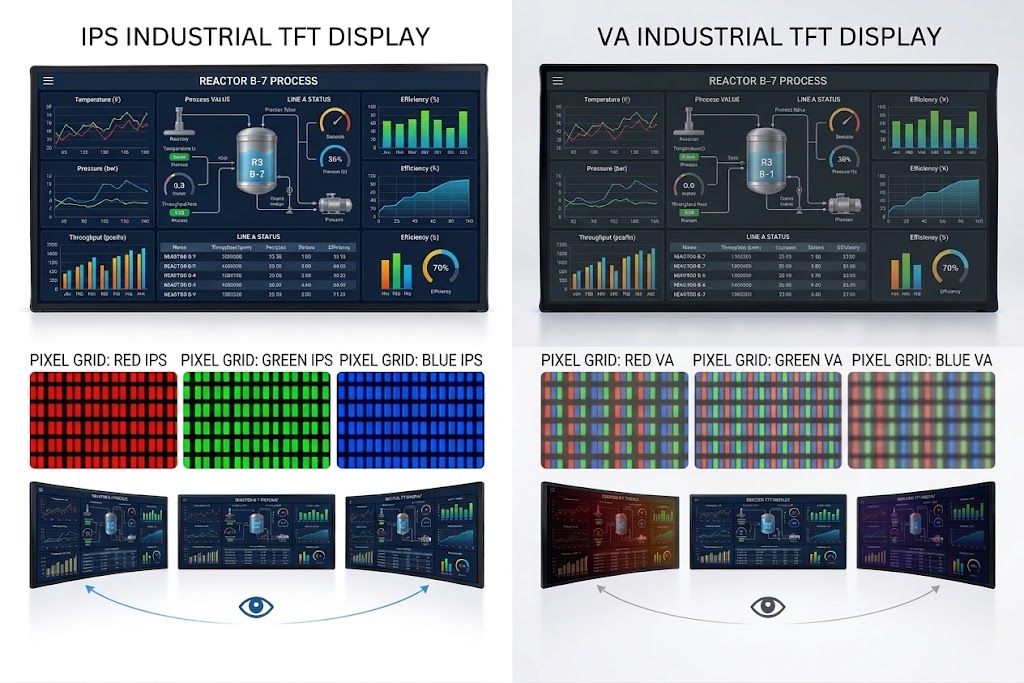
IPS vs VA Industrial TFT Panel Comparison
|
Parameter |
IPS TFT LCD |
VA TFT LCD |
|
Viewing Angle |
Generally provides more consistent color and grayscale performance across wide viewing angles. |
Can provide good viewing angles, but off-axis contrast and grayscale performance may vary more by panel design. |
|
Native Contrast Ratio |
Typically lower than comparable VA panels, depending on the panel design. |
Typically higher than comparable IPS panels, producing deeper black levels under suitable viewing conditions. |
|
Color Performance |
Often preferred when consistent image appearance across multiple viewing positions is important. |
Can provide strong frontal-view contrast; color and gamma may shift at off-axis angles. |
|
Operating Temperature |
Wide-temperature options are available in selected modules. Verify the complete module’s rated operating range. |
Temperature capability depends on the specific panel and module. Verify the rated operating range. |
|
Response Time |
Depends on gray-to-gray transitions, drive conditions, temperature, and panel design. |
Depends on panel design and operating conditions. Some VA panels may exhibit slower dark-to-dark transitions, causing visible smearing in moving content. |
|
Typical Applications |
Industrial HMIs, instrumentation, and equipment viewed from different positions. |
Equipment with defined viewing positions and applications prioritizing high native contrast. |
|
CDTech Availability |
Customized IPS TFT LCD modules are available, subject to product specifications and project requirements. |
Not currently offered by CDTech. The engineering team can assess whether an IPS alternative meets the project requirements. |
What Is an IPS Panel?
IPS (In-Plane Switching) is a TFT LCD technology in which liquid-crystal molecules primarily reorient within the plane of the panel under an applied electric field. The electrode structure and liquid-crystal alignment help IPS panels maintain relatively consistent color and grayscale performance across wide viewing angles.
The specified viewing angle should be evaluated alongside contrast retention, grayscale behavior, and color shift. A headline viewing-angle figure alone does not fully describe image quality at off-axis positions.
For industrial applications, the practical benefits depend on the specific panel design and module configuration. Engineers should evaluate viewing-angle performance, contrast, brightness, and environmental ratings using the product datasheet rather than relying on the IPS label alone.
How IPS Technology Has Evolved
IPS technology has evolved through multiple generations and manufacturer-specific implementations. Designs such as H-IPS have refined aspects of IPS performance. Related wide-viewing-angle technologies, such as ADS, use their own electrode and liquid-crystal configurations to achieve wide viewing angles. Improvements in contrast, light transmission, and response performance depend on the specific implementation. Engineers should compare actual module specifications rather than assume that all IPS-type displays perform identically.
Advantages of IPS Industrial TFT Displays
- Wide viewing angles: Maintains relatively consistent color and grayscale performance across different viewing positions.
- Flexible integration: Supports various display sizes, interfaces, touch configurations, and cover-glass designs.
- Industrial-grade options: Selected modules are available with high-brightness backlights and extended operating-temperature ranges, subject to the specific product configuration.
Limitations of IPS Industrial TFT Displays
- Native contrast: IPS panels typically have lower native contrast than comparable VA panels, which may produce deeper black levels.
- Customization trade-offs: High brightness, touch integration, optical bonding, and environmental requirements may affect module cost, power consumption, and development time.
What Is a VA Panel?
VA (Vertical Alignment) is a liquid-crystal display technology in which the liquid-crystal molecules are generally aligned perpendicular to the panel substrates in the zero-voltage state.
In a typical normally-black VA configuration, the crossed polarizers block most of the backlight when no voltage is applied, producing a dark screen. When voltage is applied, the liquid-crystal molecules tilt, changing the polarization of transmitted light and allowing more light to pass through the upper polarizer.
By controlling the applied voltage, the display regulates light transmission to produce different grayscale levels and colors.
The vertical alignment structure contributes to VA panels’ typically high native contrast ratio. Compared with many IPS panels, VA panels can produce deeper black levels and stronger contrast under suitable viewing conditions.
VA technology includes several implementations, such as MVA (Multi-domain Vertical Alignment), PVA (Patterned Vertical Alignment), and other manufacturer-specific variants. Multi-domain designs can improve viewing-angle performance by arranging liquid-crystal orientations in different regions of a pixel. Therefore, VA viewing-angle performance should be evaluated by model rather than assumed to be uniformly limited.
Advantages of VA Industrial TFT Displays
- High native contrast: Typically provides higher native contrast and deeper black levels than comparable IPS panels.
- Frontal-view image performance: Can deliver strong contrast when viewed from suitable positions, depending on the panel design.
Limitations and Considerations for VA Industrial TFT Displays
- Off-axis image performance:Color, gamma, and brightness can vary with viewing angle, depending on the panel design.
- Response-time variation:Some VA panels exhibit slower transitions between certain dark gray levels, which can produce visible smearing in moving content. This may affect fast-scrolling graphics, animated interfaces, or video playback. Actual performance should be verified against the selected module’s response-time specifications and operating-temperature requirements.
- Model-dependent specifications:Contrast, response time, viewing angle, and operating temperature must be verified against the individual panel datasheet.
- Industrial availability:The selection of suitable sizes, interfaces, temperature ranges, and customization options depends on the supplier and product portfolio.
Neither IPS nor VA should be considered universally superior. The appropriate choice depends on the display’s intended use, optical requirements, and integration constraints.
How to Choose Between IPS and VA for Industrial Applications
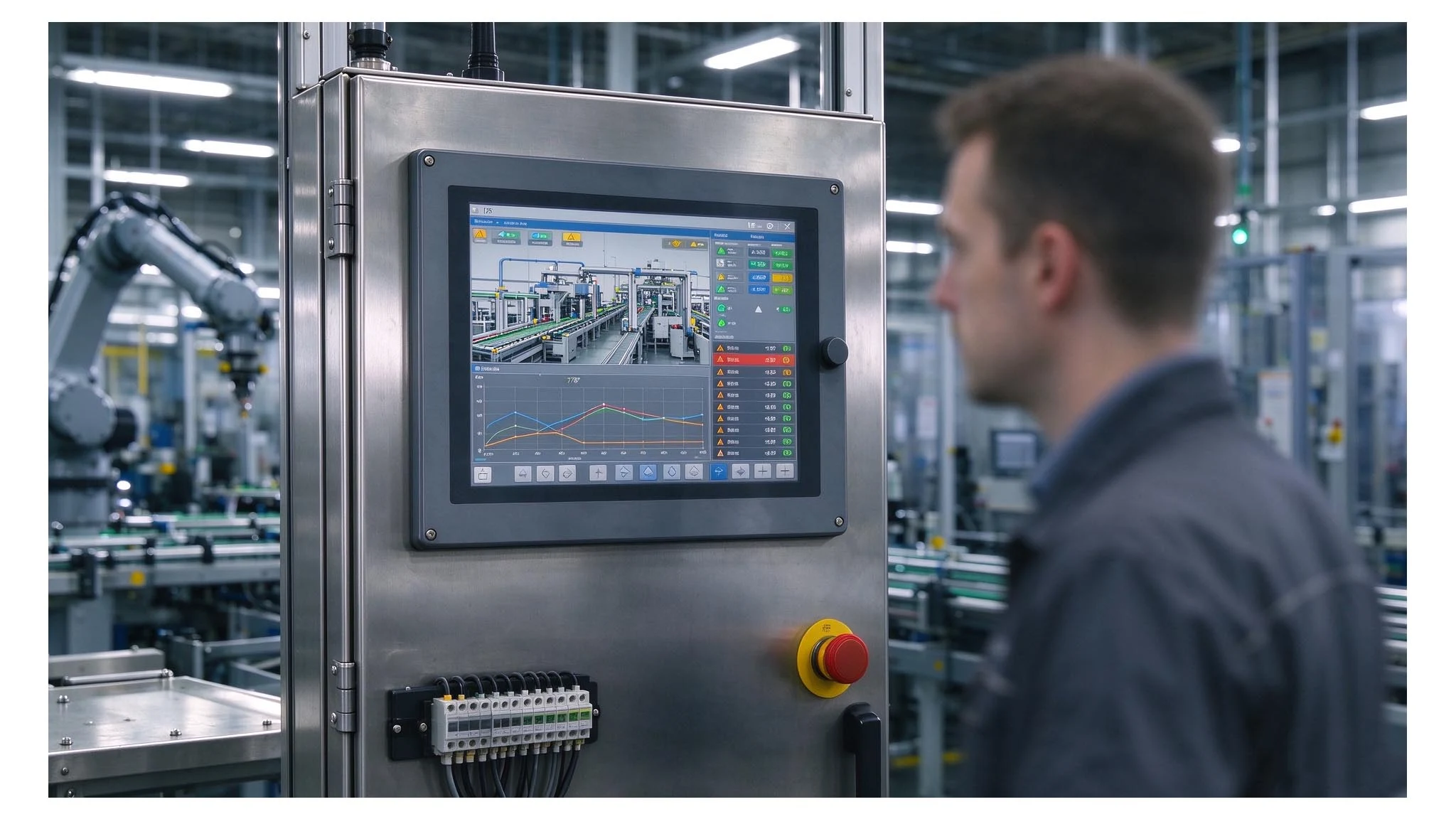
The selection process should begin with the actual viewing environment and display performance requirements, rather than panel technology alone.
When Should You Choose an IPS Panel?
IPS is often a strong choice when an application requires consistent image presentation across different viewing positions.
Consider IPS if your project involves:
- Multi-position operation: Operators need to read the display from different sides or heights.
- Industrial HMI and instrumentation: The display is integrated into automation equipment, control panels, or embedded systems.
- Medical equipment interfaces: Wide viewing angles can help operators read information from different positions. Diagnostic imaging and other image-critical applications require additional evaluation of calibration, luminance uniformity, grayscale performance, and applicable regulatory requirements.
- Outdoor or high-ambient-light environments: Evaluate the complete display module’s brightness, surface reflectance, optical bonding, and anti-reflective treatment. IPS may help maintain image consistency across viewing angles, but outdoor readability must be verified under the intended lighting conditions.
Explore CDTech’s industrial LCD display solutions for HMI systems, automation equipment, and other industrial applications.
CDTech provides customized IPS TFT display modules with options for touch integration, cover glass, optical bonding, selected high-brightness configurations, and wide-temperature designs. Available options depend on the target product specification.
When Should You Consider a VA Panel?
VA may be worth evaluating when high native contrast and deep black levels are the primary priorities.
Consider VA if your project involves:
- High-contrast requirements: Deep black levels and strong native contrast are key priorities.
- Defined viewing positions: The display is primarily viewed from a known position, and off-axis performance meets the application requirements.
- Verified module specifications: Contrast, response time, operating temperature, and other parameters meet the system requirements.
For industrial equipment, evaluate the actual viewing-angle requirements rather than assuming VA is unsuitable for every multi-user application. Some VA designs incorporate optical structures that improve off-axis performance.
Key Factors Beyond IPS vs VA
Panel technology is only one part of the display selection process. Engineers should also evaluate the following factors:
- Brightness and ambient lighting:Confirm that the display remains readable under the intended lighting conditions.
Outdoor readability depends on more than panel technology or backlight brightness alone. Surface reflectance, cover-glass treatment, optical bonding, and ambient-light conditions all influence visibility. A high-brightness display may still be difficult to read in direct sunlight if reflections are not adequately controlled.
- Contrast and black-level requirements:Compare measured specifications under consistent test conditions.
- Operating temperature:Verify the specified operating range for the complete display module.
- Touch integration:Consider capacitive touch, cover-glass thickness, and the expected user interaction.
- Optical bonding and surface treatment:Assess reflections, air gaps, and readability requirements. Learn more about optical bonding vs. air bonding and how the bonding method affects display readability and durability.
- Interface and mechanical integration:Check the interface, connector, available space, mounting method, and system compatibility.
- Power consumption:Compare the complete module at the required brightness and operating conditions rather than assuming one panel technology always consumes less power.
- Cost and development schedule:Evaluate customization, qualification, tooling, and production requirements.
CDTech Custom IPS TFT Display Solutions
CDTech provides customized IPS TFT LCD modules for industrial, medical, smart home, and embedded applications. Depending on project requirements and product availability, customization options may include display size, brightness, touch integration, cover glass, optical bonding, and operating temperature range.
For projects requiring a compact display, explore CDTech’s 5.7-inch IPS TFT LCD module and review the available interface options for your system. If outdoor readability is a priority, our guide to sunlight-readable industrial TFT displays explains how brightness, optical bonding, and surface treatments affect visibility under high ambient light.
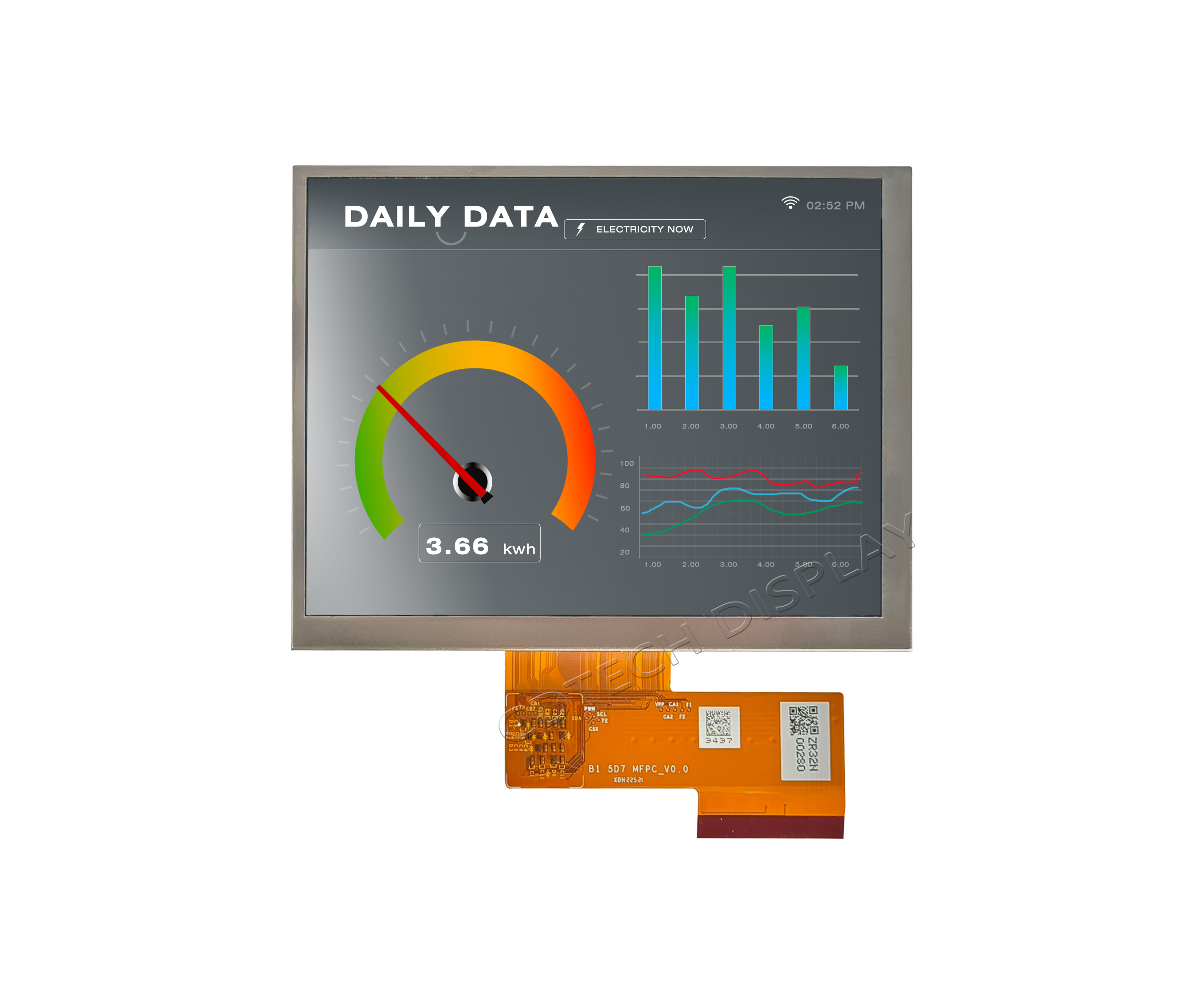
For projects evaluating VA panels, CDTech’s engineering team can review viewing-angle requirements, contrast targets, ambient lighting, mechanical constraints, interface specifications, and operating conditions to assess whether a customized IPS module is suitable. The final selection should be based on the complete system requirements rather than panel technology alone.
Evaluating IPS as an Alternative to VA?
Share your display size, target contrast ratio, viewing-angle requirements, brightness, interface, and operating temperature range with CDTech. Our team can review your application requirements and assess whether a customized IPS TFT LCD module is a suitable fit for your project.
Contact CDTech to discuss your industrial display requirements.
Frequently Asked Questions
Q1. What is the main difference between IPS and VA panels for industrial use?
A: The main difference is their typical optical performance. IPS panels generally maintain more consistent color and grayscale performance across wide viewing angles, while VA panels typically provide higher native contrast and deeper black levels. Actual performance depends on the specific panel design.
Q2. Does CDTech supply VA TFT displays?
A: No. CDTech currently focuses on customized IPS TFT display modules. Our engineering team can evaluate whether an IPS solution is suitable for a project that initially specifies VA technology.
Q3. Can an IPS panel replace a VA panel in my project?
A: It depends on the application’s contrast requirements, viewing positions, ambient lighting, mechanical constraints, and other specifications. An IPS module may be a suitable alternative when wide viewing angles and consistent image presentation are priorities. However, the proposed module should be evaluated against the project’s required contrast ratio, response time, operating temperature, and integration constraints before a replacement decision is made.
Q4. Which panel type is better for medical displays?
A: IPS is often a suitable choice for medical equipment interfaces because it generally provides consistent image presentation across wide viewing angles. However, the best choice depends on the intended medical application. Diagnostic imaging and other regulated applications may require additional calibration, image-quality verification, and compliance measures beyond panel technology alone.
Q5. Does a higher contrast ratio always mean better display quality?
A: No. A higher native contrast ratio can improve black-level reproduction, but overall display quality also depends on brightness, color performance, viewing angle, response time, ambient lighting, and the requirements of the application.
Conclusion
IPS and VA TFT panels serve different display priorities. IPS is often preferred when consistent image presentation across wide viewing angles is important, while VA typically offers higher native contrast and deeper black levels.
For industrial display projects, the best choice depends on the complete set of optical, environmental, mechanical, and electrical requirements. By evaluating these factors together, engineers can select a display module that delivers the performance required by the end application.

