
What Is an IPS Display? Complete Guide to IPS LCD Panels & Modules
 2026-03-13
  18:45
18:45 

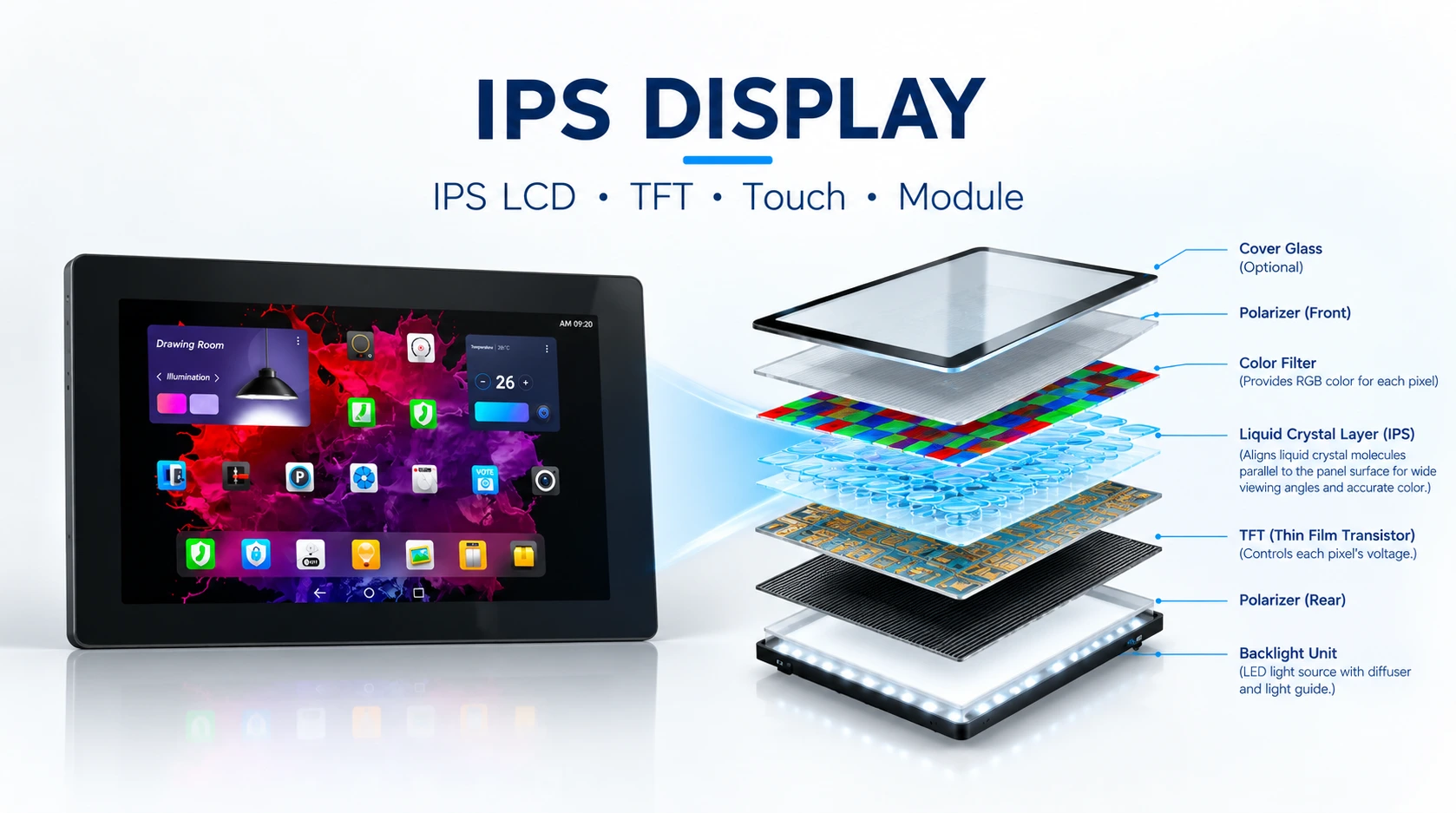
An IPS display is a type of LCD technology designed to provide wide viewing angles, stable color performance, and consistent image quality. IPS stands for In-Plane Switching, referring to the way liquid crystal molecules rotate within the plane of the display when an electrical field is applied.
Today, IPS technology is widely used in monitors, laptops, tablets, smartphones, industrial HMIs, automotive displays, medical equipment, and other embedded systems. For engineers and OEMs, however, choosing an IPS display involves more than simply selecting an IPS panel. Factors such as resolution, brightness, interface, touch integration, optical bonding, operating temperature, mechanical design, and long-term availability can all affect the final display solution.
This guide explains what an IPS display is, how IPS LCD technology works, the difference between IPS, LCD and TFT, the advantages and limitations of IPS panels, and how to select an IPS TFT display or module for different applications.
What Is an IPS Display?
An IPS display is an LCD panel that uses In-Plane Switching technology to control liquid crystal molecules within the plane of the display.
Unlike conventional TN structures, where liquid crystal molecules change their orientation in a more vertically tilted configuration, IPS technology uses an electrode structure that causes the liquid crystals to rotate within the plane of the panel. This helps maintain more consistent light transmission and color performance when the screen is viewed from different angles.
This structure is one of the main reasons IPS displays are known for:
- Wide viewing angles
- Stable color reproduction
- Consistent image quality
- Reliable off-axis visibility
- Strong suitability for multi-viewer applications
Many IPS panels offer viewing angles approaching 178° horizontally and vertically, depending on the specific panel design and optical characteristics.
Because IPS is an LCD technology, an IPS display still requires a backlight to illuminate the liquid crystal layer. The IPS structure controls how that light passes through the panel to produce the final image.
In simple terms:
IPS is a type of LCD panel technology optimized for wide viewing angles and stable image performance.
This makes IPS particularly useful when a display may be viewed from different positions rather than directly from the front.
How Does IPS Display Technology Work?
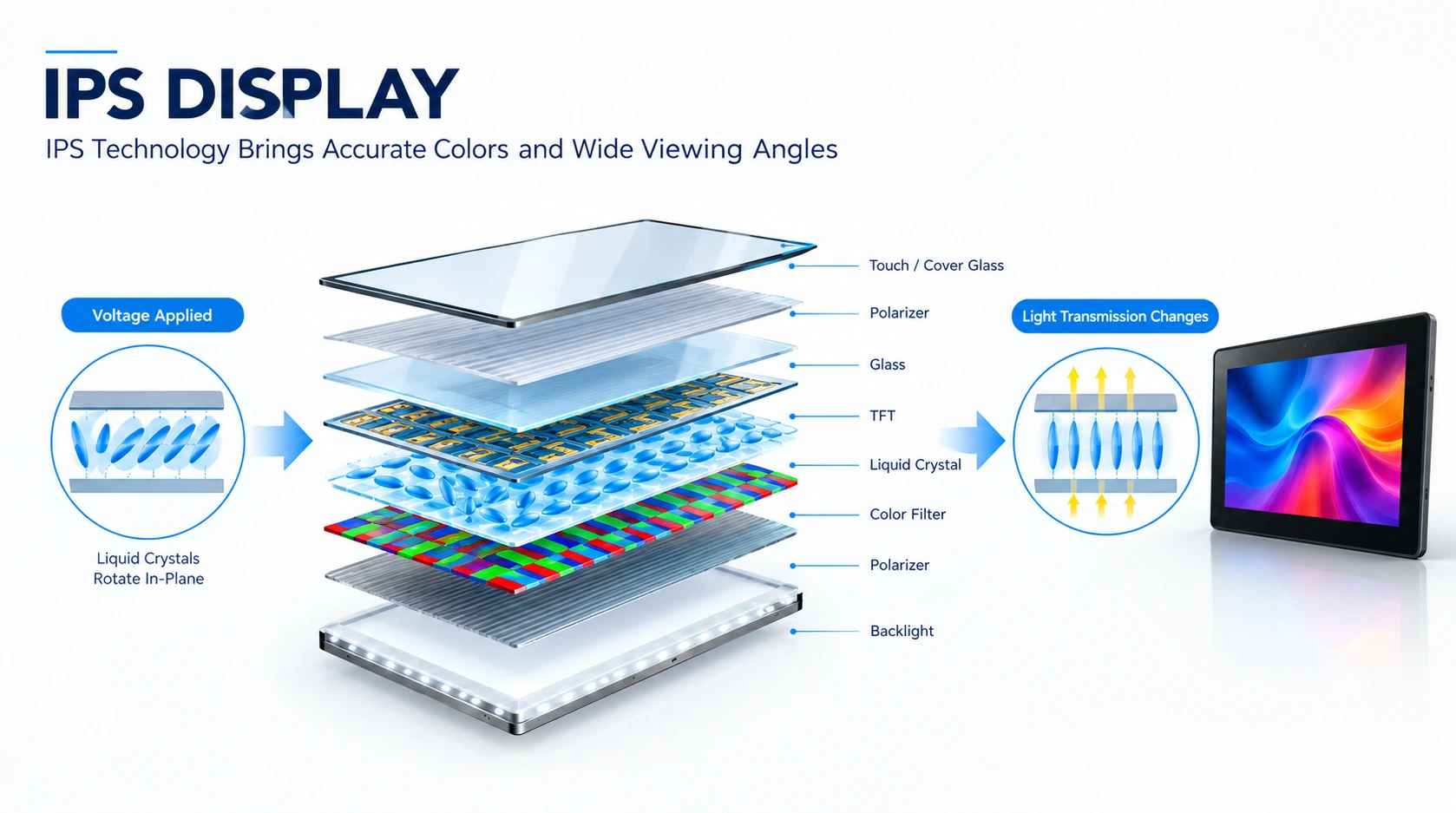
An IPS LCD consists of several key layers and components, including:
1. Backlight unit
2. Rear polarizer
3. Glass substrate
4. Thin-film transistor (TFT) array
5. Liquid crystal layer
6. Color filter
7. Front polarizer
8. Cover glass or touch panel, when integrated
The liquid crystal molecules are positioned between glass substrates. When the display electronics apply voltage to individual pixels, the liquid crystals rotate within the plane of the panel.
This rotation changes the polarization and transmission of light through each pixel.
The display controller determines the electrical signals required for each pixel, while the RGB color filters generate the red, green, and blue components needed to produce the full-color image.
The backlight provides the illumination required by the LCD.
Modern IPS display performance also depends on several additional factors, including:
- TFT characteristics
- Electrode structure
- Liquid crystal materials
- Polarizer design
- Gamma control
- Driving waveform
- Overdrive technology
- Backlight architecture
Together, these components determine the display’s viewing angle, brightness, contrast, color performance, response time, and overall image quality.
IPS vs LCD vs TFT: What Is the Difference?
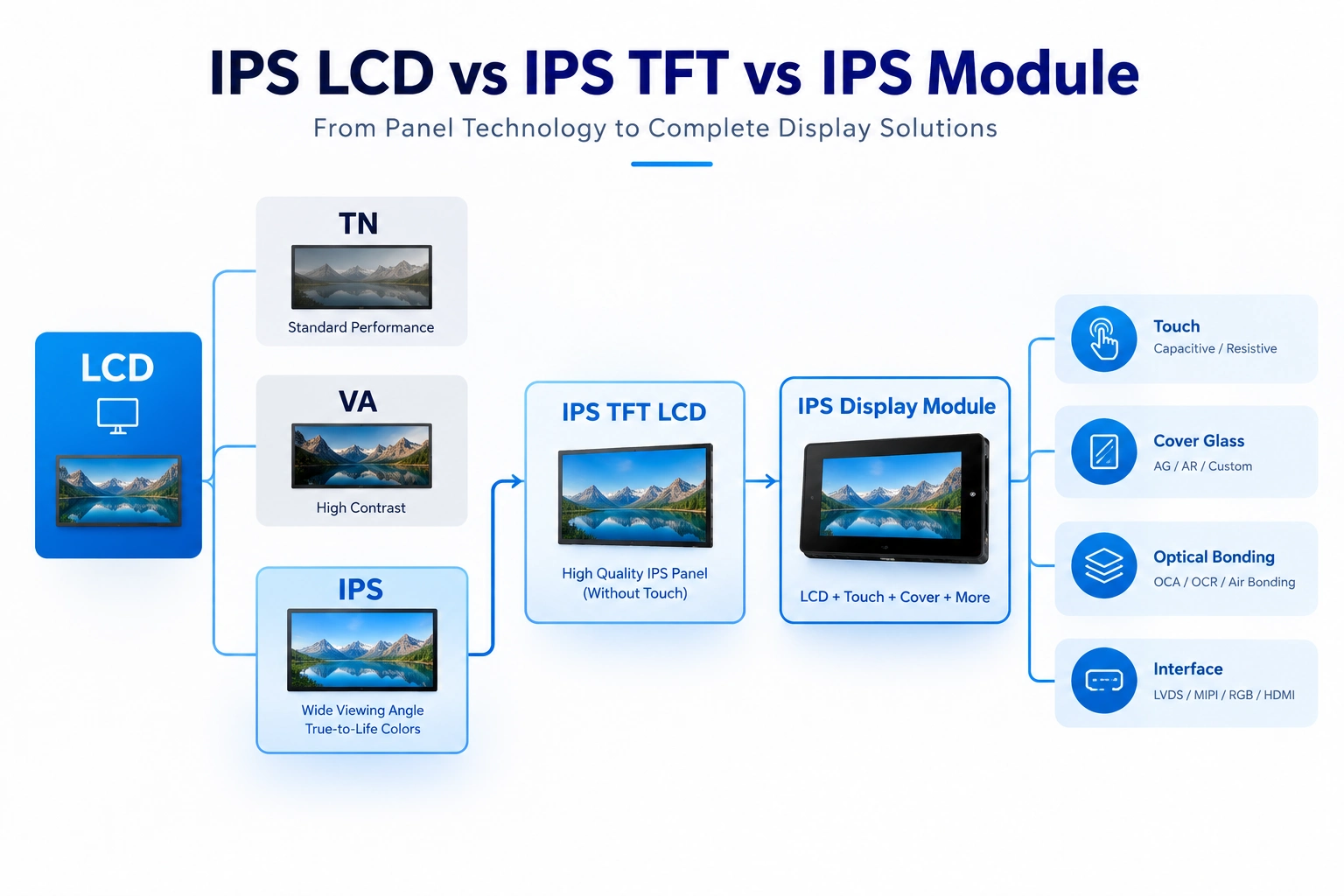
The terms IPS, LCD, TFT, and IPS TFT LCD are often used together, but they do not mean the same thing.
LCD
LCD (Liquid Crystal Display) is the broad display technology category.
An LCD uses liquid crystals to control the transmission of light from a backlight.
TFT
TFT (Thin-Film Transistor) refers to the active-matrix driving technology used to control individual pixels.
Modern high-resolution LCD panels commonly use TFT technology.
IPS
IPS (In-Plane Switching) describes the liquid crystal panel structure and switching method.
IPS is therefore a type of LCD panel technology.
IPS TFT LCD
An IPS TFT LCD combines these technologies:
IPS panel structure + TFT active-matrix driving + LCD backlight
This is why product descriptions commonly use terms such as:
- IPS LCD display
- IPS TFT display
- IPS TFT LCD panel
- IPS LCD screen
- IPS display module
They can refer to closely related products, but the exact configuration depends on whether the product is a bare panel, TFT module, touch display, or complete display assembly.
What Are the Advantages of IPS Displays?
The benefits of IPS displays include wide viewing angles, stable color performance, consistent image quality, and flexible configurations for different applications. These benefits make IPS display monitors suitable for a wide range of embedded, industrial, automotive, medical and consumer applications.
Wide Viewing Angles
One of the defining characteristics of IPS panels is their wide viewing angle.
Colors and contrast remain relatively stable when users view the display from the side, above, or below. This is especially important for:
- Industrial HMIs
- Automotive dashboards
- Medical equipment
- Public information displays
- Kiosks
- Collaborative workstations
A wide viewing angle allows multiple users to see similar image information without requiring everyone to sit directly in front of the screen.
Stable Color Performance
IPS panels generally provide strong color consistency across different viewing angles.
This makes them suitable for applications where accurate and repeatable image reproduction matters, including:
- Medical imaging equipment
- Professional displays
- Industrial visualization
- Automotive interfaces
- Graphic design
- Photo and video applications
Color performance still depends on the individual panel, backlight, color gamut, calibration, and display system. IPS technology itself does not guarantee a particular color gamut or Delta-E specification.
Good Image Consistency
The IPS structure helps reduce the color and contrast shifts commonly associated with narrow-viewing-angle LCD technologies.
For embedded applications, this can be more important than simply achieving a high contrast ratio.
Flexible Display Configurations
IPS TFT panels are available in a wide range of:
- Sizes
- Resolutions
- Aspect ratios
- Brightness levels
- Interfaces
- Touch configurations
- Mechanical formats
This allows IPS displays to be adapted to consumer products as well as specialized industrial and automotive systems.
What Are the Limitations of IPS Displays?
IPS technology also involves trade-offs.
Lower Native Contrast Than Some VA Panels
IPS panels generally do not achieve the same native black levels and contrast ratios as many VA panels.
For applications where deep blacks are the highest priority, VA or OLED may be more appropriate.
IPS Glow
IPS glow is a visible haze or glow that can appear around darker areas when the screen is viewed from an angle.
Its severity depends on the panel structure, optical design, viewing angle, screen size, and manufacturing quality.
Backlight Bleeding
Backlight bleed occurs when illumination from the backlight becomes more visible around areas of the display than intended, particularly when displaying dark content.
IPS glow and backlight bleed are related to different physical mechanisms and should not be treated as exactly the same phenomenon.
Power Consumption Depends on the Complete Display Design
IPS technology itself does not determine the complete power consumption of a display.
Brightness, backlight efficiency, screen size, resolution, touch technology, driver electronics, refresh rate, and system configuration can all affect total power consumption.
For embedded products, engineers should therefore evaluate the complete display module rather than comparing panel technologies alone.
IPS vs TN vs VA vs OLED: Which Display Technology Is Better?
The right display technology depends on the application’s priorities.
|
Feature |
IPS |
TN |
VA |
OLED |
|
Viewing Angle |
Very wide |
Narrower |
Wide |
Very wide |
|
Color Consistency |
High |
Lower |
Good |
Excellent |
|
Native Contrast |
Moderate |
Low–moderate |
High |
Extremely high |
|
Black Level |
Good |
Moderate |
Very good |
Excellent |
|
Response Time |
Fast in modern designs |
Very fast |
Moderate to fast |
Very fast |
|
Burn-in Risk |
No typical permanent burn-in |
No typical LCD burn-in |
No typical LCD burn-in |
Possible with prolonged static content |
|
Backlight |
Required |
Required |
Required |
Not required |
|
Typical Strength |
Viewing angle & color |
Speed & cost |
Contrast |
Contrast & HDR |
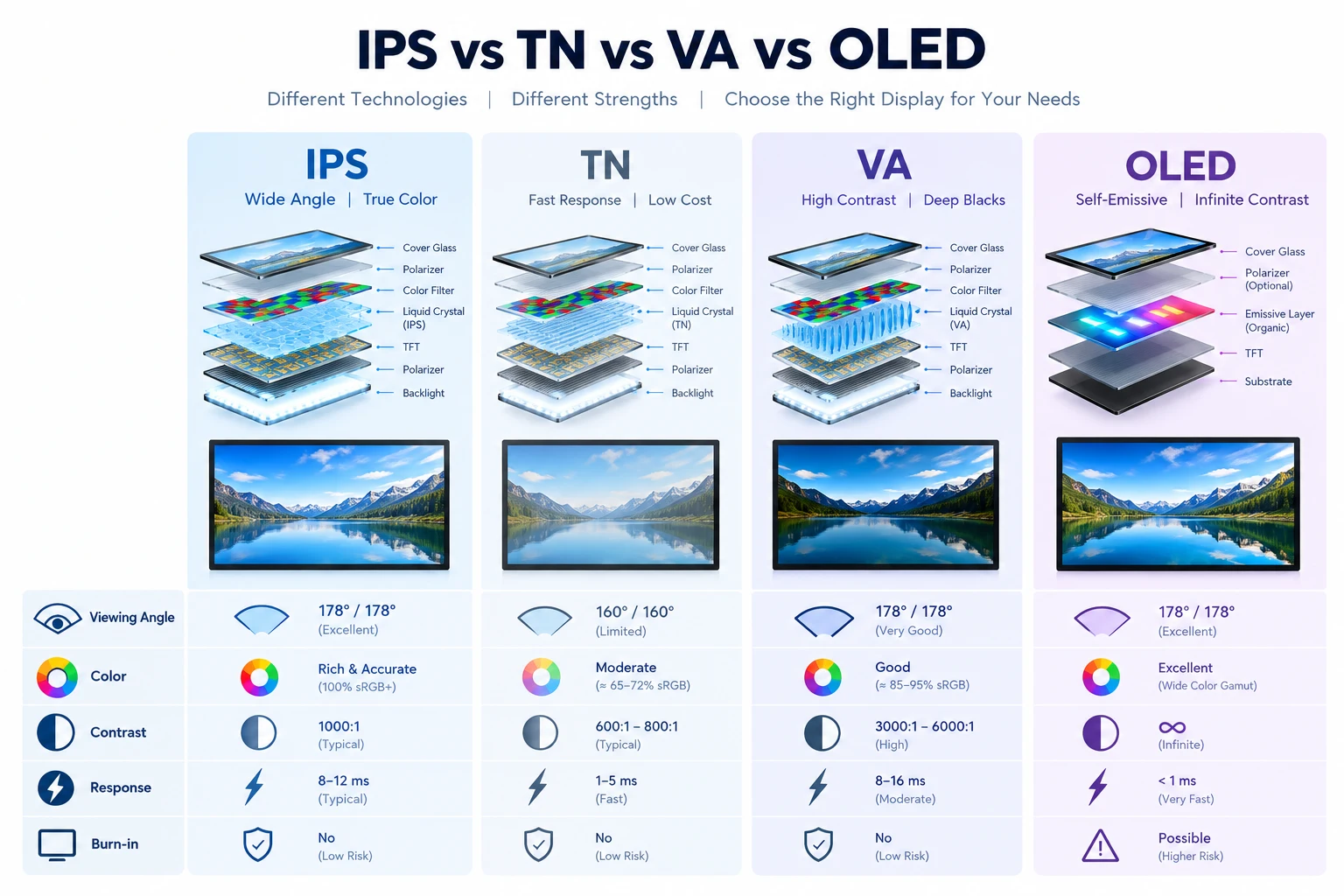
IPS vs TN
TN panels can provide very fast response times and low cost, but viewing angles and color consistency are generally weaker than IPS. IPS is usually the better choice when image quality and multi-angle viewing are more important.
For a more detailed comparison of viewing-angle stability and color consistency in industrial applications, see our guide to IPS vs TN for industrial screens.
IPS vs VA
VA panels typically provide higher native contrast and deeper blacks.
IPS generally offers better viewing-angle consistency and is often preferred when color stability and readability from different positions are important.
IPS vs OLED
OLED provides per-pixel illumination, extremely high contrast, and excellent black levels.
IPS LCD, however, remains attractive for applications that prioritize long-term stability with static content, high brightness, cost efficiency, and established LCD manufacturing infrastructure.
For industrial HMIs, dashboards, signage, and other applications displaying static interfaces for long periods, IPS LCD can therefore be a practical alternative to OLED.
As emerging display technologies continue to develop, Micro LED is also being evaluated as an alternative for applications requiring very high contrast and brightness. See our comparison of Micro LED and IPS displays for a broader technology perspective.
What Is an IPS LCD Module?
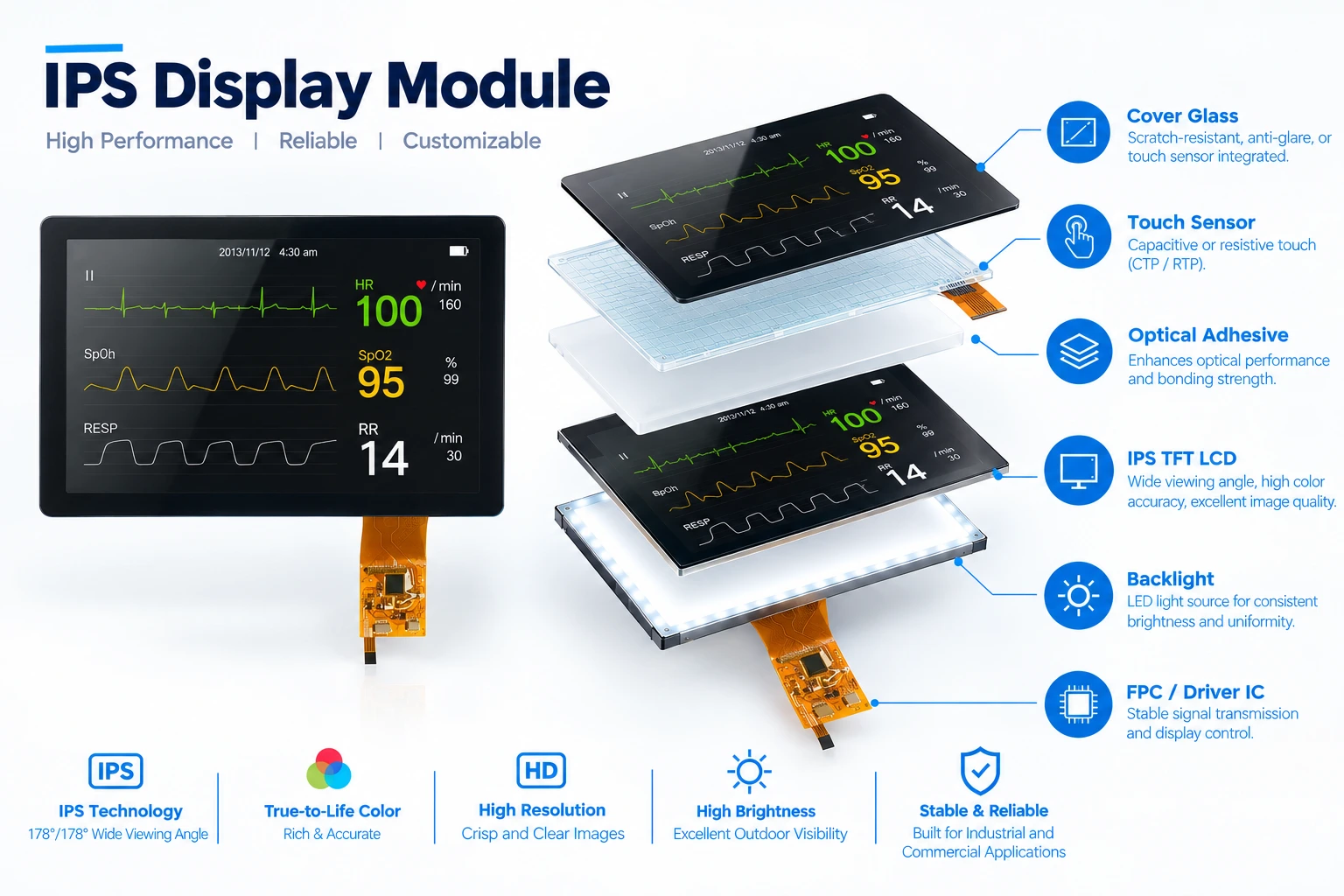
An IPS LCD module is more than simply an IPS panel.
A panel is primarily the display cell itself, while an LCD module can include additional components required to integrate the display into an electronic system.
Depending on the product configuration, an IPS display module may include:
- IPS TFT LCD panel
- Backlight unit
- Driver IC
- FPC
- Interface connection
- Touch panel
- Cover glass
- Optical bonding
- Surface treatment
- Mechanical frame or customized structure
For example, an OEM may require an IPS TFT LCD module with MIPI DSI, capacitive touch, optical bonding, and a customized cover glass rather than a standard bare panel.
This distinction is important when selecting a display for a new product.
For OEM applications, an IPS display module is often configured around the host system rather than selected as a standalone panel.
The correct question is not simply:
“Do I need an IPS screen?”
It is:
“What IPS display configuration is required by my system?”
IPS Display Types and Configurations
IPS displays can be configured for very different application requirements.
Standard IPS TFT Displays
Standard IPS TFT LCD modules are suitable for general embedded products, control panels, instruments, and consumer electronics.
Typical specifications include:
- 5″ to 15.6″ or larger sizes
- Various resolutions
- MIPI, LVDS, RGB or eDP interfaces
- Capacitive or resistive touch options
- Different brightness levels
Explore our standard IPS TFT LCD displays for embedded and industrial applications.
High-Brightness IPS Displays
High-brightness IPS displays are designed for environments with strong ambient light.
Applications include:
- Outdoor terminals
- Industrial equipment
- Automotive displays
- Kiosks
- Transportation equipment
- Agricultural machinery
Brightness should be specified according to the actual viewing environment rather than selected solely by the highest available nits value.
Bar-Type and Stretched IPS Displays
Bar-type IPS displays use unconventional aspect ratios for applications where conventional 16:9 or 4:3 screens do not fit the mechanical design.
They can be used in:
- Automotive center consoles
- Transportation displays
- Industrial instruments
- Smart retail equipment
- Specialized control interfaces
Touch IPS Displays
An IPS TFT display can be integrated with a projected capacitive touch panel to create an interactive display solution.
Touch configurations can include:
- G+G structures
- Cover glass
- Customized touch sensors
- Multi-touch
- Glove touch
- Water-resistant touch configurations
Optical-Bonded IPS Displays
Optical bonding integrates the display and cover glass or touch panel using an optical adhesive layer.
Benefits can include:
- Reduced air-gap reflections
- Improved outdoor readability
- Better optical clarity
- Improved touch integration
- Reduced internal reflection
Optical bonding is particularly useful for industrial, automotive and outdoor applications.
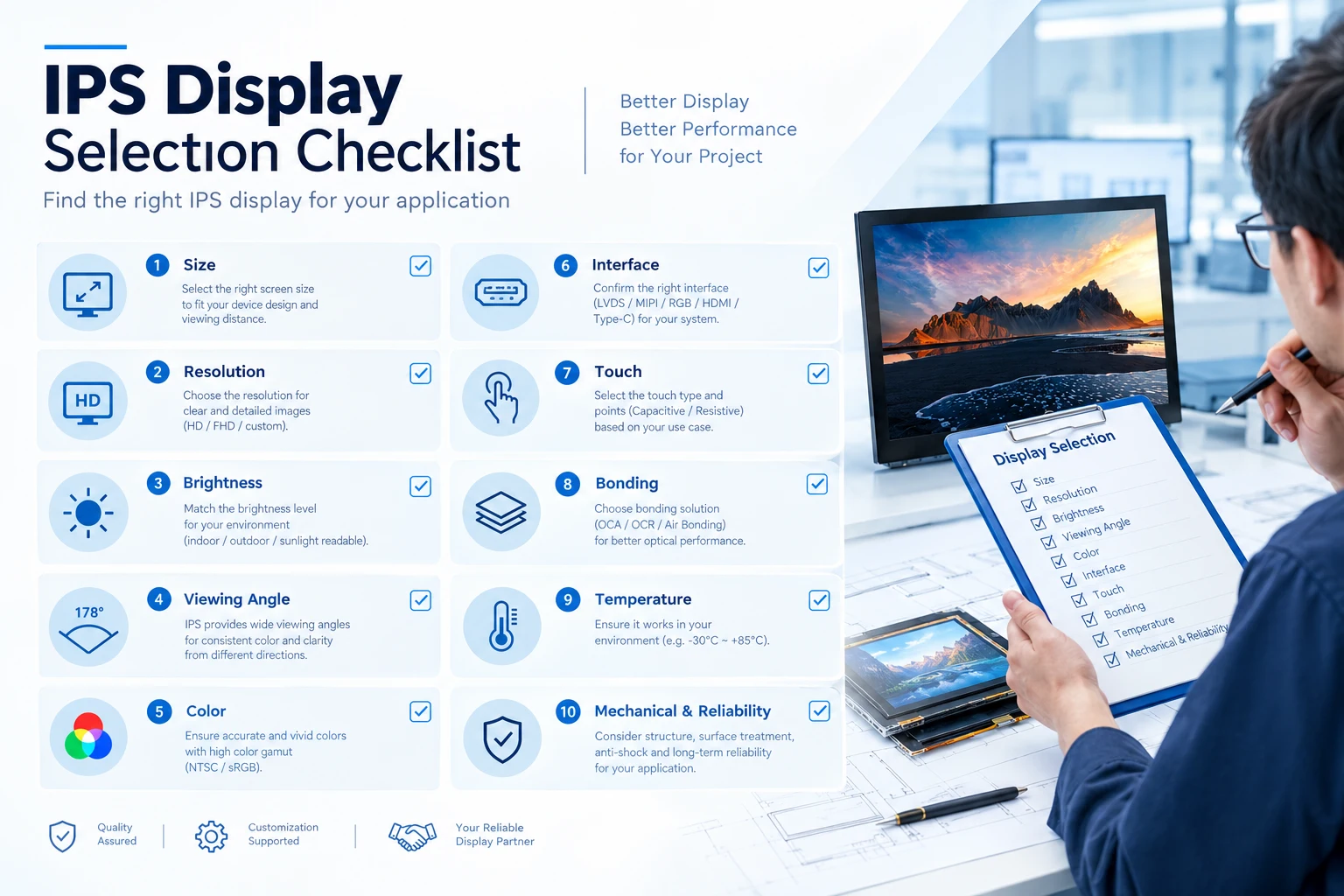
How to Choose an IPS Display for Your Application
Selecting an IPS display requires evaluating the complete system rather than choosing the panel based on viewing angle alone.
1. Display Size
Choose the size based on:
- Available installation space
- Viewing distance
- Information density
- User interaction
- Mechanical constraints
2. Resolution
Higher resolution can improve image sharpness and information density, but it can also increase system requirements and power consumption.
The resolution should match the application’s visual content and processor capabilities.
3. Brightness
Brightness is measured in nits (cd/m²).
Indoor equipment may require moderate brightness, while automotive, outdoor and high-ambient-light applications may require significantly higher brightness.
4. Viewing Angle
IPS is often selected when users need to view the display from different positions.
However, engineers should review the actual viewing-angle specifications of the selected module rather than relying only on the term “IPS.”
5. Color Performance
When color accuracy or consistency is important, engineers should evaluate color gamut, color temperature, calibration requirements and other panel-specific specifications rather than assuming that every IPS display provides the same color performance.
6.Contrast Ratio
Contrast ratio describes the difference between the brightest white and darkest black a display can produce. It can affect perceived image depth and readability, particularly when dark interface elements or high-contrast visual content are important. Engineers should evaluate the specified contrast ratio together with viewing angle, brightness, optical bonding and the actual operating environment rather than treating contrast as an isolated specification.
7. Display Interface
The display interface must match the host processor or display controller.
Common interfaces for IPS TFT displays include MIPI DSI, LVDS, RGB and eDP. HDMI may also be supported through an appropriate controller or interface solution.
Interface selection affects PCB design, signal integrity, bandwidth, cable length and system architecture.
8. Touchscreen
If users interact directly with the display, consider whether the system requires:
- PCAP touch
- Resistive touch
- Multi-touch
- Glove touch
- Water-resistant operation
9. Optical Bonding and Surface Treatment
For outdoor or demanding environments, engineers may consider:
- OCA optical bonding
- AG anti-glare treatment
- AF anti-fingerprint treatment
- AR anti-reflective treatment
- Rugged cover glass
These options should be selected according to the actual environmental and mechanical requirements.
10. Operating Temperature
Industrial and automotive products may operate across wider temperature ranges than consumer electronics.
The display module should therefore be evaluated according to its specified:
- Operating temperature
- Storage temperature
- Reliability requirements
11. Mechanical Integration
Mechanical compatibility can be just as important as optical performance.
Consider:
- Overall dimensions
- Active area
- Bezel
- Mounting holes
- FPC position
- Connector location
- Cover glass dimensions
- Thickness
- Customized cutouts
12. Long-Term Supply and Reliability
For commercial and industrial products, the display should remain available throughout the expected product lifecycle.
OEMs should evaluate:
- Production stability
- Quality control
- Reliability testing
- Change management
- Product lifecycle
- Customization capability
- Long-term supply support
IPS Displays for Industrial, Automotive, Medical and Smart Home Applications
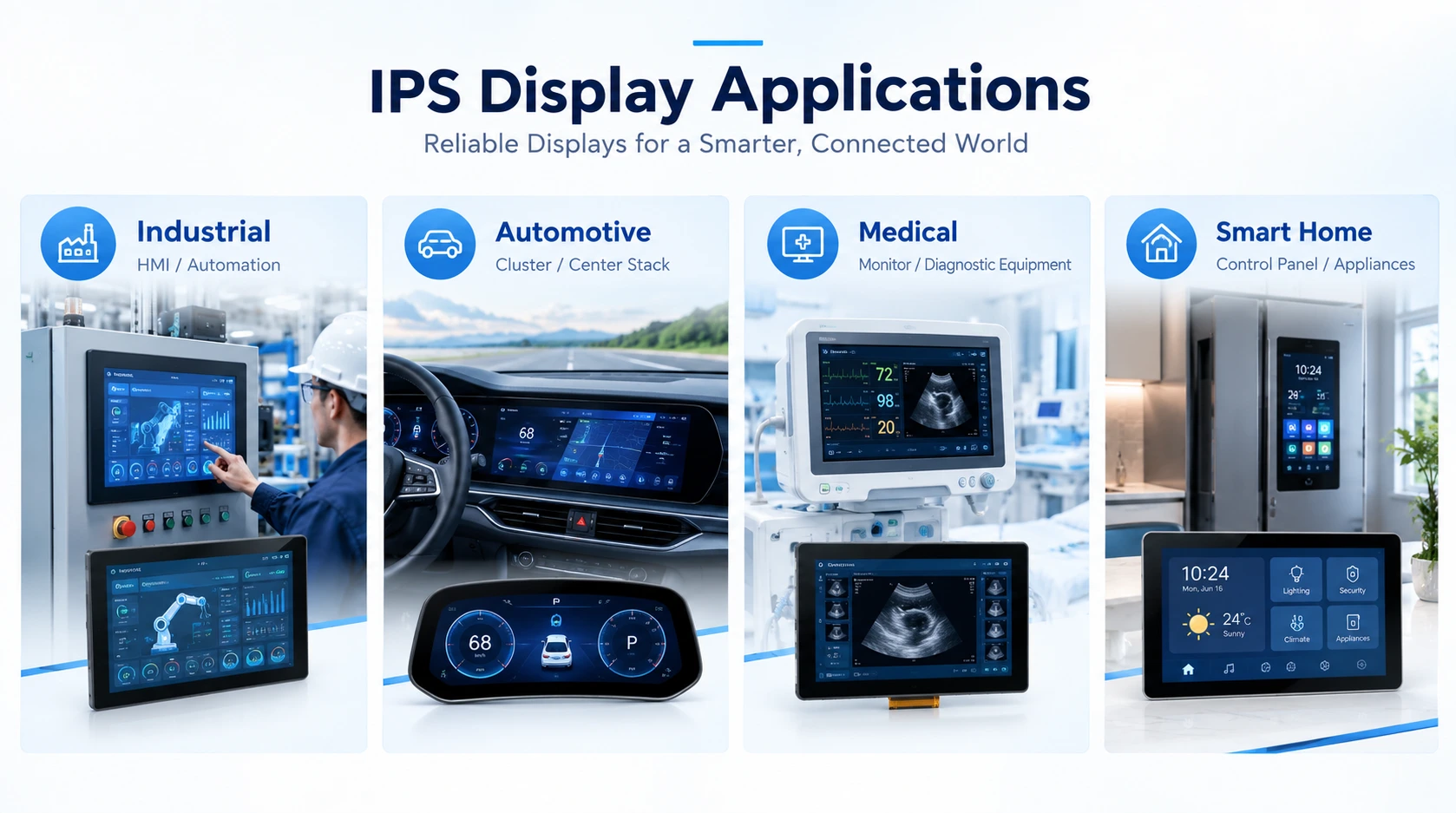
The advantages of IPS become particularly valuable in applications where displays must remain readable, stable and reliable under real operating conditions.
Industrial Applications
Industrial IPS displays are commonly used in:
- HMIs
- Factory automation
- PLC control panels
- Industrial instruments
- Kiosks
- Warehouse equipment
- Machine interfaces
Industrial environments may require high brightness, wide temperature operation, touch integration, optical bonding and rugged mechanical construction.
Automotive Applications
Automotive IPS displays can be integrated into:
- Instrument clusters
- Center-stack displays
- Infotainment systems
- Passenger information systems
- Rear-seat displays
- Specialized vehicle controls
Automotive applications may require wide viewing angles, high brightness, temperature resistance, vibration resistance and long-term reliability. For digital instrument clusters, contrast, luminance and viewing-angle performance can also be important for maintaining clear and consistent information visibility. See our guide to high-contrast IPS LCDs for digital instrument clusters for a more detailed discussion.
Medical Applications
IPS technology can be suitable for medical equipment where image consistency and wide viewing angles are important.
Potential applications include:
- Medical monitors
- Diagnostic equipment
- Patient monitoring systems
- Portable medical devices
- Medical control interfaces
For medical projects, display selection should also consider the complete system’s regulatory and reliability requirements.
Smart Home and Appliances
IPS TFT displays can also be integrated into:
- Smart home control panels
- Kitchen appliances
- Cleaning appliances
- Climate control systems
- Personal care devices
- Smart security products
Compact IPS modules with touch integration can provide a clear and intuitive user interface while supporting customized industrial design.
Common IPS Display Issues
What Is IPS Glow?
IPS glow is a visible haze that may appear in dark areas when the display is viewed from an angle.
The effect varies between panel designs and manufacturers.
What Is Backlight Bleeding?
Backlight bleeding occurs when backlight illumination becomes visible around areas of the display where it should be more uniform.
It is especially noticeable against dark or black images.
Can IPS Displays Be Used Outdoors?
Yes. High-brightness IPS displays can be used in outdoor and semi-outdoor applications when the complete display is appropriately designed.
Outdoor readability depends on more than panel brightness. Engineers should also consider:
- Anti-glare treatment
- Anti-reflective treatment
- Optical bonding
- Cover glass
- Backlight design
- Enclosure design
- Ambient-light conditions
Do IPS Displays Have Burn-In?
IPS is an LCD technology and does not have the same permanent OLED burn-in mechanism associated with emissive displays.
IPS display lifespan depends on factors such as backlight aging, operating temperature, brightness settings, usage conditions, and overall module design. For long-term static-display applications, the complete display system should still be evaluated for image retention, backlight aging and overall lifetime.
How Does CDTech Provide IPS TFT LCD Display Solutions?
For OEM and industrial projects, an IPS display is rarely a completely standard component. A custom IPS display or custom IPS LCD module may be configured around the required display size, resolution, brightness, interface, touch, cover glass, bonding, mechanical structure and environmental conditions.
CDTech provides TFT LCD and touch display solutions for industrial, automotive, medical, smart home and other embedded applications.
Depending on project requirements, an IPS display solution can be configured with:
- IPS TFT LCD panels
- Custom display sizes
- High-brightness backlights
- MIPI DSI, LVDS, RGB and other interfaces
- Capacitive touchscreens
- Resistive touchscreens
- Optical bonding
- OCA/SCA bonding
- AG/AF/AR surface treatments
- Customized cover glass
- Wide-temperature operation
- Ruggedized display structures
- Customized mechanical dimensions
For automotive display projects, supplier quality management and process control are also important considerations. Learn more about IATF 16949 certification for automotive display manufacturers and its role in automotive display quality and traceability.
For a new product, the best IPS display should therefore be selected according to the application environment, optical requirements, electrical interface, mechanical structure and expected product lifecycle, rather than by panel technology alone
Frequently Asked Questions About IPS Displays
What is an IPS display?
An IPS display is a type of LCD that uses In-Plane Switching technology to rotate liquid crystal molecules within the plane of the display. This provides wide viewing angles and stable color performance.
What does IPS screen mean?
An IPS screen is an LCD screen using IPS panel technology. The term is commonly used interchangeably with IPS display or IPS LCD screen.
What is an IPS panel?
An IPS panel is an LCD panel based on In-Plane Switching technology. It is designed to maintain relatively consistent colors and contrast when viewed from different angles.
Is IPS the same as LCD?
No. LCD is the broader display technology category, while IPS is one type of LCD panel technology.
Is IPS the same as TFT?
No. TFT refers to the active-matrix transistor technology used to control pixels, while IPS refers to the liquid-crystal switching structure. An IPS TFT LCD combines both technologies.
What is an IPS LCD?
An IPS LCD is a liquid crystal display that uses an In-Plane Switching panel structure. It combines LCD backlighting with IPS liquid-crystal technology.
What is an IPS TFT display?
An IPS TFT display is an IPS-based LCD using a TFT active matrix to control individual pixels. This is a common configuration for modern embedded display modules.
What is an IPS display module?
An IPS display module is an integrated display assembly based on an IPS TFT panel. Depending on the design, it may include a backlight, driver IC, FPC, touch panel, cover glass, bonding and other components.
Is IPS better than TN?
IPS is generally better than TN for viewing angles and color consistency. TN can still be advantageous where extremely fast response, low cost or specific gaming requirements are the priority.
Is IPS better than VA?
IPS generally provides better viewing-angle consistency, while VA typically offers higher native contrast and deeper blacks. The better choice depends on the application.
Is IPS better than OLED?
OLED provides superior black levels and per-pixel contrast, while IPS LCD can offer advantages in cost, high-brightness applications and long-term use with static content. The appropriate choice depends on the application requirements.
Can IPS displays be used in industrial applications?
Yes. IPS TFT displays are widely suitable for industrial applications, especially when combined with high brightness, wide-temperature operation, touch integration, optical bonding and ruggedized construction.
Can IPS displays be used outdoors?
Yes. High-brightness IPS displays can be used in outdoor and semi-outdoor applications when the complete display is appropriately designed. A sunlight-readable IPS display may combine a high-brightness backlight with optical bonding, anti-glare treatment, anti-reflective treatment and appropriate cover glass to improve visibility under strong ambient light.
What interfaces are available for IPS TFT displays?
Common interfaces include MIPI DSI, LVDS, RGB and eDP. The correct interface depends on the host processor, required resolution, bandwidth and system architecture.
What should I consider when choosing an IPS LCD module?
Key factors include:
- Display size
- Resolution
- Brightness
- Viewing angle
- Color performance
- Interface
- Touchscreen requirements
- Optical bonding
- Surface treatment
- Operating temperature
- Mechanical dimensions
- Reliability
- Product lifecycle
- Customization requirements
Conclusion: Is an IPS Display Right for Your Application?
IPS remains one of the most versatile LCD panel technologies because it combines wide viewing angles, stable color performance, flexible configurations and strong application compatibility.
For consumer displays, IPS can provide an effective balance of image quality and cost. For industrial and automotive products, its wide viewing angle and configurable TFT LCD architecture make it suitable for HMIs, instrument clusters and embedded interfaces. With high-brightness backlights, optical bonding, touchscreens and customized mechanical structures, IPS TFT technology can also be adapted to demanding operating environments.
For OEM and product developers, the most important step is not simply choosing an “IPS screen,” but defining the complete IPS LCD module specification required by the product.
The right IPS display should match the application’s optical, electrical, mechanical and environmental requirements from the beginning of the design process.
Post Search
Related Articles
-
Capacitive vs Resistive Touch Screen Car Stereo: Which Is Right for You?
-
TN LCD vs IPS LCD: How to Choose the Right Display for You
-
Capacitive Touch Panel or Resistive: Which Suits Your Needs?
-
Why Choose an IPS LCD Panel for Your Next Screen Purchase?
-
CDTECH to Showcase Cutting-Edge Display Solutions at SID 2025
-
Comparing Different Types of Displays in Cars: A Detailed Overview
-
White Spots on LCD Screen: Causes, Fixes & Industrial Solutions (2026 Guide)