

Serial vs Parallel Communication: Key Differences, Pros & Industrial Use Cases
 2026-03-27
  11:54
11:54 

Introduction
In industrial and embedded display systems, choosing the right communication interface affects display performance, wiring complexity, PCB design, and system reliability.
Parallel and serial communication are two fundamental methods for transferring data between a processor and a display. Parallel interfaces transmit multiple bits simultaneously through multiple data lines, while serial interfaces transfer data sequentially through fewer signal lines.
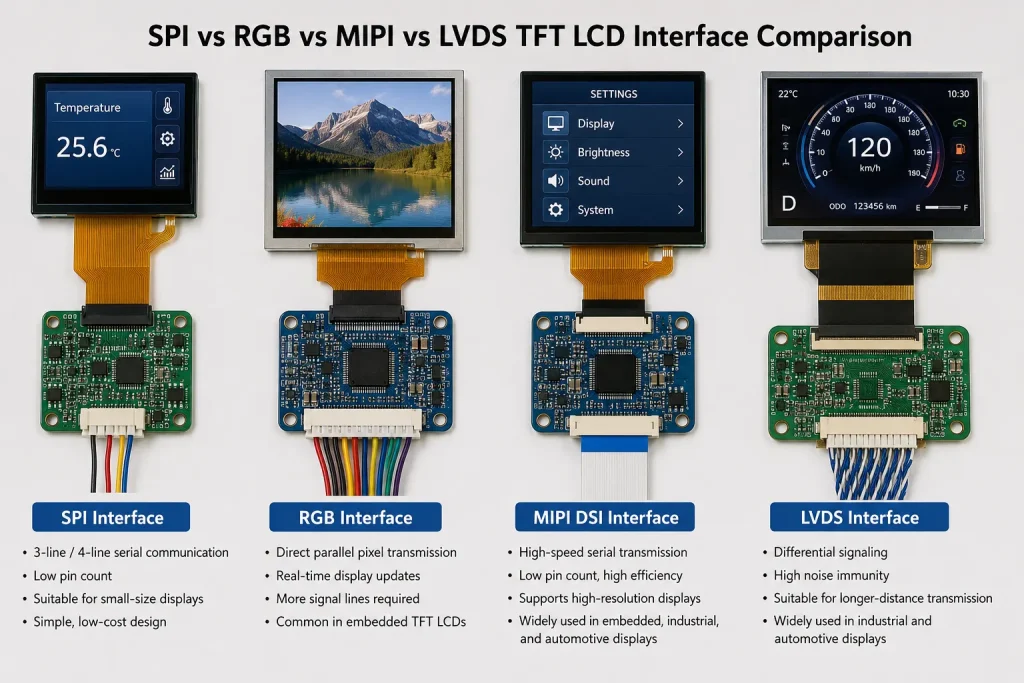
For TFT LCD displays, common interfaces include SPI, RGB, MIPI DSI, and LVDS. Understanding the differences between these interfaces can help engineers select the right display solution based on resolution, bandwidth, system architecture, and application requirements.
What Is Serial Communication?
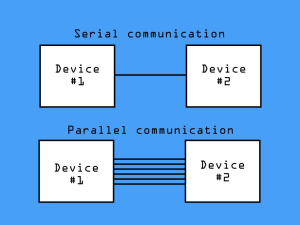
Serial communication transmits data bit by bit over a single channel or differential signal pair. It is widely used in modern electronics due to its simplicity and reliability.
Key Characteristics:
- Minimal wiring (fewer pins and cables)
- Strong resistance to EMI (Electromagnetic Interference)
- Supports longer transmission distances
- Lower power consumption
Common Serial Communication Interfaces:
- SPI (Serial Peripheral Interface):Short-distance, fast, simple integration,typical transmission rate 1~50 Mbps, 4 core signal lines, suitable for low-to-medium resolution small displays (≤480×320).As a basic serial interface, SPI is limited by its transmission rate; for industrial displays with higher resolution than 480×320, the MIPI DSI interface is the preferred alternative for higher transmission efficiency.
- MIPI DSI (Mobile Industry Processor Interface Display Serial Interface): High-speed interface for high-resolution displays,typical transmission rate 1Gbps (1-lane)~4Gbps (4-lane), supports multi-lane transmission, ideal for HD/2K industrial displays. For detailed lane selection and EMI considerations, see our guide to [2-lane and 4-lane MIPI DSI].
- UART / RS-485 (Universal Asynchronous Receiver/Transmitter): widely used for device and controller communication in industrial systems, but they are generally not used as direct pixel-data interfaces for TFT LCD displays.
Best for: compact devices, industrial environments, embedded systems
What Is Parallel Communication?
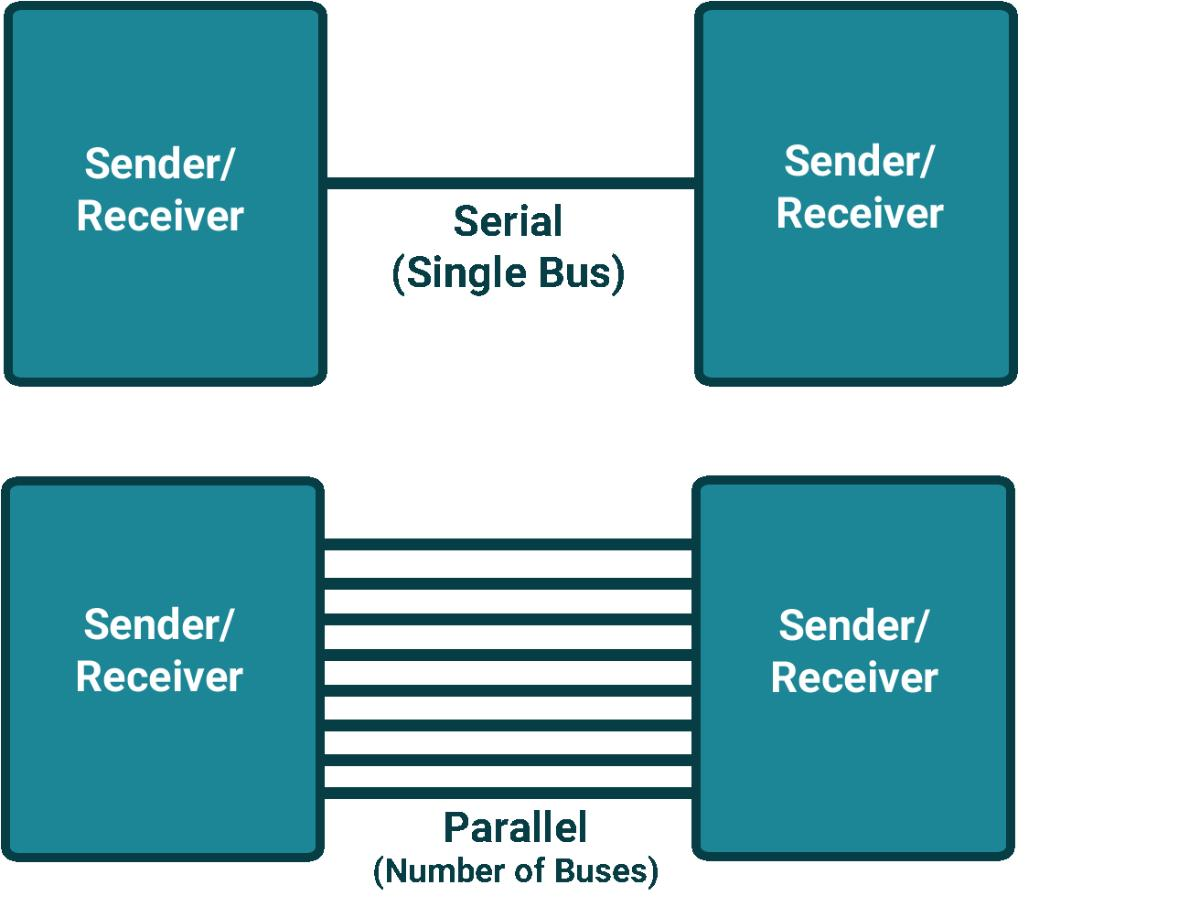
Parallel communication transmits multiple bits simultaneously across multiple data lines, enabling very high data throughput.
Key Characteristics:
- High data transfer speed
- Real-time data transmission
- Requires many signal lines
- Higher susceptibility to EMI
Common Parallel Communication Interfaces:
- RGB (8/16/24-bit): Standard for LCD displays,8-bit for basic color displays, 16/24-bit for true color medium and high resolution displays (≥800×480) and ultra-high resolution displays (≥720×1080),real-time pixel refresh without delay
- Intel 8080 / Motorola 6800: Legacy parallel interfaces,8/16-bit data bus, classic for traditional industrial control panels, compatible with old MCU systems
Best for: high-resolution displays, real-time graphics, legacy systems
Serial vs Parallel Communication: Key Differences
Here’s a quick comparison of the two communication methods:
|
Feature |
Serial Communication |
Parallel Communication |
|
Data Transmission |
One bit at a time |
Multiple bits simultaneously |
|
Wiring |
Simple (few wires/pins) |
Complex (many wires/pins) |
|
Speed |
Moderate to high (high-speed serial optional) |
Very high (raw data throughput) |
|
Distance |
Long (up to 1200m for RS-485) |
Short |
|
EMI Resistance |
Strong |
Weaker |
|
Cost |
Lower |
Higher |
|
Power Consumption |
Lower |
Higher |
Pros and Cons of Serial vs Parallel Communication
Serial Communication
Advantages:
- Simple hardware design
- Lower cost and power consumption
- Better for long-distance transmission
- Strong EMI resistance
Disadvantages:
- Lower raw data throughput compared to parallel
- May require encoding/decoding overhead
Parallel Communication
Advantages:
- High-speed data transfer
- Ideal for real-time applications
- Direct data transmission (no serialization)
Disadvantages:
- Complex PCB design
- Higher cost and power usage
- Limited transmission distance
- Susceptible to signal interference
Signal skew easily occurs during transmission, which increases the difficulty of hardware debugging and layout optimization
When to Use Serial vs Parallel
Choosing between serial and parallel communication depends on your application:
Use Serial Communication If:
- You need long-distance transmission
- Your system operates in high-EMI environments
- You want compact and low-power design
- You’re working with modern embedded systems or IoT devices
Typical applications:
- Industrial HMI panels
- Portable devices
- Remote monitoring systems
Unsure which interface fits your industrial project? Take our free interface selection assessment for a detailed and professional recommendation
Use Parallel Communication If:
- You need high-speed real-time data transfer
- Your display requires high resolution or video rendering
- You must support legacy hardware interfaces
Typical applications:
- Medical imaging systems
- Industrial control panels
- Automotive displays
TFT LCD Display Interfaces: SPI, RGB, MIPI DSI and LVDS
In TFT LCD applications, serial and parallel communication are implemented through different display interfaces. SPI and MIPI DSI use serial transmission, while RGB uses parallel pixel data transmission. LVDS is a high-speed differential signaling interface commonly used for serial display data transmission in industrial and automotive displays. The appropriate interface depends on display resolution, required bandwidth, wiring complexity, processor compatibility, and application requirements.
Serial Interfaces (SPI / MIPI)
- Easier integration with modern MCUs
- Reduced wiring and PCB complexity
- Suitable for small to mid-size displays
- Low EMI, support long-distance transmission
Parallel Interfaces (RGB)
- Supports real-time pixel updates
- Ideal for high-resolution displays (≥800×480)
- Requires more pins and careful PCB layout
- High raw data throughput for real-time rendering
Serial Interfaces (LVDS)
LVDS (Low-Voltage Differential Signaling) is commonly used for high-speed display data transmission in larger industrial and automotive TFT LCD displays. Differential signaling provides good signal integrity and resistance to electromagnetic interference. LVDS is suitable for applications requiring stable high-speed transmission, although proper differential routing and impedance control are important during PCB design.
TFT LCD Interface Comparison
|
Interface |
Type |
Typical Use |
Key Advantage |
|
SPI |
Serial |
Small TFT LCDs |
Low pin count |
|
RGB |
Parallel |
Industrial HMI |
Direct pixel transmission |
|
MIPI DSI |
High-speed serial |
High-resolution displays |
High bandwidth with fewer lines |
|
LVDS |
Differential serial |
Industrial & automotive displays |
Good signal integrity |
For small, low-resolution TFT LCDs, SPI can be suitable when low pin count and simple integration are priorities. RGB is commonly used for embedded and industrial HMI displays that require direct pixel data transmission. MIPI DSI is well suited to high-resolution displays where high bandwidth and compact wiring are important, while LVDS is commonly selected for larger industrial and automotive displays requiring stable high-speed transmission.
For a broader comparison of MIPI DSI, LVDS, and RGB for TFT LCDs, see our detailed interface comparison guide.
Recommended Industrial Display Solutions
Choosing the right interface is only part of the solution. Selecting a compatible and reliable display module is equally important for long-term system stability.
At CDTech, we provide TFT LCD modules with SPI, RGB, MIPI DSI, and LVDS interfaces for industrial and embedded display applications. Our display solutions can be customized according to resolution, brightness, touch integration, interface requirements, and operating environment.
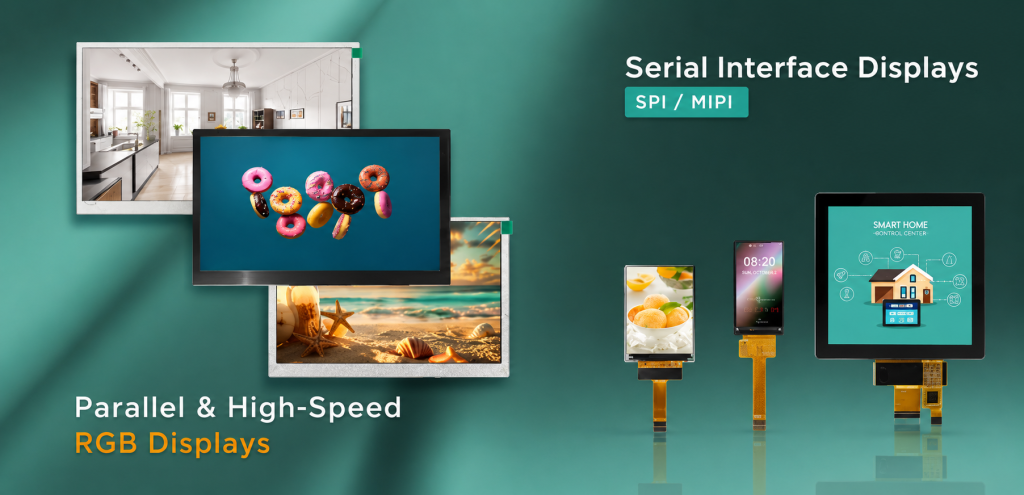
Serial & Parallel Interface Display Products Summary
|
Product Model |
Interface Type |
Resolution |
Core Parameters |
Operating Temp. |
Applicable Scenarios |
|
SPI (12-pin FPC) |
170×320 |
65K true color, 3.3V, ST7789 driver, 700 nits, IPS full viewing angle |
-20°C ~ +70°C |
Industrial meters, handheld medical devices, smart wearables |
|
|
MIPI 2-lane (30-pin FPC); CTP: I2C |
480×480 |
5-point capacitive touch (G+G structure), ST7701S-G5 driver, 300 nits, IPS full viewing angle, low EMI |
-20°C ~ +70°C |
Industrial handheld devices, smart home terminals, portable in-vehicle controls |
|
|
RGB (24-bit, 50-pin FPC); CTP: I2C |
800×480 |
24-bit true color, 60Hz refresh rate, HX8664-B+HX8264-E dual driver, 12 o’clock viewing angle, air bonding process |
-30°C ~ +80°C |
Real-time industrial HMI panels, industrial control panels, portable industrial testing equipment |
If you have doubts about the interface selection for your industrial project,
our professional engineering team can provide customized selection suggestions for the most suitable display module according to your system architecture, performance indicators and actual industrial environmental conditions.
Conclusion
Serial and parallel communication each serve different purposes in modern electronics.
- Serial communicationis ideal for most modern industrial applications due to its simplicity, reliability, and long-distance capability.
- Parallel communicationremains essential for high-speed, high-resolution display systems and legacy hardware compatibility.
Understanding their differences helps you choose the most efficient and cost-effective solution for your project.
FAQ
Q:What is the main difference between serial and parallel communication?
A: Serial communication sends data one bit at a time, while parallel communication sends multiple bits simultaneously using multiple lines.
Q:Is serial communication slower than parallel?
A: Not necessarily. Although parallel communication can transmit multiple bits simultaneously, modern serial interfaces can provide high bandwidth with fewer signal lines
Q:Why is serial communication more widely used today?
A: It generally requires fewer signal lines, simplifies PCB routing, and can provide good signal integrity for high-speed data transmission.
Q:When should I use parallel communication?
A: When your application requires real-time data transfer, high resolution, or compatibility with legacy systems.
Post Search
Related Articles
-

The Ultimate Touch Screen Panel Buying Guide: Technology, Size, Interface, and Applications
-
How can MIPI DSI enhance industrial display interfaces?
-
How can an8-bit Intel8080 interface with a modern TFT display?
-
Is there a universal way to integrate SPI, MCU, RGB and MIPI LCD interfaces?
-
7 Inch MIPI Display: Features, Benefits, and Application Cases
