
Sunlight-Readable Industrial TFT Displays: An Engineering Guide
 2026-10-20
 10:10


Introduction
Outdoor industrial equipment often requires an outdoor LCD display that remains readable under changing ambient light and direct sunlight. Standard TFT LCD modules with typical brightness levels of 300–500 cd/m² may lose visible contrast when reflections from the display surface compete with the emitted image, making information difficult to read on machinery HMIs, marine terminals, and field-testing equipment.
Sunlight readability depends on more than backlight brightness. Surface reflectance, viewing angle, cover-glass construction, UV exposure, and thermal management all affect display performance in outdoor environments. This guide explains the key technologies and engineering trade-offs involved in selecting sunlight-readable industrial TFT LCD modules.
For OEMs developing outdoor equipment, explore CDTech’s industrial LCD display solutions for application-specific display integration.
What Is a Sunlight-Readable Industrial TFT Display?
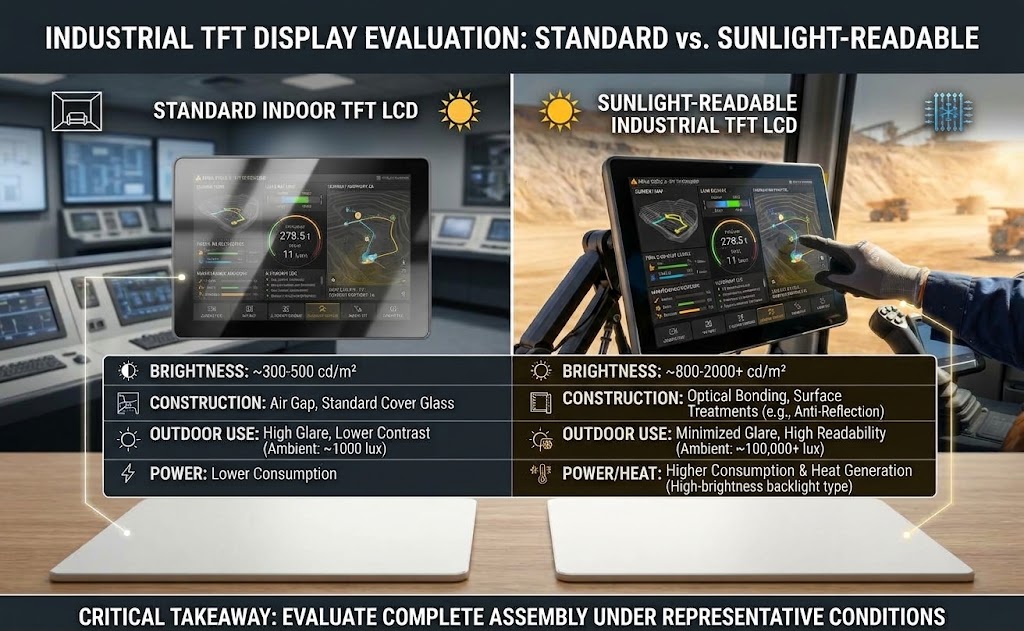
A sunlight-readable industrial TFT LCD is designed to maintain usable image contrast and legibility under high ambient light, including direct sunlight. These outdoor LCD displays help operators read text, graphics, and equipment status information in outdoor working environments.
Unlike an indoor display selected primarily for controlled lighting conditions, an outdoor display must be evaluated against the actual installation environment. Brightness, surface reflectance, viewing angle, optical construction, power consumption, and thermal conditions all influence the final result.
The appropriate configuration depends on the equipment’s application, mechanical design, power budget, and environmental requirements. Not every project requires the same optical enhancements.
Standard TFT LCD vs. Sunlight-Readable TFT LCD
|
Evaluation Parameter |
Standard Indoor TFT LCD |
Sunlight-Readable Industrial TFT LCD |
|
Brightness |
Often 300–500 cd/m² |
May use 800–2000 cd/m² or other project-specific levels |
|
Optical construction |
May use an air gap and standard cover glass |
May incorporate optical bonding and surface treatments |
|
Outdoor visibility |
Depends on ambient light and surface reflection |
Optimized for improved readability in bright environments |
|
Power and heat |
Generally lower at comparable brightness |
High-brightness backlighting may increase power and heat |
|
Operating environment |
Based on the specified application conditions |
Must be matched to actual temperature and environmental requirements |
Important: Brightness alone does not guarantee sunlight readability. The complete display assembly should be evaluated under representative lighting and viewing conditions.
Three Key Technologies for Sunlight-Readable TFT Displays
1. High-Brightness LED Backlighting
Higher backlight luminance can improve display visibility under strong ambient light, but it also increases power consumption and heat generation. Brightness should therefore be selected according to the installation environment rather than maximized by default.
|
Indicative Brightness |
Potential Application Conditions |
|
800–1000 cd/m² |
Some shaded outdoor or bright indoor environments |
|
1000–1500 cd/m² |
Many daylight-exposed outdoor applications |
|
1500–2000 cd/m² |
More demanding ambient-light conditions, subject to thermal and power limits |
These ranges are preliminary selection references, not guaranteed sunlight-readability thresholds. Actual performance depends on surface reflectance, optical construction, viewing angle, and ambient lighting.
For each project, confirm the required brightness, power budget, heat dissipation, dimming requirements, and specified backlight lifetime.
When selecting an outdoor LCD panel, engineers should evaluate required luminance alongside surface reflectance, optical bonding, power consumption, and heat dissipation.
CDTech Product Example: 7-inch 1000-nit IPS TFT LCD
For embedded equipment that requires enhanced outdoor readability, CDTech offers a 7-inch 1024 × 600 sunlight-readable IPS display with 1000 cd/m² brightness, capacitive touch, and optical bonding. It provides an example of combining high-brightness backlighting with optical integration in an industrial display module.
For applications requiring a larger display and a higher brightness target, the 10.1-inch 1400-nit industrial touch display is another configuration to evaluate. Engineers should consider the complete optical stack, power consumption, and thermal conditions when selecting a high-brightness module.
Explore our range of high-brightness TFT LCD modules to compare available display sizes and integration options for your project.

2. Optical Bonding
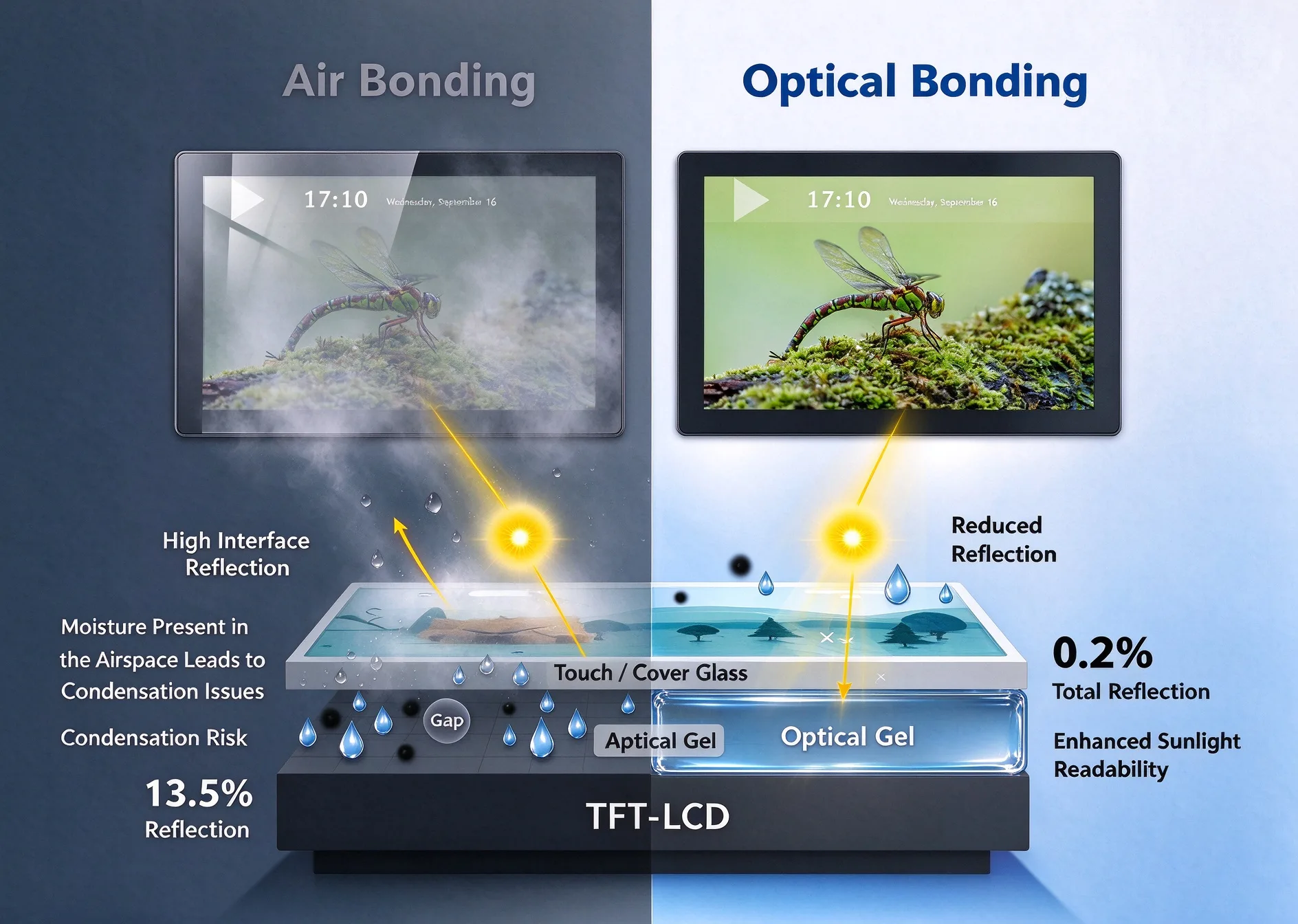
Optical bonding fills the gap between compatible display layers, such as the LCD, touch assembly, and cover glass, with an optically clear adhesive. By reducing reflections associated with internal air gaps, it can improve perceived contrast and outdoor readability.
Bonding may also improve front-assembly integration and reduce the risk of condensation within the former air gap. However, it does not eliminate all reflections or moisture-related risks.
The trade-offs include additional manufacturing cost, material compatibility requirements, and potentially more complex repair or replacement. Whether optical bonding is necessary depends on the optical stack, environmental conditions, and project budget.
For a closer look at bonding methods, optical performance, and integration considerations, read our guide to how optical bonding improves LCD sunlight readability.
3. AR and AG Surface Treatments
Anti-reflective (AR) and anti-glare (AG) treatments address different optical issues.
- AR treatment reduces reflection from the treated surface, helping preserve image contrast under strong ambient light.
- AG treatment diffuses reflected light to reduce sharp, mirror-like glare. Depending on the surface design, it may introduce haze or reduce image sharpness.
AR and AG are not interchangeable, and combining them is not automatically the best choice for every project. The appropriate treatment depends on cover-glass design, touch requirements, viewing conditions, and acceptable image quality. Confirm the available options and performance specifications for the selected module.
Why IPS Matters in Outdoor Embedded Display Applications
IPS TFT LCDs are often selected for industrial equipment that requires wide viewing angles and consistent image presentation. This can be useful for outdoor HMIs, marine terminals, and machinery control panels viewed from different operator positions.
However, IPS technology alone does not guarantee sunlight readability. Engineers should verify the selected panel’s viewing-angle performance, brightness, contrast, operating-temperature range, and compatibility with the required touch and cover-glass assembly.
The final choice should be based on the complete module specification and the equipment’s operating conditions.
CDTech focuses on customizable IPS TFT LCD modules. The appropriate configuration should be selected according to the project’s optical, electrical, mechanical, and environmental requirements.
High-Brightness IPS TFT LCD vs. Transflective TFT LCD
High-brightness transmissive TFT LCDs rely primarily on backlighting, while transflective displays combine transmitted backlight with reflected ambient light. Their suitability depends on visibility requirements, power constraints, and the characteristics of the specific panel.
|
Comparison Factor |
High-Brightness IPS TFT LCD |
Transflective TFT LCD |
|
Operating principle |
Primarily backlight-driven |
Combines backlight and reflected ambient light |
|
Image presentation |
Suitable for full-color graphics and dynamic interfaces |
Depends on the specific panel and lighting conditions |
|
Power considerations |
High brightness may increase power consumption |
May reduce backlight demand in strong ambient light |
|
Potential applications |
Outdoor HMIs and industrial terminals |
Selected low-power portable devices |
|
CDTech availability |
Custom IPS TFT LCD configurations, subject to specifications |
Not currently offered by CDTech |
Neither technology is universally superior. High-brightness transmissive TFT LCDs can be suitable for outdoor embedded applications when the brightness, optical construction, and thermal design meet the requirements. CDTech offers customizable IPS TFT LCD modules using transmissive display technology but does not currently offer transflective TFT LCD panels.
Typical Applications of Sunlight-Readable Industrial TFT LCD Modules
1. Construction, Agricultural, and Off-Road Machinery
Equipment HMIs used outdoors may require high brightness, suitable viewing angles, glove-compatible touch, and an operating-temperature range matched to the installation. Vibration, dust, and moisture protection must be addressed at the complete equipment level.
2. Marine Equipment
Marine terminals and vessel control panels may face direct sunlight, reflections, and temperature fluctuations. Display selection should consider brightness, cover-glass reflection, viewing angle, optical bonding, and the environmental protection of the enclosure.
3. Outdoor Industrial Terminals
Outdoor kiosks and industrial monitoring interfaces require readable text, graphics, and status information under changing daylight. Brightness, touch performance, optical construction, and thermal design should be evaluated together.
For larger outdoor interfaces, CDTech’s 15.6-inch Full HD IPS industrial touch display offers a 1920 × 1080 resolution and 900 cd/m² brightness. It can be considered for industrial terminals where screen size and interface space are important selection factors. Actual outdoor readability should be validated under the intended lighting conditions.
Parking equipment may use a compact outdoor display module for status information, user input, and equipment control. CDTech’s 7-inch 1024 × 600 IPS TFT LCD touch display for parking equipment is an option to evaluate. Before selecting it for direct-sunlight use, confirm its brightness, optical construction, and environmental specifications against the installation requirements.
4. Portable Field Instruments
Portable testing and inspection devices must balance readability with battery life, size, and heat dissipation. Brightness control and power consumption are especially important when the device operates away from a fixed power source.
Key Engineering Trade-Offs and Selection Considerations
1. Power, Heat, and Backlight Lifetime
High-brightness backlighting increases power demand and can add heat to the display assembly. Direct solar radiation may further raise the temperature of the equipment’s front surface and internal enclosure, particularly when the display is installed behind cover glass or inside a sealed housing.
Engineers should evaluate the display together with the power supply, enclosure, thermal path, and expected duty cycle. Depending on the system design, heat may need to be managed through enclosure design, heat spreading, ventilation, or other thermal measures. Automatic brightness control may reduce power consumption when full brightness is unnecessary.
Backlight lifetime depends on LED characteristics, drive conditions, operating temperature, and usage. Confirm the manufacturer’s stated lifetime conditions and any applicable derating guidance for the selected module.
2. Operating Temperature
The required operating-temperature range should reflect the equipment’s actual environment. A module installed behind cover glass inside a sealed enclosure may experience different thermal conditions from a module tested in isolation.
Confirm operating and storage temperature specifications separately, and evaluate the complete assembly under representative conditions when temperature is critical to the application.
For wide-temperature applications, confirm the specified operating and storage temperature ranges of the LCD panel, backlight, touch assembly, and other relevant components. A temperature range specified for one component does not automatically apply to the complete display module or finished equipment.
3. Touch and Optical Integration
Touch sensors, cover glass, adhesives, and protective windows can affect optical performance and touch response. Capacitive touch projects may also require evaluation of glove operation, controller configuration, grounding, and electromagnetic compatibility.
Where outdoor readability is critical, test the complete display assembly using the intended cover glass, touch structure, viewing angles, and representative lighting conditions. This is more reliable than selecting a module based on brightness alone.
4. UV Exposure and Outdoor Material Durability
Outdoor displays may be exposed to prolonged sunlight, including ultraviolet (UV) radiation. Depending on the materials and construction, UV exposure can contribute to aging, discoloration, or performance changes in cover-glass coatings, adhesives, and other polymer components.
For equipment used outdoors over extended periods, engineers should verify the UV resistance of the complete front assembly and confirm whether UV-resistant cover glass, coatings, or other protective measures are required. Material compatibility and durability should be evaluated for the intended exposure conditions rather than assumed from the LCD panel specification alone.
UV resistance is a separate consideration from sunlight readability. A display may offer high brightness without necessarily meeting the long-term UV durability requirements of a particular outdoor application.
Industrial Sunlight-Readable TFT LCD Selection Checklist
Before selecting a display module for an outdoor embedded project, define the following requirements:
- Display specifications:Size, resolution, brightness, and viewing angle
- Optical construction:Cover glass, touch sensor, optical bonding, and AR/AG requirements
- Environmental conditions:Operating and storage temperatures, humidity, and equipment-level vibration or ingress-protection requirements
- Electrical integration:Interface, connector, power supply, and backlight control
- Thermal constraints:Enclosure temperature, heat dissipation, and expected duty cycle
- Project requirements:Estimated production volume, prototype needs, and project timeline
Defining these requirements early helps suppliers evaluate module feasibility and reduces the risk of selecting a display based on brightness alone.
Custom Industrial TFT LCD Solutions from CDTech
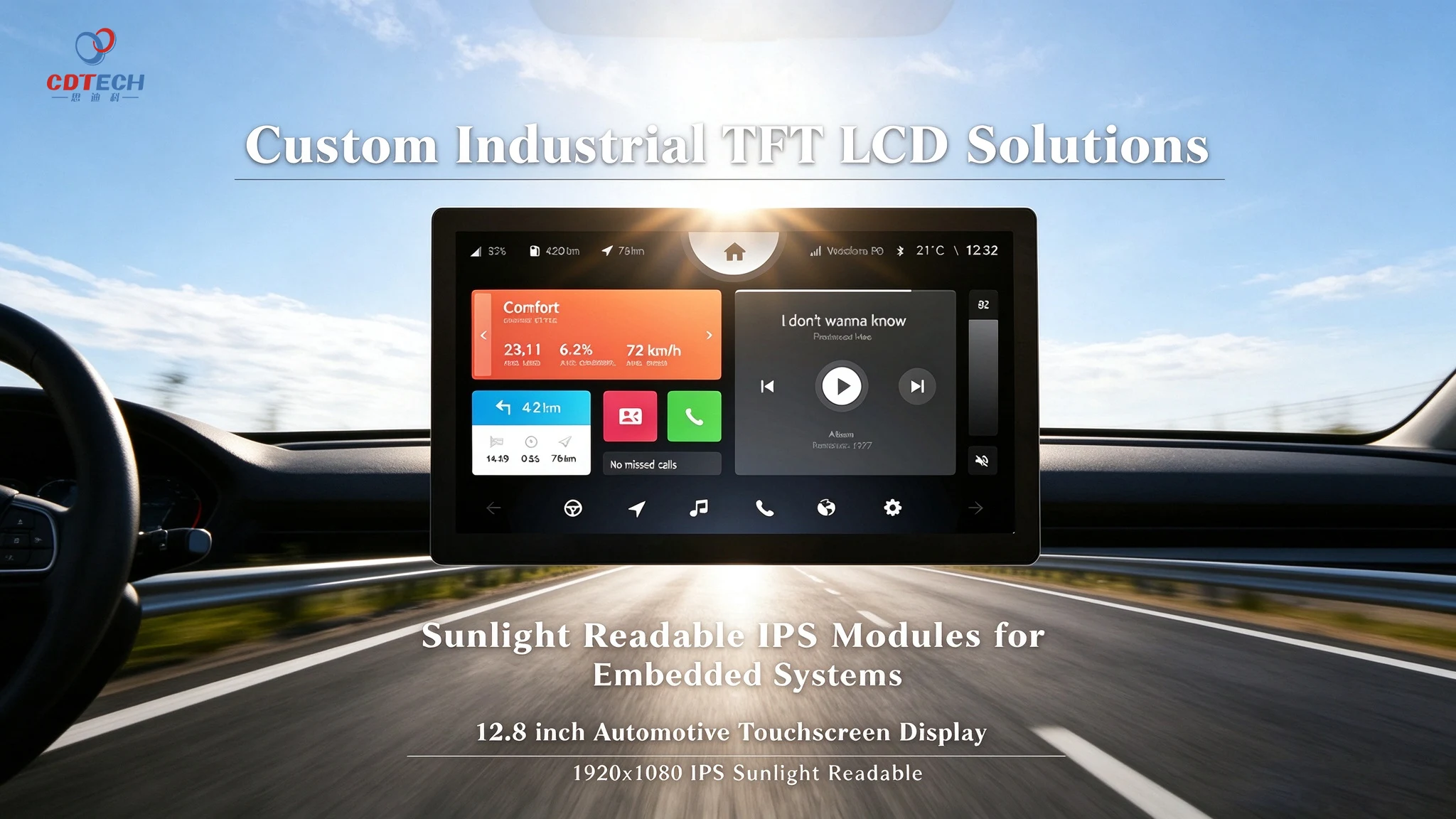
12.8 inch sunlight readable IPS touch display for automotive and industrial embedded systems
CDTech provides customizable IPS TFT LCD modules for industrial and embedded equipment. Depending on product availability and project feasibility, configuration options may include brightness, touch integration, cover glass, optical bonding, surface treatment, and interface.
For outdoor applications, selection should account for the complete optical, electrical, mechanical, and thermal design rather than brightness alone.
CDTech’s sunlight readable IPS displays serve both automotive and industrial embedded applications, supporting customized configurations from LCD modules to complete touch display solutions.
FAQ: Sunlight-Readable Industrial TFT Displays
Q: How many nits are needed for a sunlight-readable TFT LCD?
A: There is no universal brightness threshold. Some shaded outdoor applications may work with 800–1000 cd/m², while direct-sunlight applications may require 1000 cd/m² or higher. The final choice depends on ambient light, surface reflectance, optical construction, and thermal constraints.
Q: Is optical bonding necessary for every outdoor display?
A: No. Optical bonding can reduce internal reflections from air gaps and improve perceived contrast. Whether it is necessary depends on the optical stack, installation environment, cost target, and required performance.
Q: What is the difference between AR and AG treatment?
A: AR treatment reduces reflection from the treated surface. AG treatment diffuses reflected light to reduce sharp glare. The appropriate treatment depends on cover-glass design, viewing conditions, and acceptable image sharpness.
Q: Is IPS always the best choice for outdoor industrial displays?
A: Not in every application. IPS panels are often suitable when wide viewing angles and consistent image presentation are important. Brightness, reflection control, power consumption, and operating temperature must also be considered.
Q: How do UV exposure and temperature affect outdoor display selection?
A: Prolonged sunlight can increase the temperature of the display assembly and expose front-facing materials to UV radiation. Depending on the materials used, this may affect coatings, adhesives, and other components over time. Engineers should verify the operating-temperature range of the complete module and assess the UV resistance of the cover glass and other exposed materials against the intended application conditions.
Conclusion
Sunlight readability in an outdoor display depends on more than backlight brightness. Optical reflection, viewing angle, cover-glass construction, power consumption, and thermal management all influence performance under outdoor lighting conditions.
For industrial OEMs, the best approach is to define the operating environment, select the appropriate optical and electrical configuration, and validate the complete assembly under representative conditions.
CDTech provides customizable IPS TFT LCD modules for industrial embedded applications. Early technical evaluation helps engineers identify suitable configurations for their equipment’s readability, integration, and environmental requirements.
Post Search
Related Articles
-
Capacitive vs Resistive Touch Screen Car Stereo: Which Is Right for You?
-
TN LCD vs IPS LCD: How to Choose the Right Display for You
-
Capacitive Touch Panel or Resistive: Which Suits Your Needs?
-
Why Choose an IPS LCD Panel for Your Next Screen Purchase?
-
CDTECH to Showcase Cutting-Edge Display Solutions at SID 2025
-
Comparing Different Types of Displays in Cars: A Detailed Overview
-
White Spots on LCD Screen: Causes, Fixes & Industrial Solutions (2026 Guide)