

When Should You Combine Capacitive and Resistive Touch Technologies in Industrial HMI Displays?
 2026-04-11
  20:31
20:31 

Choose hybrid touch technology for industrial HMI when you need glove-compatible operation (resistive layer enables stylus/bare-hand input in harsh outdoor environments), multi-touch precision (capacitive layer provides gesture recognition), cost optimization (dual-tech balances durability with UX without full PCAP investment), or non-standard form factors (custom sizing via patented 2nd Cutting technology).
Check: Which Touch Technology Wins: PCAP vs Resistive for Medical vs Factory Floors?
What Are Hybrid Touch Displays and How Do They Differ from Single-Technology Solutions?
Hybrid touch displays integrate capacitive touch panels (CTP) and resistive touch panels (RTP) into a single LCD module for versatile input in demanding environments.
Capacitive touch (PCAP/CTP) supports multi-finger gestures and precise control ideal for modern user interfaces, while resistive touch (RTP) excels in glove or stylus use, harsh conditions, and lower power draw. Hybrid solutions layer these technologies, with CTP handling primary multi-touch and RTP providing backup for rugged scenarios. Unlike single PCAP, which fails with gloves or in dust, or standalone RTP lacking gestures, hybrids offer balanced performance.
CDTech’s full in-house production, including CTP and LCD assembly with OCA optical bonding or air bonding, enables seamless hybrid integration across sizes from 1.5″ to 12.3″+.
| Attribute | PCAP (Capacitive) | RTP (Resistive) | Hybrid |
|---|---|---|---|
| Glove Compatibility | No | Yes | Yes (RTP layer) |
| Multi-Touch Gestures | Yes | No | Yes (CTP primary) |
| Durability in Dust/Moisture | Moderate | High | High (sealed RTP) |
| Power Consumption | Higher | Lower | Balanced |
| Cost | Medium-High | Low | Medium |
Why Are Industrial and Automotive OEMs Adopting Hybrid Touch Solutions?
OEMs adopt hybrid touch for HMI displays to address environments needing both precise gestures and glove operation, reducing field failures and redesigns.
In automotive dashboards and industrial terminals, bare-hand multi-touch (PCAP) suits drivers or operators, but gloves in cold or dirty conditions demand RTP reliability. CDTech serves over 1,000 customers with IATF16949-certified solutions operating at -30°C~+85°C, like the S043HWQ50EG 4.3″ automotive IPS LCD at 1000 nits. Hybrids cut costs by avoiding dual SKUs and leverage vertical integration for quick customization.
Which Niche Applications Benefit Most from Mixing Capacitive and Resistive Touch?
Niche applications like outdoor automotive dashboards, medical HMIs, rugged industrial terminals, and smart-home panels gain most from hybrid touch versatility.
Outdoor automotive dashboards require PCAP for navigation gestures and RTP for gloved winter use; CDTech’s S050BWV105EP-FL96-AG 5.0″ IPS with capacitive anti-glare touch handles -30°C~+85°C. Medical panels need PCAP precision plus RTP for sterile gloves, as in S035BV108HN-DC49-D 3.5″ IPS with 2.5D cover glass. Rugged factory kiosks use RTP sealing against dust, with PCAP for efficiency. Smart-home controls switch modes for guests or wet areas.
Hybrid touch solutions shine in automotive and industrial HMIs where single-tech limits deployment. For instance, our S043HWV104EN-FL63 4.3″ bar IPS LCD with CTP and optical bonding at 800 nits operates -20°C~+70°C, enabling glove-compatible input alongside multi-touch in non-standard bar formats via patented 2nd Cutting technology. This reduces OEM redesigns across harsh environments.”
— CDTech Engineering Team, Specialists in Custom LCD and Touch Integration
Lab instrumentation balances operator comfort with protective gear, all supported by CDTech’s 391+ SKUs and full lamination capabilities.
How Do You Design a Hybrid Touch Architecture That Balances Cost and Performance?
Design hybrid touch by prioritizing CTP for multi-touch zones and RTP overlay for glove input, using single controllers and custom sizing for efficiency.
Stack CTP as primary with RTP secondary for validation, consolidating drivers on one PCB to cut BOM costs. CDTech’s 2nd Cutting patent crafts non-standard sizes like 7.0″ bar S070QWU142FN-FL150-GF (1200×1920, up to 2300 nits MIPI), with OCA bonding sealing stacks. Trade-offs favor integrated PCBs over discrete for footprint savings.
| Architecture | Cost | Lead Time | Complexity |
|---|---|---|---|
| Stacked Discrete | Low | 4 weeks | High |
| Integrated PCB | Medium | 6 weeks | Medium |
| Custom Molded (2nd Cutting) | Medium-High | 8 weeks | Low |
What Are the Technical Challenges When Integrating Hybrid Touch Panels?
Hybrid integration faces electrical noise, calibration alignment, temperature drift, and firmware disambiguation, mitigated by precision manufacturing and testing.
Check: LCD with Touch
PCAP noise from RTP requires firmware filters; dual calibration holds ±0.5mm tolerance to avoid ghost touches. CDTech’s -30°C~+85°C automotive-grade displays like S050BWV125ES counter CTP cold drift with RTP stability. OCA bonding ensures uniform thickness, while in-house CTP/LCD production handles firmware for embedded OS compatibility.
How Can Manufacturers Ensure Reliability and Certifications in Hybrid Touch Deployments?
Ensure reliability via ISO9001, IATF16949, ISO13485, ISO14001 certifications, rigorous testing, and ERP traceability for hybrid modules.
Test for EMC, thermal cycling (-30°C~+85°C), shock, and 10M glove cycles. CDTech’s 10,000㎡ factory with 3,500㎡ Class 1000 clean rooms, 35 software patents, and 44+ utility patents support full traceability. Vertical integration from LCD cutting to OCA lamination de-risks automotive and medical hybrids for 1,000+ global customers.
What Is the Implementation Timeline and Cost Structure for Custom Hybrid Touch HMI Projects?
Custom hybrid projects follow 2–4 week design, 6–8 week prototyping, with transparent NRE and 6–8 week production for 500+ units.
Feasibility uses 2nd Cutting for custom sizes; leverage existing lines like 10.1″ S101ZWX89FP-FC86 (optical bonded CTP). Costs tier by volume, thermal range (-30°C~+85°C adds testing), and certifications. CDTech discloses MOQ/NRE upfront, with $30M+ 2023 sales ensuring scale.
How Can You Transition from Single-Touch to Hybrid Solutions Without Disrupting Production?
Transition via modular firmware updates, on-demand RTP add-ons, and vertical integration for seamless SKU switching without supply chain delays.
CDTech produces base LCD+CTP at volume, adding RTP per order to manage inventory. Proven with automotive OEMs shifting to hybrids for cold climates, backed by ERP traceability and 1,000+ customer transitions.
Conclusion
Hybrid touch technology strategically integrates capacitive multi-touch precision with resistive glove compatibility, solving HMI pain points in automotive, industrial, and medical applications without costly redesigns. CDTech’s patented 2nd Cutting enables custom bar displays like S123BWU11EP-FC19-AF-HDMI09-A (12.3″ 1920×720), while quad certifications (ISO9001, IATF16949, ISO13485, ISO14001) and vertical integration ensure reliability across -30°C~+85°C. With $30M+ sales and transparent MOQ/NRE, CDTech reduces procurement risks.

Ready to evaluate hybrid touch for your HMI? Contact sales@cdtech-lcd.com to discuss non-standard form factors and start prototyping today.
Frequently Asked Questions
Can I retrofit an existing PCAP display with a resistive touch layer, or does hybrid integration require design changes from the start?
Retrofitting adds thickness and reduces responsiveness; design hybrids from start for optimal sensor placement and OCA bonding. CDTech’s 2nd Cutting makes custom hybrids cost-competitive.
What is the typical cost premium for hybrid touch versus single-technology PCAP or RTP displays?
Hybrid premiums 15–25% over PCAP, justified by dual integration, OCA sealing, and certifications. CDTech’s 391+ SKUs and integration lower NRE for 500+ unit volumes.
Are hybrid touch displays suitable for extreme temperature ranges (below -20°C or above 70°C)?
Yes, CDTech’s -30°C~+85°C certified range suits arctic automotive and tropical use; RTP handles PCAP cold drop-off via sensor redundancy.
Which compliance certifications do I need for a hybrid touch HMI in automotive applications?
IATF16949, ISO14001, plus ISO26262/EMC; medical adds ISO13485. CDTech holds all, offering pre-certified hybrids for tier-1 suppliers.
How does glove touch performance differ between resistive layers integrated into a hybrid stack versus standalone RTP displays?
Hybrid RTP hits 90–95% accuracy vs. 85–90% standalone, thanks to shared calibration and OCA protection against dust/moisture.
Post Search
Related Articles
-
Capacitive vs Resistive Touch Screen Car Stereo: Which Is Right for You?
-
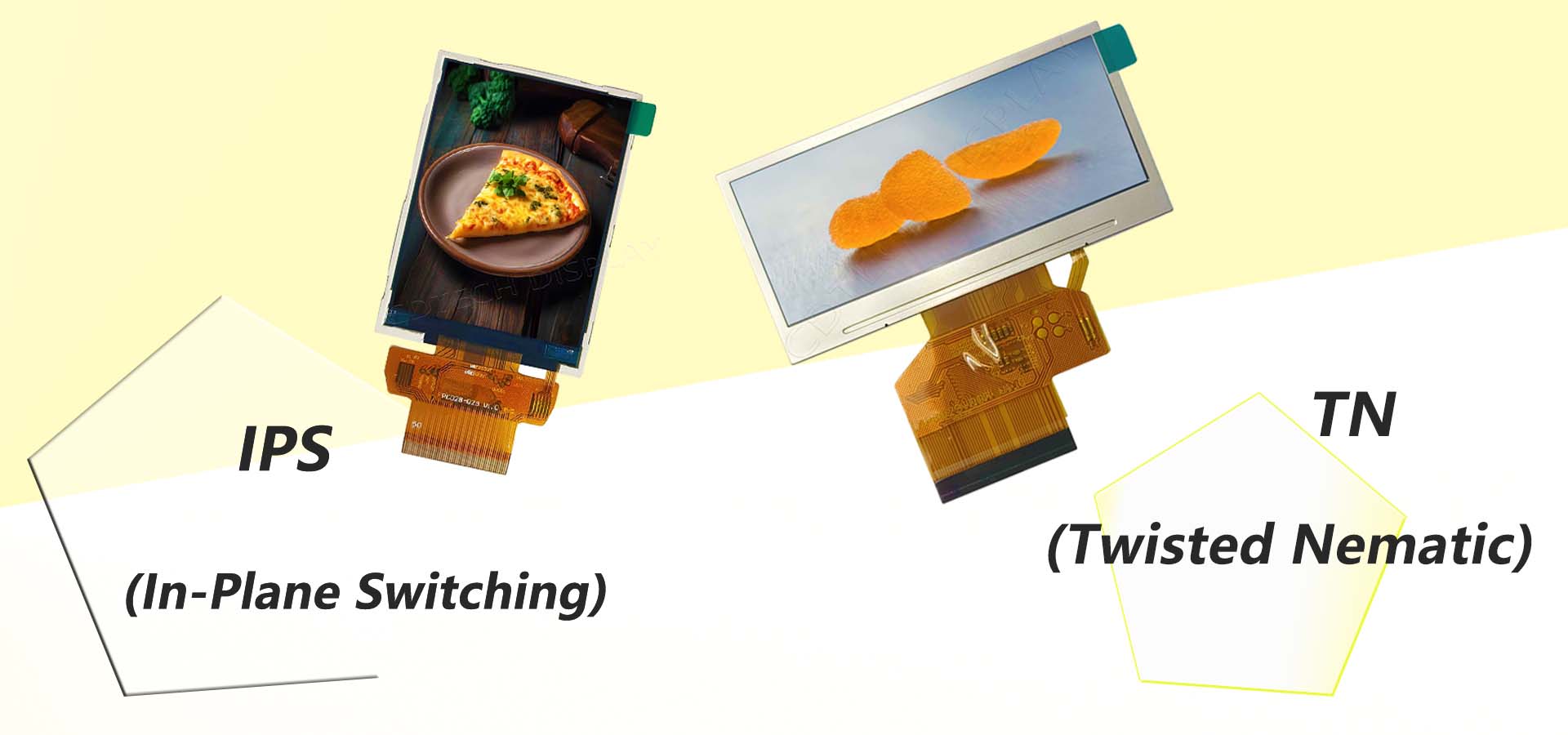
TN LCD vs IPS LCD: How to Choose the Right Display for You
-
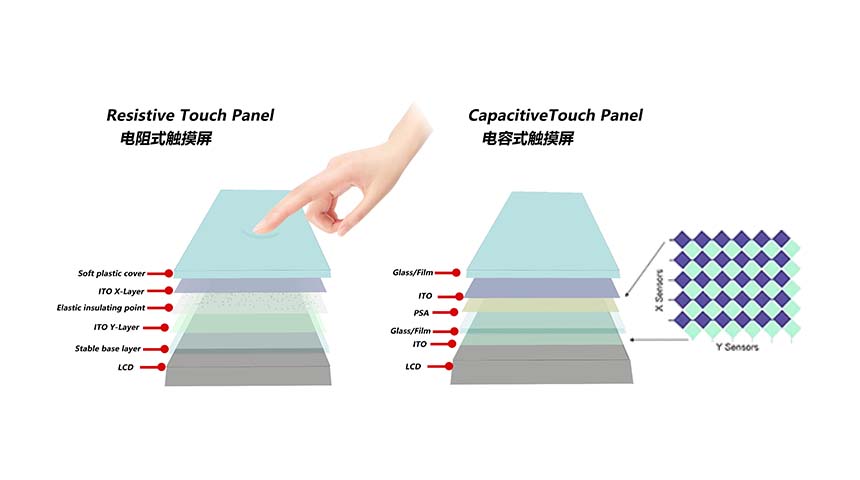
Capacitive Touch Panel or Resistive: Which Suits Your Needs?
-
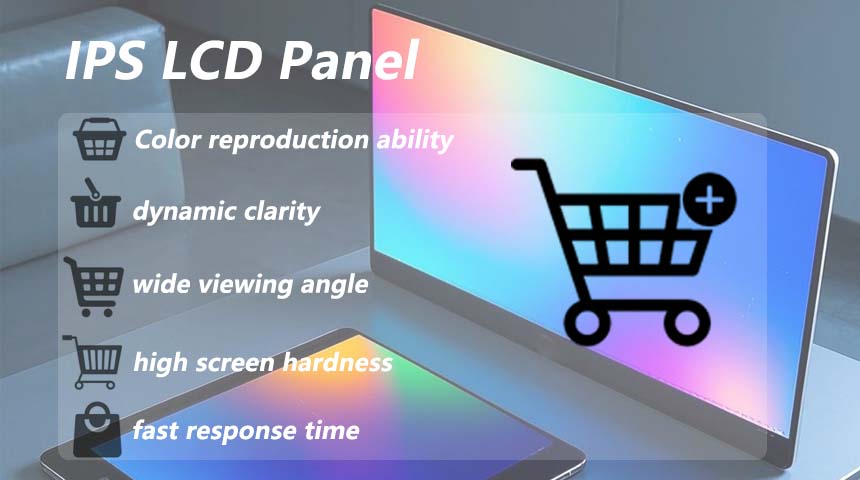
Why Choose an IPS LCD Panel for Your Next Screen Purchase?
-
CDTECH to Showcase Cutting-Edge Display Solutions at SID 2025
-
Comparing Different Types of Displays in Cars: A Detailed Overview
-
White Spots on LCD Screen: Causes, Fixes & Industrial Solutions (2026 Guide)